
Deck Repair or Replace? How to Decide and What It Costs
Repair a deck when the frame, ledger and posts are sound and the damage is limited to boards, railings, stairs or the finish. Replace it when rot or insects have spread through the framing. Repairs average about $1,465; replacement often runs $5,420 to $14,540.
By LandscapeLookup Editors8 min read
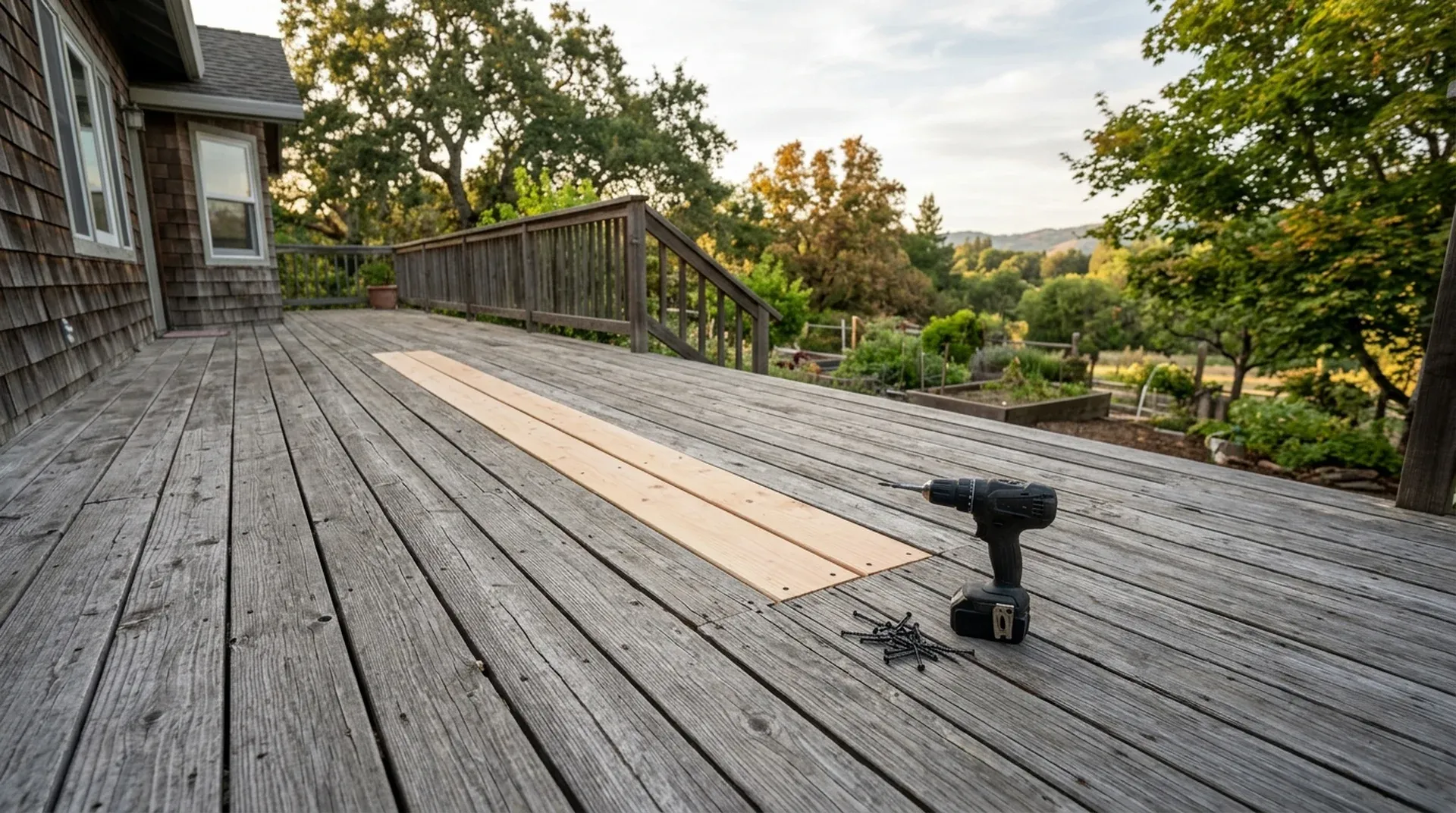
Repair your deck if the frame is sound and the damage is limited to a few boards, a wobbly railing, loose stairs or a worn finish. Replace it when rot or insect damage has spread through the joists, posts or ledger, or when the deck is near the end of its life anyway. As of October 2026, Lawn Love puts the average deck repair cost at $1,465, with most jobs between $570 and $2,600, while a full tear-out and rebuild typically runs $5,420 to $14,540.
The structure underneath, not the boards you walk on, usually decides it.
Repair or replace: the quick test
Decks.com says that in most cases repairing a deck is far less expensive than replacing it, and a worn but structurally sound deck may need nothing more. The same guide warns that rot or insects in several areas usually means the problem is wider than it looks.
|
What you find |
Usually means |
|---|---|
|
A few cracked, cupped or splintered boards |
Repair: replace the boards |
|
Popped nails, loose screws |
Repair: refasten with screws |
|
Wobbly railing post or loose balusters |
Repair: add blocking and structural screws or bolts |
|
Bouncy stairs, loose treads |
Repair: reinforce stringers, anchor treads |
|
Gray, weathered wood that won't hold stain |
Refinish, or resurface if the boards are worn out |
|
Rot in one spot (where roof runoff drips, for example) |
Repair that section |
|
Soft wood in several joists, posts or the ledger |
Replace, or at least rebuild the frame |
|
Ledger pulling away from the house |
Have a pro evaluate it before anyone uses the deck |
Lawn Love adds a practical rule. If your deck is due for replacement in the next couple of years and a storm or termites hit it, it's probably best to go ahead with a new one.
Is it worth repairing an old deck?
Often, yes, but have the framing checked first. Fine Homebuilding notes that decks built before the mid-1970s were often framed with untreated lumber, which decays faster, and that many stair connections rely on nails that can pull out. Decks.com suggests asking your building department whether a permit was issued and the deck was inspected when it was built.
How to inspect your deck
The North American Deck and Railing Association (NADRA) publishes a free consumer deck checklist. Fine Homebuilding suggests an annual inspection, which takes less than an hour. Walk the deck, then get underneath it with a flashlight and a screwdriver.
- Probe for rot. Push an ice pick or screwdriver into the wood where it stays damp or touches fasteners. NADRA says decay may be present if you can easily sink it 1/4 to 1/2 inch, if the wood breaks off without splintering, or if it feels soft and spongy.
- Start with the ledger. That's the board fastened to your house, and NADRA calls it a common source of deck failure. Fine Homebuilding says ledgers must be bolted or screwed to the house, not just nailed, because nails tend to pull out.
- Check the flashing. NADRA describes flashing as the metal or plastic guard that keeps water from collecting between the house and the ledger. Fine Homebuilding notes that water often leaks behind the ledger when flashing is undersized or poorly installed, even on newer decks.
- Look at fasteners and hangers. NADRA suggests replacing rusted or corroded fasteners, which can rot the surrounding wood. Older frames may have joists held only by nails, and Fine Homebuilding says joist hangers can be added.
- Check posts where they meet the ground. Posts buried in soil or set in concrete can rot even if they're pressure-treated.
- Push on railings and test the stairs. NADRA says railings should be secure, especially on higher decks. Stair risers and stringers should be firmly attached, and open gaps behind treads should be no more than 4 inches. The deck shouldn't sag, sway or move when you test it.
NADRA notes its checklist doesn't make a deck code compliant. If anything looks wrong, have a deck builder or home inspector evaluate it.
Common deck repairs and what they cost
Prices below are national ranges from cost guides that run contractor marketplaces. Labor varies by region: Lawn Love notes that labor costs less in states like Mississippi and Alabama and more in Hawaii and Massachusetts.
|
Repair |
Lawn Love (hired out) |
DIY materials (Decks.com) |
|---|---|---|
|
Replace a damaged board |
$10 to $35 per sq ft |
$25 to $85 per board and fasteners |
|
Replace popped nails |
$150 to $200 |
N/A |
|
Joist replacement |
$150 to $350 |
N/A |
|
Railing repairs |
$465 to $4,335 |
$10 to $15 in screws for loose rails; $50 to $75 to brace a wobbly post |
|
Stair repairs |
$115 to $300 |
$85 to $100 to stiffen bouncy stringers |
|
Insect damage |
$250 to $2,350 |
N/A |
|
Mold or mildew |
$215 to $515 |
N/A |
|
Refurbish (nails, sanding, stain) |
$500 to $1,600 |
$100 to $300 in finish |
Sources: Lawn Love (October 2026) and Decks.com (2026).
HomeAdvisor's deck repair guide adds a few more figures: $200 to $500 to fix rotted wood, $15 to $40 per step to anchor loose stairs, and $200 to $600 for pest control on a deck. It says rot can often be cut out and filled with two-part epoxy, but only in a spot that isn't weight-bearing.
A few tips that make DIY fixes last:
- Use screws, not nails. Decks.com says a nail pounded back down will almost surely pop up again, so pull it and drive a screw.
- Keep fasteners at least 1 inch from board edges and ends to avoid splitting, per Decks.com.
- Composite boards are different. Boards held with hidden fasteners are harder to swap, and Decks.com suggests tracking down the exact fastener the deck uses.
Lawn Love also says late winter and early spring, when deck contractors are busiest, is typically the most expensive time to book repairs.
What a deck replacement costs
Lawn Love puts replacement, including removal and a new deck, at $5,420 to $14,540. Tear-out alone runs $5 to $10 per square foot by Lawn Love's figures and $5 to $15 per square foot by HomeAdvisor's.
Size and height drive the rebuild. HomeAdvisor's size table lists a new 16x20 deck at $12,800 to $19,200 and a 20x20 deck at $16,000 to $24,000, with demolition priced separately. Material choice matters too: see composite vs. wood decking for board prices and upkeep. If your yard is fairly flat, it may be worth pricing a patio instead; our deck vs. patio guide compares the two.
If only the boards are worn out and the frame is solid, resurfacing is the middle option. Lawn Love lists resurfacing at $1,500 to $5,000. Rebuilding anyway? It's a good time to price a patio cover or screened porch too.
How long does a deck last?
Trex says wood decks last 10 to 30 years depending on material and conditions, and HomeAdvisor says most composite decks last 25 to 50 years. Lawn Love breaks it down by material:
|
Decking material |
Typical lifespan (Lawn Love) |
|---|---|
|
Pressure-treated pine |
10 to 15 years |
|
Cedar |
15 to 20 years |
|
Redwood |
20 to 30 years |
|
Composite |
25 to 30 years |
|
Ipe |
50 to 100 years |
Climate makes a big difference. Decks.com says a well-built deck in a dry climate can last well over 50 years, but maybe half as long on a house in a region with lots of rain and harsh winters. Shade matters too: HomeAdvisor says cedar can deteriorate faster in shaded spots that take longer to dry out.
Deck refinishing is your first line of defense. In a USDA Forest Products Laboratory release, researchers say a clear water-repellent preservative lasts about 1 year on a deck, a tinted one about 2 years longer, and a semitransparent stain about 4 to 6 years. Trex suggests a simple test: if water doesn't bead on the boards, it's time to reseal. For timing and products, see our guide on how often to stain a deck.
Permits, insurance and who can do the work
Do deck repairs need a permit?
Small repairs usually don't. Structural work often does. Decks.com says most minor repairs typically don't require a building permit. Berkeley, California's rules for raised decks are one example: replacing joists, beams, posts, piers or stair stringers needs a permit, while repairing decking, stair treads or railing parts typically doesn't, though the work must still meet code.
Wentzville, Missouri, requires a permit for decks that are attached, over 30 inches high or over 200 sq ft, and says repairs to their beams, posts or joists also require a permit, as does switching to heavier decking. Rules vary, so call your building department, and check with your HOA before changing railings or board colors.
Replacing posts or footings means digging. Contact 811 a few business days before anyone digs. It's free.
Will homeowners insurance cover deck repair?
Usually not for age-related damage. New Jersey's insurance department, summarizing typical policies, lists wear and tear, rotting and termites among losses that aren't covered, while windstorm, hail and the weight of ice and snow are. Decks.com notes that a deck badly damaged by a storm may be covered. Read your own policy or ask your agent.
Can a handyman repair a deck?
For small, non-structural fixes, often yes, but licensing rules vary by state. In California, for example, the Contractors State License Board requires a licensed contractor if a job needs a building permit, uses employees, or totals $1,000 or more in labor and materials, and a larger job can't be split up to stay under that limit. Check your own state's rules before you hire.
When to call a pro
DIY is reasonable for swapping a few boards, refastening loose screws or refinishing. Hire a licensed contractor for structural repairs: a loose or rotted ledger, rotted joists, beams or posts, sinking footings, or any raised deck where a failure could hurt someone. Fine Homebuilding warns that rot in the house framing behind the ledger can mean removing the deck to fix the wall.
Before you hire:
- Get 2 or 3 written quotes that list the same scope, such as which boards, joists or railings get replaced and with what material.
- Ask for photos of similar repairs or rebuilds the company has done.
- Check licensing and insurance where your state requires it, and ask who pulls the permit.
- Get the scope, a plan for hidden damage found during the work, and the payment schedule in writing.
You can find deck and outdoor living pros near you on LandscapeLookup. It's free, with no sign-up. Pros are ranked by Google rating weighted by review count, plus how local they are and their main service, and you contact them directly.
Editorial team
The LandscapeLookup editorial team writes guides to help US homeowners plan yard projects and hire the right pro. Each guide is based on university extension services, government sources such as EPA WaterSense and USDA, manufacturer instructions and published cost guides, and links to them so you can check the details.
Keep reading

Fire Pit Ideas and Costs
Fire pit ideas run from a portable steel bowl on gravel to a stone pit or gas fire table built into a patio. HomeAdvisor puts the average at about $850, with most projects between $200 and $3,000.
September 29, 2026
Patio Covers: Types, Materials and Costs
A patio cover can be a $120 shade canopy or a $30,000 gable roof. This Old House puts most patio roofs at $14,000 to $31,000, and the right type depends on whether you need shade, rain cover or snow strength.
September 27, 2026
How Often to Stain a Deck (and When)
Most wood decks need a fresh coat every 2 to 3 years, from about 1 year for a clear sealer to 4 to 6 years for a semitransparent stain. Stain on a dry, mild day between 50°F and 90°F, out of direct midday sun, with no rain in the forecast.
September 23, 2026