
How Often to Stain a Deck (and When)
Most wood decks need a fresh coat every 2 to 3 years, from about 1 year for a clear sealer to 4 to 6 years for a semitransparent stain. Stain on a dry, mild day between 50°F and 90°F, out of direct midday sun, with no rain in the forecast.
By LandscapeLookup Editors8 min read
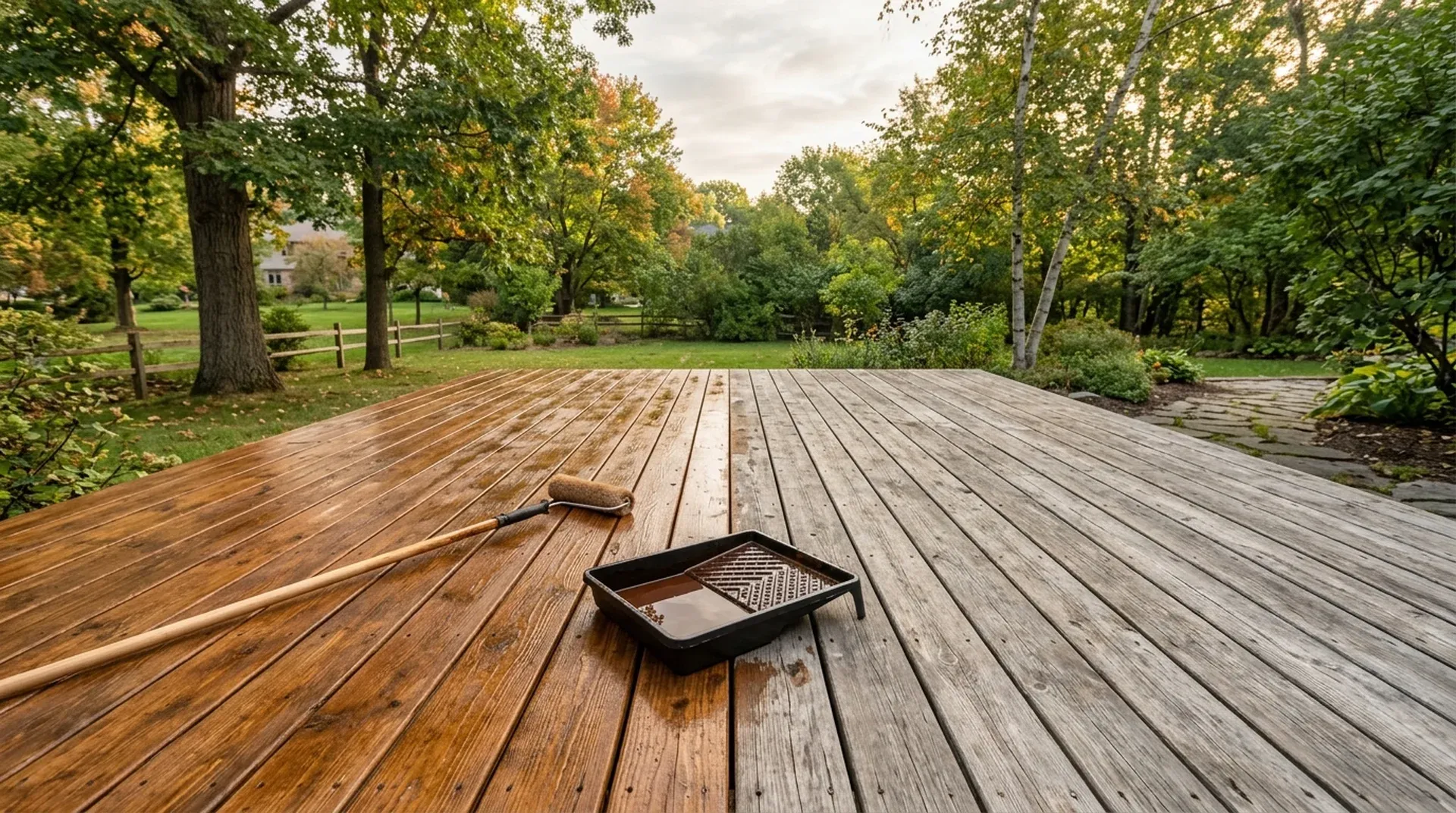
Most wood decks need a fresh coat of stain every 2 to 3 years, but the real range runs from about 1 year for a clear sealer to 4 to 6 years for a semitransparent stain. The best time to stain is a dry, mild stretch between 50°F and 90°F, out of direct midday sun, with no rain due for at least a day. To check if yours is due, sprinkle on some water and see if it beads up or soaks in.
How often to stain a deck
How long a finish lasts depends a lot on how much pigment it has. A USDA Forest Products Laboratory (FPL) release says a clear water-repellent preservative lasts about 1 year, adding tint buys about 2 more years, and a semitransparent stain lasts about 4 to 6 years.
Real-world schedules tend to be shorter:
- Sherwin-Williams says to plan on staining every 2 to 3 years, depending on climate and wear.
- Consumer Reports says the best stains in its tests give at least 3 years of protection on a deck, and that decks wear faster than fences.
- University of Missouri Extension says penetrating stains on decks need refinishing every 1 to 2 years, and that light colors outlast dark ones on decks.
|
Finish |
Typical life on a deck floor |
Notes |
|---|---|---|
|
Clear water repellent or sealer |
About 1 year |
Quickest to apply and redo |
|
Tinted (toned) water repellent |
About 2 years longer than clear |
Some color, grain still shows |
|
Semitransparent stain |
2 to 3 years is common; up to 4 to 6 in the FPL's estimate |
Best balance for most decks |
|
Solid stain or paint |
Not recommended on deck floors |
Fine on railings |
The water test
Cabot's rule of thumb: if the stain still repels water, it's still working, and you may only need to clean the deck this season. Test the busiest boards, like stair treads and the path to the door. If water soaks in and darkens the wood instead of beading, it's time.
Best time to stain a deck
Weather matters more than the month. Consumer Reports says to stain when it hasn't rained for 3 days, with at least 2 dry days in the forecast and temperatures between 50°F and 90°F with low to average humidity. Cabot uses the same range for both air and wood surface temperature and says to skip staining if rain is forecast within 12 to 24 hours.
Avoid direct sun, which Consumer Reports says can dry stain before the wood absorbs it. On a sunny deck, work in the early morning or late afternoon.
Season by region:
- Northern states: An FPL deck researcher quoted in that same release likes to wait until April because penetrating finishes work better in warmer weather. Missouri Extension also says spring is best. Late summer and early fall work too, as long as temperatures stay in that 50°F to 90°F range through drying.
- Hot, sunny regions (South, Southwest): Midsummer afternoons can run past the 90°F limit, so spring, fall or early mornings are easier.
- Rainy, humid regions: Finding 2 or 3 dry days in a row is the hard part, and Sherwin-Williams suggests waiting 24 to 48 hours after rain so the deck is fully dry.
Staining a new deck
New pressure-treated wood is often too wet to absorb stain. Advice on the wait runs from 6 to 8 weeks (Consumer Reports) to at least 6 months (Sherwin-Williams). Viance, which makes wood preservatives, says treated wood is typically ready about 60 days after installation and recommends the water-drop test: once the wood soaks up a few drops, it's ready.
Don't wait too long, either. FPL's deck finishing factsheet says boards with a factory water repellent may need 2 to 3 months of weathering, and that waiting up to a year can lead to significant checking (small surface cracks). It adds that most decks are retired because of cracks and checks that timely finishing could mostly have prevented.
What if it rains, and when can you walk on it?
Cabot notes that stain applied to damp wood won't adhere well and can crack or peel. If a surprise shower hits fresh stain, let the deck dry fully, then check the can or call the manufacturer before you touch up or recoat. Consumer Reports says stain can take 1 to 48 hours to dry enough to walk on, and days or even weeks to fully cure. Wait until it has cured before dragging back grills, fire pits or heavy furniture.
Choosing a deck stain
For the deck floor, use a penetrating finish. FPL's factsheet says penetrating finishes, not film-forming finishes, should be used on wood decks, because paint and solid stains trap moisture, wear in traffic areas and fail by peeling. Purdue Extension adds that semitransparent stains won't blister or peel even if moisture gets into the wood. On railings, FPL says paints and solid stains may perform quite well.
|
Type |
Grain shows? |
Durability |
Best for |
|---|---|---|---|
|
Clear or toned sealer |
Yes, fully |
Shortest |
Easy yearly upkeep; FPL's pick if you're unsure |
|
Semitransparent |
Yes, partly |
Longer |
Most deck floors |
|
Semi-solid |
Mostly hidden, some texture shows |
Check the label |
More color, less grain |
|
Solid |
No |
Can peel on floors |
Railings |
Oil or water-based? Sherwin-Williams says oil-based stains penetrate deeper with longer-lasting color, while water-based stains dry fast, clean up easily and suit areas with frequent rain. In mildew-prone areas, FPL says finishes with a mildewcide (water-repellent preservatives) perform much better than plain water repellents.
Check what's on the deck before you recoat. Purdue notes that semitransparent stain won't work over solid stain or old paint. If you have a composite deck, see our composite vs. wood deck guide, since composite usually needs only cleaning.
How to stain a deck, step by step
- Fix problems first. Replace cracked boards, reset popped nails and probe soft spots. Rot in joists, posts or the ledger is structural, so see our deck repair guide before you spend money on stain.
- Protect plants. Consumer Reports suggests watering nearby plants and covering them with plastic.
- Clean the wood. FPL recommends a cleaner with sodium percarbonate. Treat no more than 200 sq ft at a time, keep it wet for about 15 minutes, then rinse with a hose for at least 10 minutes. If you use bleach, never mix it with ammonia or ammonia-based detergents; FPL warns the combination makes a toxic gas.
- Strip or sand if needed. Peeling or flaking finish has to come off. Use a stain stripper and a stiff nylon brush, then sand rough spots. Consumer Reports says to consider hiring a pro to sand pressure-treated lumber made before 2004, because it may contain chromated copper arsenate (CCA), and to wear a respirator or N95 mask on newer wood.
- Let it dry. Cabot says to let the deck dry 2 to 3 days after cleaning. FPL says at least 2 warm, windy days.
- Apply thin coats. Coat the end grain heavily, then stain 2 or 3 boards at a time along their full length, keeping a wet edge so you don't get lap marks. Cabot warns that more stain is not better: extra stain can peel, crack or stay sticky. Sherwin-Williams says most decks need 1 or 2 coats, 24 hours apart, and a gallon covers about 250 to 350 sq ft.
- Handle rags safely. Purdue warns that cloths wet with oil-based stain can spontaneously combust. Soak them in water or seal them in an airtight container right after use.
Should you pressure wash a deck before staining?
You don't have to. The FPL cleaning method in step 3 uses a broom or sponge mop and a garden hose. FPL also warns that aggressive scrubbing or power washing can remove wood from the surface, especially soft woods like western redcedar. If you do pressure wash, Viance's guidelines are no more than 800 psi, a fan tip of at least 30 degrees, and the tip at least 8 inches from the wood, moving with the grain.
How much deck staining costs
HomeAdvisor puts professional deck staining at $550 to $1,250, with an average of $850 (updated June 2026). Bob Vila's cost guide gives a similar $540 to $1,250, averaging $775, or about $2 to $4 per sq ft (updated June 2023). Prices vary by region, deck condition and how much prep the job needs.
|
Deck size |
HomeAdvisor price range |
|---|---|
|
12x12 (144 sq ft) |
$275 to $575 |
|
12x20 (240 sq ft) |
$475 to $950 |
|
19x19 (361 sq ft) |
$725 to $1,450 |
|
16x24 (384 sq ft) |
$775 to $1,550 |
HomeAdvisor's table doesn't list a 20x20 (400 sq ft) deck. Its two closest sizes (361 and 384 sq ft) run $725 to $1,550, so expect a 20x20 to land in that range or a bit above it. HomeAdvisor lists railing staining at $4 to $12.50 per linear foot and stripping old paint at $9 to $12 per sq ft, so prep can cost more than the stain.
For DIY, HomeAdvisor says materials run about $20 to $250, and stain itself costs $20 to $120 a gallon. The real cost is your time: Sherwin-Williams lists 3 to 5 days for cleaning, drying and staining.
Weighing upkeep? See deck vs. patio, or add a patio cover to shield the boards from sun and rain.
When to call a pro
Staining a small, sound deck is a doable DIY job. Hire a deck or painting contractor if the deck is large or raised, has a lot of railings and stairs, has a peeling solid stain or paint that needs stripping, or is pre-2004 pressure-treated wood that needs sanding. If you find soft or rotted joists, posts or ledger boards, get a licensed contractor to repair the structure before anyone stains it.
When you hire:
- Get 2 or 3 written quotes that list the same prep (cleaning, stripping, sanding), the stain product and color, number of coats, and whether railings and stairs are included.
- Ask for photos of similar decks they've stained.
- Check licensing and insurance where your state requires it.
- Get the scope, schedule and payment terms in writing, including what happens if rain delays the job.
- Check HOA rules on stain colors before you choose one.
You can find deck and outdoor living pros near you on LandscapeLookup for free, with no sign-up. Pros are ranked by their Google rating weighted by review count, plus how local they are and their main service, and you contact them directly.
Editorial team
The LandscapeLookup editorial team writes guides to help US homeowners plan yard projects and hire the right pro. Each guide is based on university extension services, government sources such as EPA WaterSense and USDA, manufacturer instructions and published cost guides, and links to them so you can check the details.
Keep reading
Deck Repair or Replace? How to Decide and What It Costs
Repair a deck when the frame, ledger and posts are sound and the damage is limited to boards, railings, stairs or the finish. Replace it when rot or insects have spread through the framing. Repairs average about $1,465; replacement often runs $5,420 to $14,540.
October 5, 2026

Fire Pit Ideas and Costs
Fire pit ideas run from a portable steel bowl on gravel to a stone pit or gas fire table built into a patio. HomeAdvisor puts the average at about $850, with most projects between $200 and $3,000.
September 29, 2026
Patio Covers: Types, Materials and Costs
A patio cover can be a $120 shade canopy or a $30,000 gable roof. This Old House puts most patio roofs at $14,000 to $31,000, and the right type depends on whether you need shade, rain cover or snow strength.
September 27, 2026