How to Plant a Tree (and When)
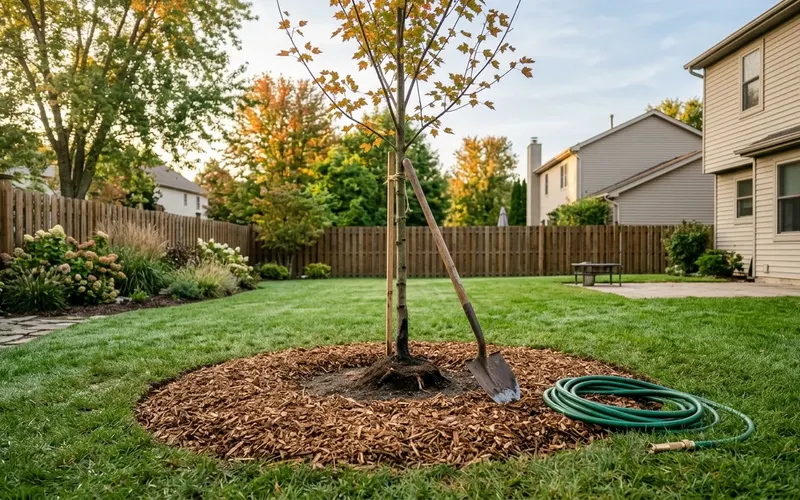
Plant in fall after leaf drop or in early spring before bud break. Dig a hole 2 to 3 times wider than the root ball but no deeper, set the root flare at or just above grade, backfill with the soil you dug out, water well and mulch 2 to 3 inches deep without touching the trunk.
By LandscapeLookup Editors7 min read
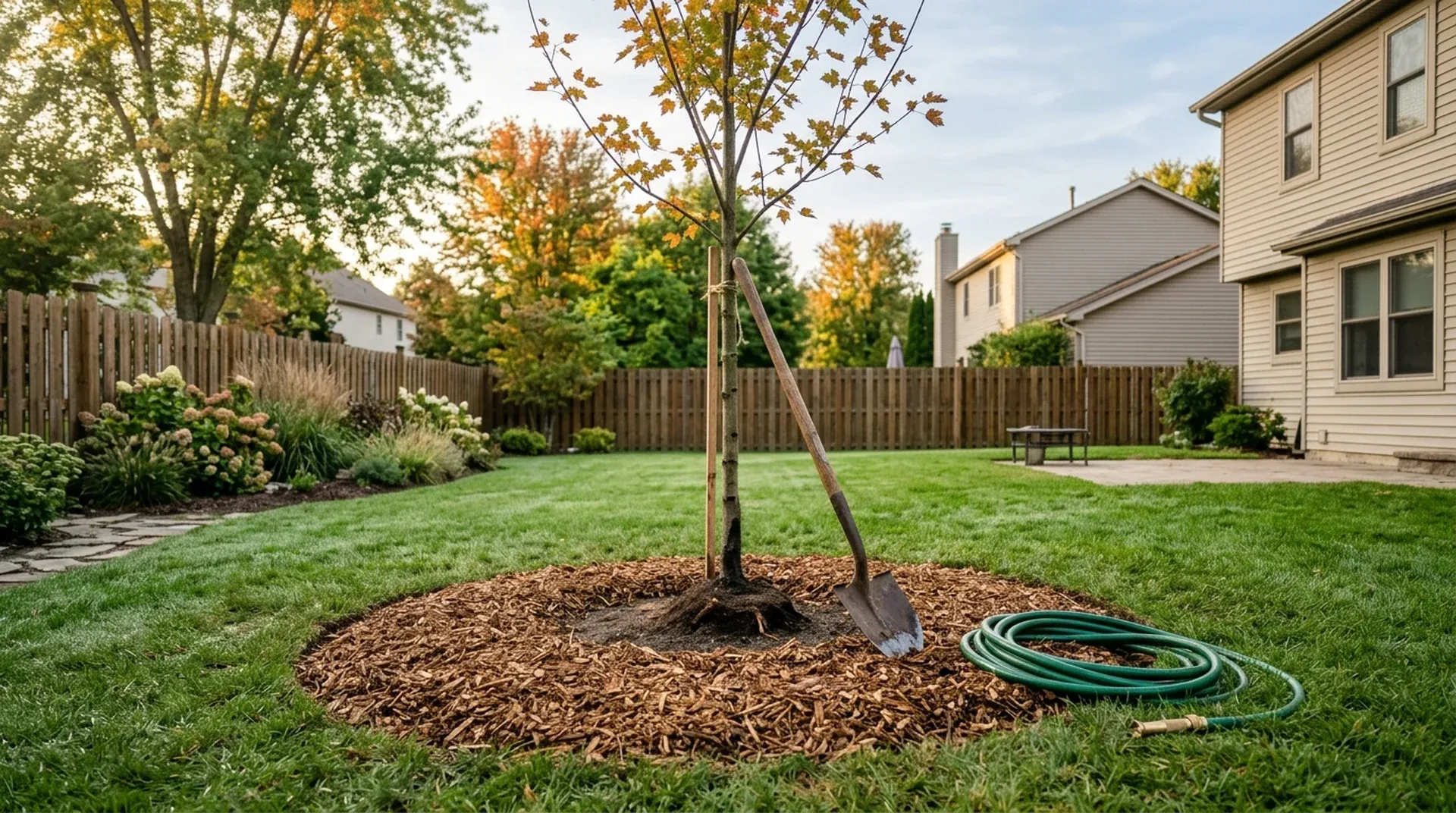
The best time to plant a tree is the dormant season: in fall after the leaves drop or in early spring before the buds open. To plant it, find the root flare, dig a hole 2 to 3 times wider than the root ball but no deeper, set the flare at or just above the soil line, backfill with the soil you dug out, then water deeply and mulch 2 to 3 inches deep without touching the trunk.
The Colorado State Forest Service says many tree failures trace back to girdling roots that weren't fixed at planting. Planting depth and mulch matter just as much, and all three are easy to get right on day one.
When is the best time to plant a tree?
The International Society of Arboriculture (ISA) says the ideal time is the dormant season, when cool weather lets roots settle in before summer heat pushes new top growth. Healthy container and balled-and-burlapped trees can go in through the growing season, too.
Your region shifts the best window:
|
Where you live |
Best planting window |
Source |
|---|---|---|
|
Upper Midwest (Wisconsin) |
Most maples, lindens, elms and crabapples in September to early October; oaks, birches, cherries and magnolias may do better in spring; evergreens by mid-August to September |
|
|
Mid-Atlantic (Washington, DC) |
Fall or early spring; winter if the ground isn't frozen; avoid summer |
|
|
Hot summers (Central Texas) |
Autumn, which gives roots almost half a year before summer heat |
|
|
Tropical and subtropical |
Any time, as long as you can water |
|
|
Bare-root trees (anywhere) |
Spring, before growth begins |
Whatever the season, skip hot, dry spells. University of Minnesota Extension notes that new trees may wilt or drop leaves after planting, especially in hot, windy weather.
Before you dig: pick the spot and call 811
Plan for the tree's mature size, not its nursery size. Check its full height and spread against your house, sidewalks and overhead wires. The ISA's utility brochure sets three zones around distribution lines:
- Within 15 feet of the lines: trees that top out at 20 feet or less.
- 15 to 50 feet away: trees with a mature height of 40 feet or less.
- 50 feet or more: large shade trees.
Call 811 a few business days before you dig. It's the free national call-before-you-dig service, and it covers planting trees. Utilities will mark buried lines with paint or flags.
Buy a good tree. The ISA's buying guide says you should be able to see the trunk flare where the trunk widens into the roots, and container roots shouldn't twist or circle. Slide the tree out of its pot to check before you buy.
How to plant a tree, step by step
- Find the root flare. Container trees often have extra soil piled over the roots. The Colorado State Forest Service says to gently remove soil until you reach the true flare and first structural root, which can sit several inches down. Don't mistake the graft bulge for the flare.
- Measure the depth. Measure from the bottom of the root ball to the flare. That's how deep the hole should be, or 1 to 2 inches shallower, since Colorado State notes loosened soil settles and can sink the tree below grade.
- Dig wide, not deep. The ISA calls for a hole 2 to 3 times wider than the root ball, and Casey Trees adds that the sides should slope out like a wide bowl. Colorado State goes to at least 3 times, and UW-Madison Extension says 3 to 5 times. New roots grow faster into loose soil.
- Unwrap and fix the roots. Remove the pot or root bag. Colorado State recommends shaving about 1 inch off the outside of a container root ball, or until no circling roots show, because slicing alone doesn't redirect them.
- Set the tree. Lift by the root ball, not the trunk. The ISA notes most roots grow in the top 12 inches of soil, so planting too deep can harm the tree. Have someone check from several angles that it's straight.
- Backfill with the native soil. Colorado State says compost and other amendments are not necessary or recommended because roots may stay in the rich backfill. UW-Madison suggests filling in thirds, watering after each layer to remove air pockets. Don't pile soil on top of the root ball.
- Build a watering ring. UW-Madison recommends a soil berm at least 3 inches high around the edge of the hole. Fill it, let it drain and fill it again.
- Mulch and water. See the next section for depth and spacing.
Container, balled-and-burlapped and bare-root trees
- Container: Check closely for circling roots, as in step 4.
- Balled and burlapped: The ISA says to remove the cover and either remove the wire basket or cut off one or two rings so it sits low. These root balls are heavy, so UW-Madison suggests sliding the tree in on a tarp.
- Bare root: Iowa State says to prune broken roots, soak the roots 1 to 2 hours, and spread them over a cone of soil in the hole. If you can't plant right away, keep them at about 40°F with damp packing.
How to stake and mulch a new tree
Staking: often not needed
Colorado State says most trees in a home yard shouldn't need staking, and the ISA notes that unstaked trees develop stronger trunks and roots. Iowa State says the exceptions are bare-root trees, top-heavy trees and trees on windy, exposed sites.
If you stake, University of Minnesota Extension advises:
- Stakes: Wooden stakes at least 2 by 2 inches by 5 feet work for trees up to 10 to 12 feet tall. One stake on the upwind side is often enough; place it outside the root ball.
- Ties: Use wide, flexible straps attached loosely, so the trunk can sway. Never use wire run through garden hose, which Iowa State says can girdle the trunk.
- Height: Attach about 1/3 or 2/3 of the way up to the first branches, never right below them.
- Timing: Remove everything after one growing season. Also pull off any bamboo stick the nursery used to straighten the stem.
Mulching: wide and flat, never a volcano
The ISA recommends a 2 to 3 inch layer with a mulch-free area 1 to 2 inches wide at the base. Casey Trees uses a "3-3-3" rule: a ring at least 3 feet wide and 3 inches deep, held 3 inches off the trunk.
A "mulch volcano" is mulch heaped against the trunk. The ISA says it can soften bark and invite insects, disease and girdling roots, and on wet soils more than 2 inches can lead to root rot. To figure out how much to buy, use our mulch calculator guide.
First-year care: water, fertilizer and pruning
Water the root ball first. Iowa State says a new tree's roots start out in the original root ball, which often dries out before the surrounding soil. Water when it's dry 1 to 2 inches down. Guidelines vary with climate:
|
Source |
How much and how often |
|---|---|
|
At least once a week without rain, more in hot, windy weather |
|
|
5 to 7 gallons, about twice a week depending on weather |
|
|
1 to 2 gallons per inch of trunk diameter, 3 to 4 days a week |
|
|
Up to 25 gallons a week, for 2 to 3 years |
Check the soil before you water, since Minnesota warns that clay can stay wet even when the tree looks thirsty. Iowa State says to keep watering young trees in fall until the ground freezes.
Skip the fertilizer. The ISA says to avoid fertilizing at planting, and Iowa State says new trees generally don't need it. Consider it only if growth is poor 2 to 3 years later.
Prune lightly. Remove only broken or damaged branches at first. Iowa State says severe pruning slows growth. See when to prune trees for later shaping. If a young tree keeps declining, check our guide to signs a tree is dying.
How much does it cost to plant a tree?
LawnStarter puts professional planting of a semi-mature tree at $565 to $680 on average, and Fixr gives a typical range of $200 to $550. Size drives the price:
|
Tree height at planting |
LawnStarter |
Fixr |
|---|---|---|
|
Small (1 to 6 ft) |
$50 to $300 |
$70 to $250 (1 to 4 ft) |
|
Medium (up to 10 ft) |
$200 to $700 |
$250 to $650 (5 to 9 ft) |
|
Large (up to 20 ft) |
$400 to $2,400 |
$650 to $2,000 (10 to 19 ft) |
|
Extra large (over 20 ft) |
$2,000 to $5,000 |
$2,050 to $4,000 (20 to 30 ft) |
LawnStarter says labor runs $50 to $150 an hour, and pros often charge a minimum fee. It estimates about $115 to do it yourself, mostly for basic tools like a shovel and wheelbarrow. LawnStarter notes prices vary by species, size and location, so expect regional differences.
When to call a pro
You can plant a small container tree yourself with the steps above. Hire help for large balled-and-burlapped trees, a whole row of trees, or any planting near power lines, where an ISA-certified arborist can help match the species to the space.
Before you hire:
- Get 2 or 3 written quotes that list the species, size, root type (container, burlap or bare root), mulch, staking and haul-away.
- Ask for photos of similar work, and look for exposed root flares and flat mulch rings, not volcanoes.
- Check licensing and insurance where your state requires it. The ISA's Verify a Credential tool confirms arborist certification.
- Confirm who calls 811 before digging starts.
- Get the scope and payment schedule in writing, including any replacement policy if the tree fails.
You can find tree care pros near you or landscapers on LandscapeLookup for free, with no sign-up. Pros are ranked by Google rating weighted by review count, plus how local they are and their main service, and you contact them directly.
Editorial team
The LandscapeLookup editorial team writes guides to help US homeowners plan yard projects and hire the right pro. Each guide is based on university extension services, government sources such as EPA WaterSense and USDA, manufacturer instructions and published cost guides, and links to them so you can check the details.
Keep reading
What a Certified Arborist Does and When to Hire One
An ISA Certified Arborist has at least 3 years of tree care experience, passed a 200-question exam and keeps up with continuing education. Hire one for large-tree pruning, risk checks, removal decisions and sick trees.
October 26, 2026
When to Prune Trees
Prune most trees in late winter to early spring, while they're dormant and before new growth starts. Remove dead or broken branches any time. Prune spring-flowering trees right after bloom, and avoid pruning oaks during your area's oak wilt season.
September 9, 2026
Stump Grinding Cost and What to Expect
Stump grinding usually costs $131–$438 per job, with national averages around $200–$272. Many pros charge $2–$5 per inch of stump diameter with a minimum of about $100, and extra stumps cost less each.
September 4, 2026