Measure the area and depth to get cubic yards and an estimate in tons, since many yards sell rock by weight.
How far a ton of rock goes
This Old House’s coverage for 1 ton of rock spread 3 inches deep. Lighter stone covers far more ground per ton.
Rock
1 ton covers at 3 inches
Crushed rock
65 to 75 sq ft
Landscape rock, 0.75 to 1.5 inches
75 to 85 sq ft
Landscape rock, 1.5 to 3 inches
45 to 60 sq ft
Lava rock
200 to 210 sq ft
How this calculator works
Cubic yards = square feet × depth in inches ÷ 324 (Texas A&M AgriLife Extension’s formula), plus 10% if you tick the box.
Tons = cubic yards × 1.4, the conversion Lawn Love uses for river rock. It’s an estimate: every stone weighs differently.
This Old House’s coverage per ton at 3 inches shows how much that varies: 65 to 75 sq ft for crushed rock, 75 to 85 for 0.75 to 1.5 inch landscape rock, 45 to 60 for 1.5 to 3 inch rock, and 200 to 210 for lava rock.
Common questions
How many tons are in a yard of gravel?
Lawn Love multiplies cubic yards by 1.4 to get tons of river rock, which is what this calculator uses. Stone varies, so ask your supplier for its own weight per yard.
How much does a ton of gravel cover?
At 3 inches deep, This Old House puts a ton of crushed rock at about 65 to 75 sq ft and a ton of lava rock at about 200 to 210 sq ft. The chart above has the other sizes.
How much extra rock should I order?
Lawn Love suggests adding 10% for rock lost in transport and installation. The calculator adds it unless you untick the box.
How do I work out cubic yards of rock?
Multiply the square feet by the depth in inches and divide by 324. A 10 by 10 foot area at 3 inches deep is 100 × 3 ÷ 324, or 0.93 cubic yards.
How deep should a gravel path be?
In This Old House’s gravel path project, the path is dug 4 inches deep, lined with about 2½ inches of packed crushed stone, covered with landscape fabric, then filled with gravel to about ½ inch below the top of the edging.
Should I put landscape fabric under gravel?
This Old House lays fabric over the compacted base to block weeds and keep soil from mixing into the gravel, pinned taut so it doesn’t bunch up through the top layer. Edging keeps the gravel from spilling into the lawn.
Use this calculator on your site
Free to cite or embed. The embed shows the full calculator, with a link back to this page.
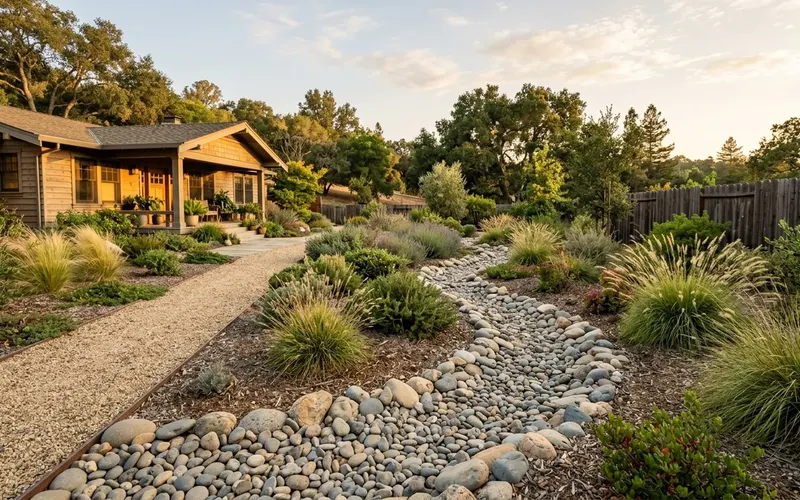
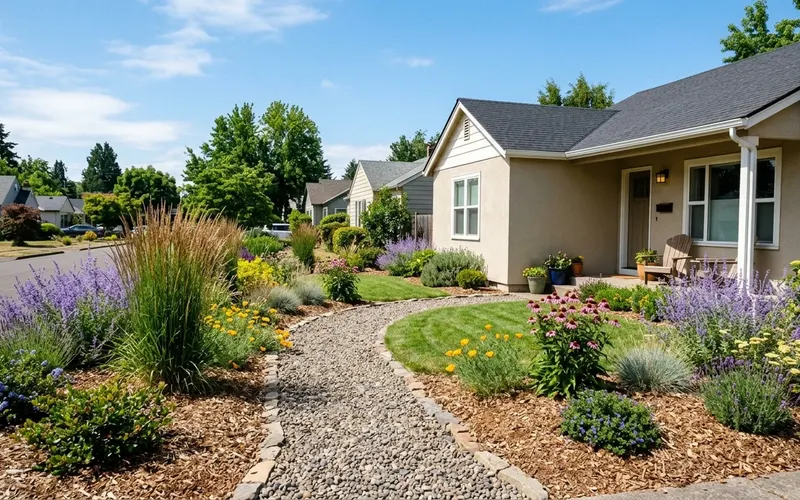
Common landscape rock like pea gravel, crushed stone, river rock and lava rock runs about $10 to $220 per ton in 2026 cost guides. It works best on paths, dry creek beds and in desert or wildfire-prone yards, and less well in most planting beds.
Xeriscaping is landscaping built to need little water beyond rainfall, using seven principles: planning, soil prep, practical turf, adapted plants, efficient irrigation, mulch and maintenance. It doesn't have to mean gravel and cactus.