How to Water Trees (New and Established)
Water a new tree daily for 2 weeks, every 2 to 3 days through week 12, then weekly, using about 1 to 1.5 gallons per inch of trunk diameter. Established trees need a slow soak 12 to 18 inches deep about every 2 weeks in dry spells.
By LandscapeLookup Editors8 min read
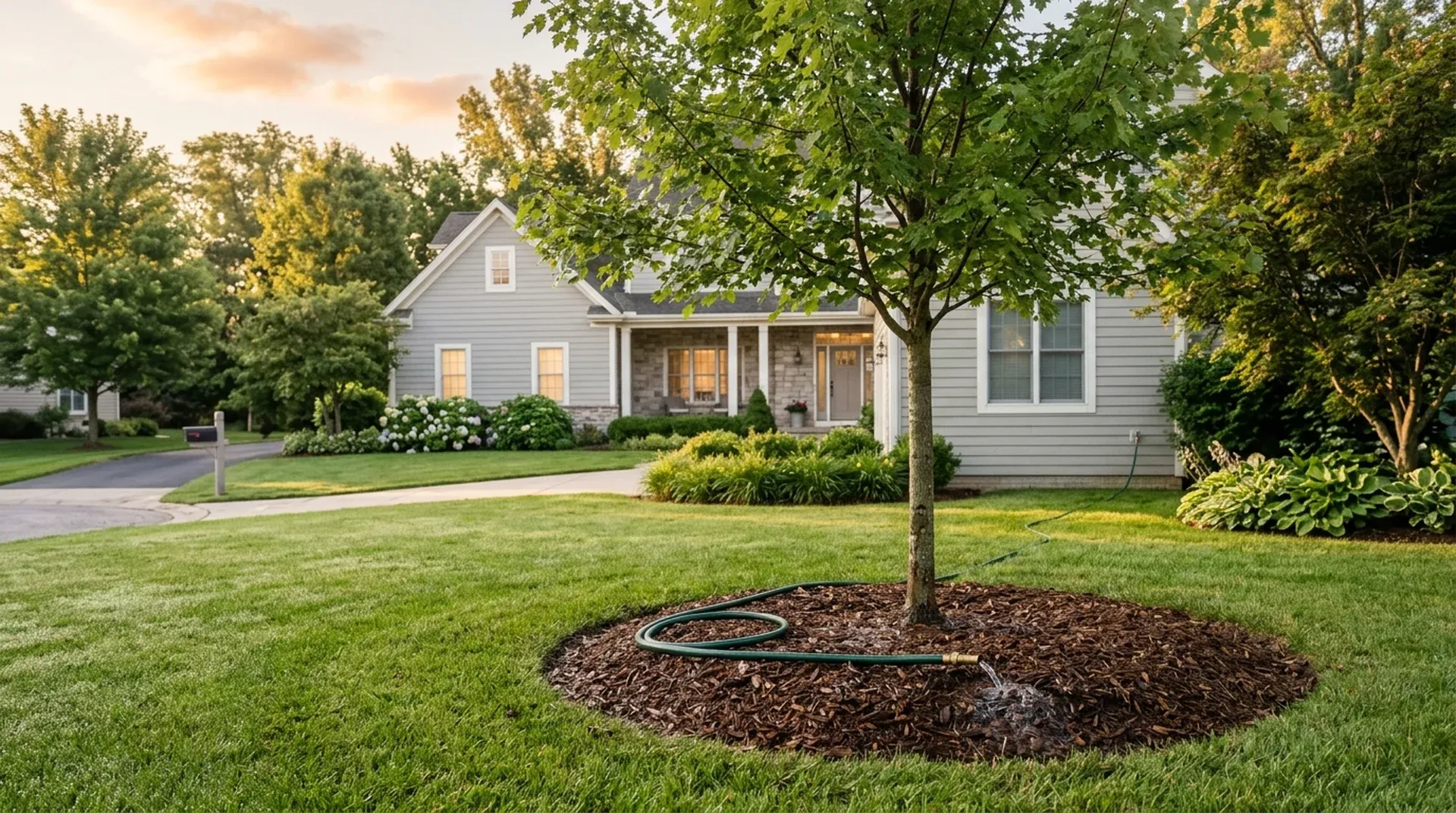
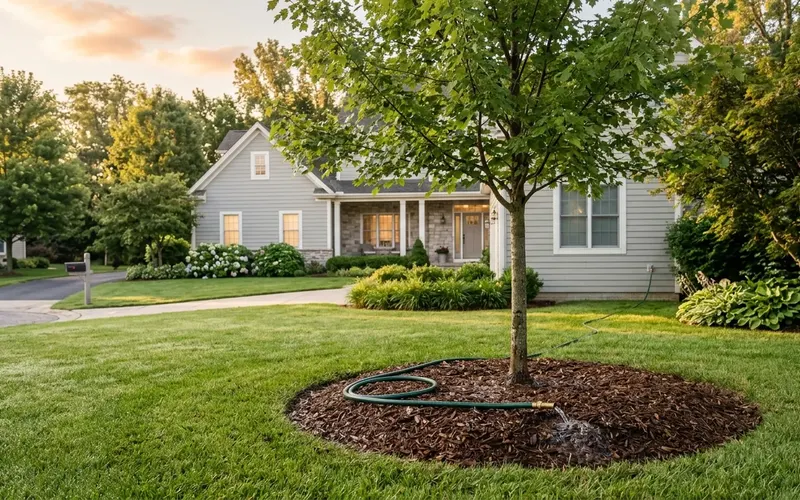
Water a newly planted tree every day for the first 2 weeks, every 2 to 3 days through week 12, then once a week until it's established, giving it about 1 to 1.5 gallons per inch of trunk diameter each time. Established trees need much less help: a slow, deep soak that wets the soil 12 to 18 inches down, out past the edge of the canopy, about every 2 weeks during dry spells.
Whatever the schedule, check the soil before you water.
How much water does a tree need?
A new tree's roots are packed into the root ball, so it needs small, frequent drinks. An established tree's roots spread far beyond the canopy, so it needs a bigger, slower soak less often.
|
Tree |
Water per session |
Source |
|---|---|---|
|
Newly planted |
1 to 1.5 gallons per inch of trunk diameter |
|
|
Established, growing season |
About 10 gallons per inch of trunk diameter (1 to 2 inches of water) every 2 weeks |
|
|
Established, bare minimum in a Texas drought |
1 to 2 gallons per inch of trunk diameter, once a week |
That's 2 to 3 gallons for a new 2-inch tree and 4 to 6 gallons for a 4-inch one, per the Minnesota table. CSU Extension says to use the higher amount at the more frequent schedule when it's hot and windy.
To measure the trunk, use a ruler 6 inches above the ground. For trunks thicker than 4 inches, Minnesota says to measure at 12 inches above the root flare instead.
How often should you water a new tree?
Penn State Extension calls lack of water the number one reason newly planted trees don't survive. Both Penn State and Minnesota give the same starting schedule:
|
Time since planting |
How often |
|---|---|
|
Weeks 1 to 2 |
Daily |
|
Weeks 3 to 12 |
Every 2 to 3 days |
|
After week 12 |
Weekly until the roots are established |
CSU Extension keeps bigger trees on daily watering for 4 weeks for 3- to 4-inch trees and 6 weeks for trees over 4 inches. In the South, Clemson says trees in well-drained soil need daily irrigation for at least the first month, and UF/IFAS Extension in Broward County, Florida, recommends daily water for 7 to 10 days, then every other day for 2 weeks, then weekly.
A few rules that keep new trees alive:
- Don't count on rain. Minnesota says to skip a watering only after substantial rain, over 1 inch in a day. Penn State adds that when an inch falls in under an hour, most of it runs off.
- Wet the root ball and beyond. Nebraska Extension says to moisten the soil a few feet or more outside the planting hole so roots grow out. Minnesota suggests a 3- to 4-inch soil berm around the root zone to hold water while it soaks in.
- Fall planting. Penn State says to follow the schedule until the first frost, then resume weekly watering in spring.
- Don't rely on the lawn sprinklers. Clemson notes that turf systems can't give new trees enough water in well-drained soil without overwatering everything else.
For planting steps, see how to plant a tree.
How long until a new tree is established?
Roughly one growing season per inch of trunk diameter, and CSU Extension notes it can take longer in cooler areas and less time in warmer ones. Penn State says a 2-inch tree takes about two growing seasons in Zones 2 to 6. Minnesota's table runs longer, at 1.5 years per inch. In South Florida, UF/IFAS estimates 6 to 12 months per inch. Until then, slow growth is normal: Penn State says new trees go through a period of transplant shock.
How to water established trees
If rain is adequate, healthy established trees usually don't need extra water, per Nebraska Extension. In dry spells, it recommends wetting the soil 12 to 18 inches deep, then waiting until the top 6 inches dry out before watering again. A deep soak every 2 weeks is enough for most established trees in unirrigated yards.
In dry-summer California, UC IPM (the University of California's pest program) says most established trees can use a thorough watering about once a month when it isn't raining, or about every 7 to 14 days in summer, depending on soil and weather.
Where to put the water
Nebraska Extension says to water from near the trunk to just beyond the drip line (the edge of the branches). That's where the roots that drink are:
- Nebraska Extension says about 90% of a tree's water-absorbing roots are in the top 24 inches of soil, and half are in the top 12.
- Roots can spread 2 to 4 times wider than the tree is tall, per Denver Water and the Colorado Tree Coalition.
- UC IPM says to keep the trunk dry.
Soil type changes the math
Nebraska Extension calls soil type the biggest factor in how often and how much to water. Sandy soil drains fast and may need water every 5 to 7 days in hot, windy weather. Clay absorbs slowly, so apply water slowly and less often, and use cycle-and-soak if it runs off. Denver Water suggests stopping and waiting 30 minutes before resuming.
Nebraska Extension says frequent, light watering is one of the most common causes of tree death because it keeps a shallow layer of soil saturated and drives out oxygen. Some trees want no summer water at all: the Sacramento Tree Foundation warns that native blue oaks may be harmed by it.
How to tell if your tree needs water
Push a long screwdriver into the soil near the drip line. If it goes in easily to 6 inches and comes out cool and moist, skip watering, according to Nebraska Extension. CSU uses 6 to 8 inches as the check depth.
For a new tree, Clemson suggests a squeeze test a few hours after watering. Dig a small hole just outside the root ball and squeeze a handful of soil. If water drips out, you're overwatering. If it crumbles, you're underwatering. Check the root ball with a finger too.
|
Sign |
Too little water |
Too much water |
|---|---|---|
|
Leaves |
Wilting, leaf scorch or browning, early fall color (UMD) |
Yellow leaves that drop (UC IPM) |
|
Canopy |
Thin canopy, small leaves (Nebraska Extension) |
Root and crown rot can follow (UC IPM) |
|
Evergreens |
Needles brown from the tip (UMD) |
|
|
Soil |
Hard, dry, crumbly 6 inches down (Sacramento Tree Foundation) |
Wet and sticky; let it dry first (Sacramento Tree Foundation) |
Penn State says overwatering can be just as harmful as underwatering, especially in clay: pores filled with water for more than a day can suffocate roots. Other problems cause similar symptoms, so see signs a tree is dying if watering changes don't help.
What's the best way to water a tree?
Slow is the goal. Water early in the morning to cut evaporation and wind loss.
|
Method |
How to use it |
|---|---|
|
Garden hose |
Let a stream the size of your little finger run 20 to 30 minutes at one spot on the drip line, then move it; medium and large trees need 3 or 4 spots |
|
Soaker hose |
Coil it around the tree. The usual 15 to 30 minutes is rarely enough: run it an hour, then dig to see how deep the water went |
|
Watering bag |
Holds 14 to 15 gallons and drips out over 5 to 9 hours; best for young trees |
|
5-gallon bucket |
Drill a 1/8-inch hole near the bottom and set it next to the root ball |
|
Sprinkler |
Run it on a low setting until the top 12 inches are moist, then move it until you've covered the area to just past the drip line |
|
Deep-root needle |
Push it no deeper than 8 inches |
|
Drip line |
Move emitters out from the trunk and add lines as the tree grows |
Do watering bags work? Yes, for young trees. A bag that's empty a few hours after filling is working as intended. The Morton Arboretum suggests refilling every 5 to 7 days in mild weather or every 3 to 5 days in extreme heat, and removing the bag for winter.
Finish with mulch. Minnesota recommends 3 inches of organic mulch for new trees, kept off the trunk. Nebraska Extension suggests a 3- to 6-foot-wide ring spread flat, not piled like a volcano. See how much mulch you need. For a permanent setup, compare drip irrigation vs. sprinklers.
Watering trees in fall, winter and drought
Keep watering in fall while the soil can take it. The Morton Arboretum says there's no set cutoff date, and Nebraska Extension suggests monthly watering through December or until the ground freezes if fall stays dry.
In dry-winter regions like Colorado, CSU Extension recommends winter watering once or twice a month, at midday, only when it's above 40°F with no snow on the ground. Denver Water says three weeks of winter without any precipitation is your cue.
CSU lists maples, lindens, birches, dogwoods and willows among shallow-rooted trees that need winter water. The Morton Arboretum adds magnolias, Japanese maples, beeches and tulip trees to its drought-sensitive list.
When water is restricted
Put trees ahead of the lawn. Texas A&M AgriLife says your trees are probably the most valuable plants in your yard, and the Morton Arboretum notes that a dormant lawn greens up again in fall. In dry years, Denver Water suggests watering small trees 4 times a month, medium trees 3 and large trees 2.
Check your water utility's and HOA's rules first. Around Sacramento, the Sacramento Tree Foundation says restrictions typically target overhead sprinklers, and hand watering with a shut-off nozzle or drip is exempt from most of them. Rules vary by town.
When to call a pro
Call an ISA-certified arborist if a tree keeps wilting, scorching or dropping branches after a few weeks of correct watering, or if construction cut its roots. See what a certified arborist does. An irrigation contractor can add a drip zone for trees; call 811 before anyone trenches.
Before you hire:
- Get 2 or 3 written quotes that spell out the work, from diagnosis to drip-line layout.
- Ask for photos or references from similar jobs.
- Check licensing and insurance where your state requires it, and ISA certification for tree work.
- Get the scope and payment schedule in writing.
You can find tree care pros near you or irrigation pros on LandscapeLookup for free, with no sign-up. Pros are ranked by Google rating weighted by review count, plus how local they are and their main service, and you contact them directly.
Editorial team
The LandscapeLookup editorial team writes guides to help US homeowners plan yard projects and hire the right pro. Each guide is based on university extension services, government sources such as EPA WaterSense and USDA, manufacturer instructions and published cost guides, and links to them so you can check the details.
Keep reading
How to Plant a Tree (and When)
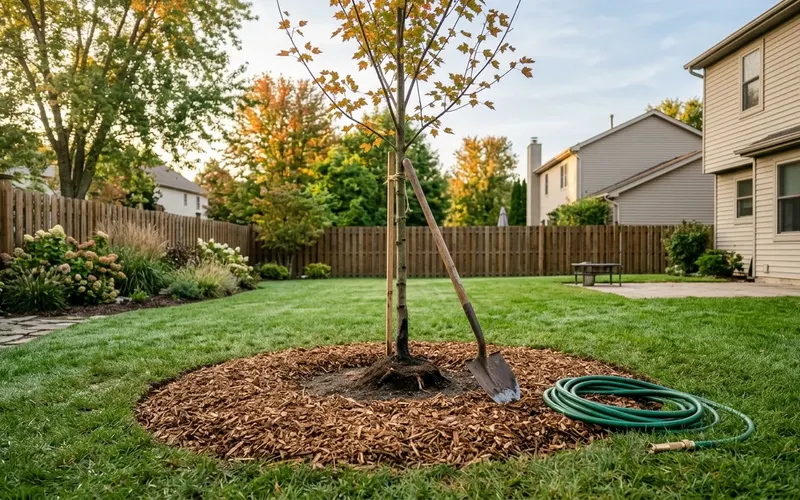
Plant in fall after leaf drop or in early spring before bud break. Dig a hole 2 to 3 times wider than the root ball but no deeper, set the root flare at or just above grade, backfill with the soil you dug out, water well and mulch 2 to 3 inches deep without touching the trunk.
October 30, 2026
What a Certified Arborist Does and When to Hire One
An ISA Certified Arborist has at least 3 years of tree care experience, passed a 200-question exam and keeps up with continuing education. Hire one for large-tree pruning, risk checks, removal decisions and sick trees.
October 26, 2026
When to Prune Trees
Prune most trees in late winter to early spring, while they're dormant and before new growth starts. Remove dead or broken branches any time. Prune spring-flowering trees right after bloom, and avoid pruning oaks during your area's oak wilt season.
September 9, 2026