By the nitrogen percentage on the bag and the nitrogen rate you want: rate ÷ nitrogen as a decimal, the method Purdue and Iowa State use.
Pounds of nitrogen per 1,000 sq ft per year, from UGA Extension. Split the yearly amount into several smaller feedings rather than one large one.
How do I calculate how much fertilizer to use?
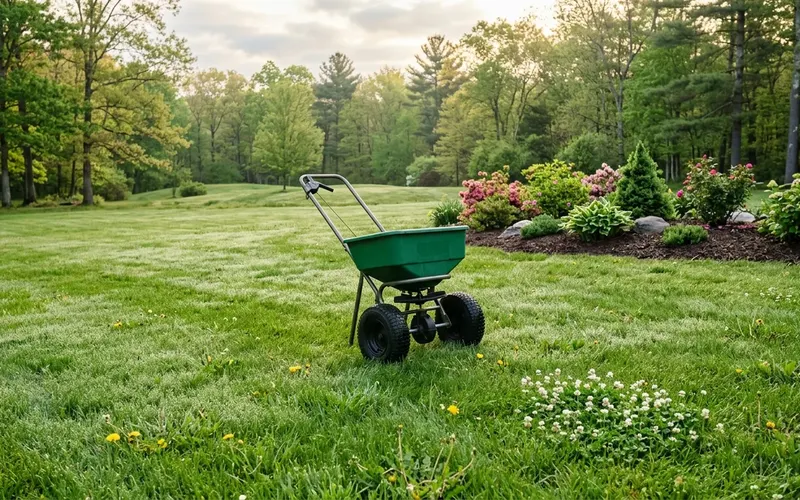
Divide the nitrogen rate you want by the bag’s nitrogen as a decimal to get pounds per 1,000 sq ft, then multiply by your lawn size in thousands of square feet. Purdue’s example: 0.75 lb of nitrogen from a 16-8-8 bag is 4.69 lb per 1,000 sq ft, or about 37 lb on an 8,000 sq ft lawn.
Which number on the bag is nitrogen?
The first one. A 16-8-8 bag is 16% nitrogen, which the formula uses as 0.16, the way Purdue and Iowa State do.
How much nitrogen should I put down at once?
Iowa State Extension’s quick table covers ¼ to 1 lb of nitrogen per 1,000 sq ft per application, and Purdue’s worked example uses ¾ lb. Your state Extension’s lawn calendar gives the right rate and timing for your grass.
When should I fertilize a cool-season lawn?
Iowa State Extension’s schedule is spring (April or May), mid-September and late October or early November. A high-quality lawn gets all three, a moderate program the two fall feedings, and a low-maintenance lawn just the late fall one. It says not to fertilize cool-season grass in June, July or August.
How much fertilizer does a new lawn need?
Purdue Extension recommends 0.75 to 1 lb of nitrogen per 1,000 sq ft four to six weeks after the seed comes up, and again at eight to ten weeks. For a mid-August seeding, that’s mid to late September and mid to late October.
Do fall rates differ by state?
Yes. K-State Research and Extension suggests 1 to 1.5 lb of quick-release nitrogen per 1,000 sq ft in September and 1 lb in November for Kansas lawns, while Iowa State’s range per application is 0.5 to 1 lb. Use your own state Extension’s schedule.
When should I fertilize a warm-season lawn?
UGA Extension says to wait until the soil 4 inches down is at or above 65°F and the grass is actively growing. Fed earlier, roots take up little of the nitrate and more of it can leach away. In North and Central Florida, UF/IFAS says lawns grow from about April through September, so fertilize only then; South Florida lawns grow year-round.
How much nitrogen does a warm-season lawn need each year?
UGA Extension puts centipedegrass and zoysiagrass at 1 to 2 lb of nitrogen per 1,000 sq ft a year, St. Augustinegrass at 2 to 5 lb (the lower end in middle and north Georgia) and Bermudagrass at 2 to 4 lb. Spread it over several feedings: UGA’s example is four 1 lb feedings for Bermuda rather than one 4 lb feeding.
How much nitrogen can I put down at once in Florida?
UF/IFAS says no more than 1 lb of nitrogen per 1,000 sq ft per application, whatever the grass, and to choose a fertilizer whose nitrogen is mostly slow-release. UF/IFAS also notes that local fertilizer ordinances can rule out summer feeding in some places, so check with your county Extension office.
Free to cite or embed. The embed shows the full calculator, with a link back to this page.
Results are estimates. Suppliers’ bag sizes, pallet sizes and stone weights vary, so check theirs before you order.