What a Certified Arborist Does and When to Hire One
An ISA Certified Arborist has at least 3 years of tree care experience, passed a 200-question exam and keeps up with continuing education. Hire one for large-tree pruning, risk checks, removal decisions and sick trees.
By LandscapeLookup Editors7 min read
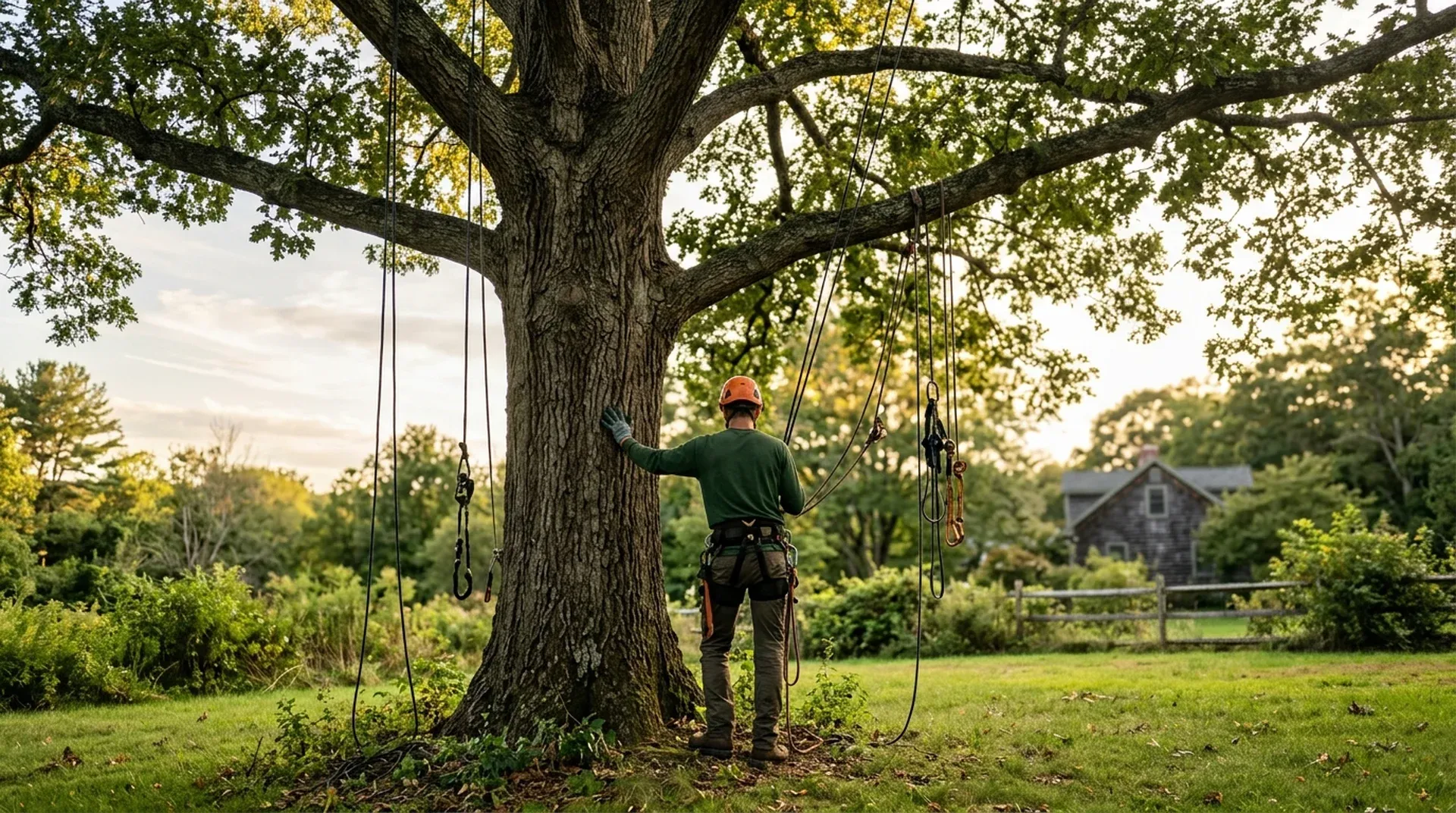
A certified arborist is a tree care professional who has earned the International Society of Arboriculture's (ISA) credential: at least 3 years of full-time tree work (or a mix of schooling and experience), a passing score on a 200-question exam, and ongoing continuing education to keep it. Hire one when a tree is big, sick, close to your house or power lines, or when you need an expert opinion on whether to prune, treat or remove it.
Certification is a voluntary industry credential, not a government license. Here's what it means, what these pros do, what a visit costs and how to check a credential before you sign anything.
What does "ISA Certified Arborist" mean?
The ISA calls its certification a nongovernmental, voluntary process. It shows a person knows the basics of tree biology, diagnosis, care and safety. Certified arborists also agree to a Code of Ethics and to use industry-accepted standards.
The ISA Certified Arborist Program Guide spells out the requirements:
- Experience: at least 3 years of full-time arboriculture work (about 1,795 hours a year), or a degree or training program plus 1 to 2 years of work.
- Exam: 200 multiple-choice questions in 3.5 hours.
- Renewal: the credential is valid for 3 years. To keep it, the arborist earns at least 30 continuing education units (CEUs) in that period or retakes the exam.
The exam covers 10 areas. The biggest shares, per the same guide:
|
Exam area |
Share of questions |
|---|---|
|
Safe work practices |
15% |
|
Pruning |
14% |
|
Tree biology |
11% |
|
Tree risk |
11% |
|
Tree identification and selection, installation and establishment, diagnosis and treatment, trees and construction |
9% each |
|
Soil management |
7% |
|
Urban forestry |
6% |
One limit matters for homeowners. The ISA says its certifications do not represent licensure or permission to run a business. That part is up to your state, if it licenses tree work (more below).
What does a certified arborist do?
According to the ISA's Why Hire an Arborist brochure, arborists offer:
- Pruning to remove dead, weak, decayed, diseased or storm-damaged limbs, and branches that get in the way of wires, roofs or sidewalks. Structural pruning also makes storm damage less likely.
- Removal advice when a tree is dead, dying, an unacceptable risk, crowding better trees or in the way of construction.
- Emergency care after storms.
- Planting advice, mainly picking species that fit the spot.
- Other services: plant health care, cabling and bracing, soil aeration, lightning protection, tree protection during construction, tree risk assessment, and consulting or legal work.
Timing matters for many of these jobs. Our guide on when to prune trees covers seasonal windows, including oak no-prune periods.
What other arborist credentials are there?
The ISA offers several separate credentials, each with its own exam. Other groups and states add their own.
|
Credential |
Who grants it |
What it tells you |
|---|---|---|
|
ISA Certified Arborist |
ISA |
Baseline tree care knowledge, 3 years of experience, continuing education |
|
ISA Board Certified Master Arborist |
ISA |
The highest level of ISA certification; applicants must already be Certified Arborists |
|
ISA Certified Arborist Utility Specialist |
ISA |
Certified Arborist plus electric utility vegetation work, such as 2,000 hours in the past 2 years |
|
ISA Tree Risk Assessment Qualification (TRAQ) |
ISA |
Training in ISA's risk method; valid 7 years, then retrain and retest |
|
Registered Consulting Arborist (RCA) |
American Society of Consulting Arborists (ASCA) |
A consulting credential that requires ASCA membership and its Consulting Academy, which covers report writing and dispute resolution |
|
State license (for example, Maryland Licensed Tree Expert) |
State agency |
Legal permission to sell tree work in that state |
Some towns want a credentialed report before you remove a protected tree. San Mateo County, California, says ISA Certified Arborists, RCAs or TCIA-accredited firms may be preferable for those reports. If your city needs one, ask the permit office which credentials it accepts.
What is a tree risk assessment, and what does it cost?
A tree risk assessment estimates how likely a tree or limb is to fail and what it would hit. Alabama Extension describes three levels used by certified arborists:
- Level 1, limited visual: a quick look from one side, often a walk-by, drive-by or drone pass, to spot obvious defects. Cities use it to screen street trees.
- Level 2, basic: a full walk-around of the trunk, roots, branches, crown and site, using tools like a measuring tape, binoculars, mallet and decay probe.
- Level 3, advanced: follow-up testing such as sonic tomography or resistance drills to measure internal decay. It costs more, takes longer and needs your approval first.
Alabama Extension says homeowners who notice defects usually hire for Level 2 or Level 3. The ISA's Recognizing Tree Risk checklist lists the signs that call for a certified arborist:
- Large dead branches, or broken ones hanging in the tree
- Cracks or splits in the trunk or where branches attach
- Cavities, rotten wood or mushrooms at the base
- Loose bark on the trunk
- Recent construction, grade changes or new paving near the roots
Our guide on signs a tree is dying goes through those symptoms.
What a consultation costs
Prices vary by region, tree size and how detailed the report is. Two cost guides:
|
Service |
Typical range |
Source |
|---|---|---|
|
Consultation and estimate |
$75 to $250 per hour |
|
|
Tree inspection |
Free to $250 |
LawnStarter |
|
Written arborist report (one tree) |
$250 to $400 |
LawnStarter |
|
Arborist hourly rate |
$85 to $120 per hour |
|
|
Tree trimmer (non-arborist) hourly rate |
$50 to $80 per hour |
Fixr |
If a free inspection comes with a quote from the company that wants the job, get a second opinion before you remove a valuable tree. One option: pay for a written report from an arborist who won't do the work. For job prices, see our guides to tree trimming costs and tree removal costs.
When do you need a certified arborist?
You can prune small branches on young trees from the ground. Beyond that, the ISA's Pruning Mature Trees brochure says a professional arborist should handle any pruning above the ground or with power equipment. Call one when:
- A tree is near power lines. OSHA calls electrical contact one of the leading causes of death for tree care workers and says to stay at least 10 feet from overhead lines. If branches touch a line, the ISA says to call your electric utility, and never go near downed lines.
- A tree leans, cracked in a storm, or could hit your house. That's a risk assessment, not a trimming job.
- A tree looks sick or has pests. Diagnosis and treatment is one of the exam areas. Some treatments involve pesticides, which some states regulate. In Connecticut, for example, the arborist license is a commercial pesticide supervisor category. Follow label directions and local rules on any product.
- You're building near trees. Tree protection during construction is one of the services the ISA lists. Call 811 before anyone digs.
- You're deciding whether to remove a valuable tree, or your town requires a report for a removal permit.
Red flags
The ISA warns against door-to-door bargains and always taking the lowest bid. Be wary of anyone who offers to "top" a tree: topping can remove 50 to 100% of the leaf-bearing crown and may increase risk in the long term.
How to check licenses and credentials
Start with the ISA's free tools on TreesAreGood.org: Find an Arborist and Verify a Credential. Ask for the arborist's name and certification number, then look it up. ISA credentials are granted to individuals, not companies. Ask whether that person will be on your job or will write the plan the crew follows.
States that license tree work
Some states license tree work on top of any ISA credential. Rules differ, so check yours. A few examples:
- New Jersey: every business doing tree care for hire must register with the Board of Tree Experts. It needs a Licensed Tree Expert (LTE) or Licensed Tree Care Operator (LTCO) on staff and at least $1,000,000 in liability insurance. Registered companies show their number on each service vehicle. An LTCO needs 3 years of experience and an LTE 5 years, or a qualifying degree.
- Maryland: anyone advertising or doing tree care for hire, including removal, needs a Tree Expert License, with exemptions such as trees under 20 feet tall. Licensees must show their LTE number on trucks, proposals, contracts and ads.
- Connecticut: an arborist license is required to advertise, solicit or contract for tree work.
In these states, check the state list too. Maryland's DNR suggests confirming the license is in good standing, asking for a certificate of insurance with liability and workers' compensation, asking how the crew will do the work, and calling references. Ask your city or county about tree permits as well, since some towns protect certain trees.
When to call a pro
For anything above ground level, near lines or near your house, find a tree care pro near you. LandscapeLookup is free for homeowners with no sign-up. Pros are ranked by Google rating weighted by review count, plus how local they are and their main service, and you contact them directly. Before you hire:
- Get 2 or 3 written quotes with the same scope, and compare the work described, not just the price.
- Ask for photos of similar work and recent references.
- Verify the ISA credential on TreesAreGood.org, and check the state license where your state requires one.
- Ask for proof of insurance and call the insurer to confirm it's active, as the ISA recommends.
- Get the scope and payment schedule in writing, including cleanup, stump grinding and who pulls any permit.
For storm-damaged or leaning trees, trees near power lines and trunk injections, stick with an ISA Certified Arborist or licensed pro.
Editorial team
The LandscapeLookup editorial team writes guides to help US homeowners plan yard projects and hire the right pro. Each guide is based on university extension services, government sources such as EPA WaterSense and USDA, manufacturer instructions and published cost guides, and links to them so you can check the details.
Keep reading
How to Plant a Tree (and When)
Plant in fall after leaf drop or in early spring before bud break. Dig a hole 2 to 3 times wider than the root ball but no deeper, set the root flare at or just above grade, backfill with the soil you dug out, water well and mulch 2 to 3 inches deep without touching the trunk.
October 30, 2026
When to Prune Trees
Prune most trees in late winter to early spring, while they're dormant and before new growth starts. Remove dead or broken branches any time. Prune spring-flowering trees right after bloom, and avoid pruning oaks during your area's oak wilt season.
September 9, 2026
Stump Grinding Cost and What to Expect
Stump grinding usually costs $131–$438 per job, with national averages around $200–$272. Many pros charge $2–$5 per inch of stump diameter with a minimum of about $100, and extra stumps cost less each.
September 4, 2026