How to Tell if a Tree Is Dying
Signs a tree is dying include dry tissue with no green under the bark, twigs that snap instead of bend, bare or thinning sections of canopy, loose bark, deep cracks, cavities, and mushrooms at the base. One sign alone isn't proof, so have an arborist check trees near your home.
By LandscapeLookup Editors7 min read
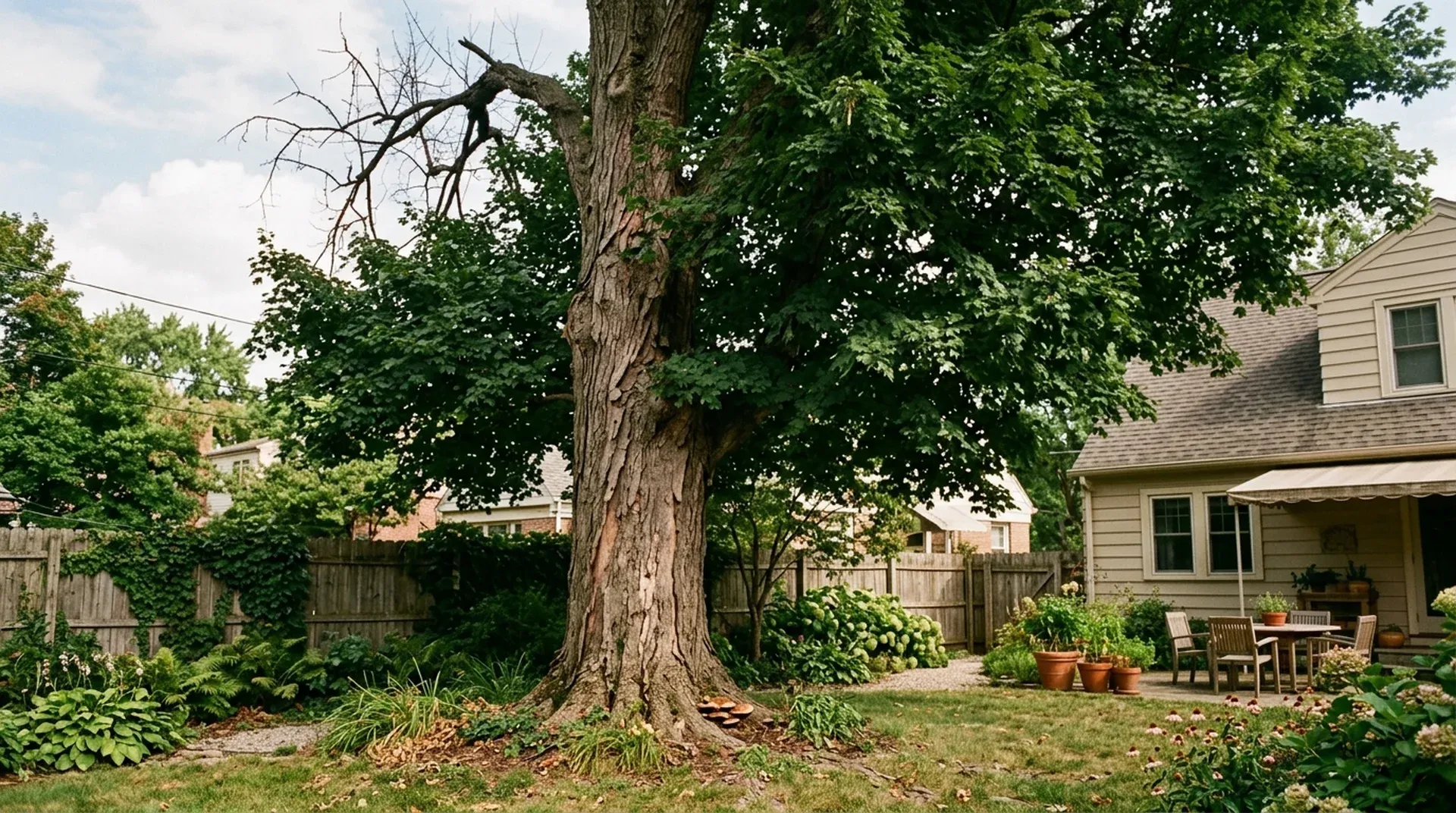
A tree is likely dying if the tissue just under the bark is dry, with no green, twigs snap instead of bending, large parts of the canopy stay bare during the growing season, or the trunk has loose bark, deep cracks, cavities or mushrooms at the base. One symptom on its own isn't proof, and a single dead branch doesn't mean the whole tree is dying. If several signs show up together, or the tree could hit your house, have an ISA Certified Arborist take a look.
Here's how to check a tree yourself, which changes are normal, and what to do if the news is bad.
Quick checks you can do yourself
These take a few minutes and need nothing more than a fingernail or pocketknife.
- The scratch test. Scrape a small patch of thin bark off a twig or small branch. TreePeople says to look for a layer of green tissue, the cambium, just beneath the bark.
- Green and moist means that part is alive.
- No green, moist tissue means that part is likely dead, according to the Texas A&M Forest Service.
- It can work in winter too. Penn State Extension notes that many hardwoods, including oak, maple and apple, keep green tissue under the thin bark of young twigs through winter.
- The bend test. Gently flex a small twig. Illinois Extension explains that dead wood is dry and brittle and doesn't bend like live wood. A twig that snaps cleanly is likely dead.
- Check the buds. Look at the buds at the branch tips. TreePeople says a dead tree's buds will be dried out or gone entirely.
Test several branches on different sides of the tree, plus spots lower down, before you draw conclusions.
Warning signs in the canopy
The crown is often where decline shows first. Illinois Extension lists these as signs of a stressed tree:
- Dieback of branch tips and limbs.
- Thinner foliage each spring, so you can see more sky through the crown every year.
- Stunted leaves that are smaller than normal.
- Dropping limbs.
The International Society of Arboriculture's (ISA) Recognizing Tree Risk checklist adds leaves that turn an unusual yellow or look smaller, large dead branches, and detached branches hanging in the tree. Trees with dead branches are easy to spot in spring and summer, because those branches have dead leaves or none at all, according to University of Kentucky Extension.
Warning signs on the trunk and roots
|
Sign |
What it can mean |
How urgent |
|---|---|---|
|
Deep cracks or splits into the wood |
The trunk or limb may be starting to fail |
Act right away (Kentucky Extension, Illinois Extension) |
|
Canker covering more than half the trunk's circumference |
Sunken or dead bark from disease or injury |
Act right away (Illinois Extension) |
|
Soft, crumbly wood or cavities |
Internal decay (Kentucky Extension) |
Have an arborist evaluate |
|
Mushrooms or other fungi at the base or on the trunk |
Possible decay inside the trunk or roots (ISA) |
Have an arborist evaluate |
|
Sawdust or crumbling wood at the base |
Damage or decay inside the tree (Kentucky Extension) |
Have an arborist evaluate |
|
Loose or falling bark |
A warning sign of a hazard tree (Kentucky Extension) |
Have an arborist evaluate |
|
New lean, or cracked or heaving soil at the base |
Roots may be moving or failing (ISA) |
Call an arborist promptly, especially if it leans toward your house |
Kentucky Extension notes that small amounts of decay don't automatically make a tree hazardous, but large amounts of rotten wood shouldn't be ignored. TreePeople adds that a dying tree may struggle to grow new bark or lose its bark entirely.
Look at what's changed around the tree
The ISA checklist asks whether the area was recently changed by construction, grading or new lawn or pavement. Kentucky Extension warns that building a road directly under a tree's canopy can compact the soil and remove roots, and there's a good chance the tree will eventually die or be badly damaged. Illinois Extension adds that girdling roots and a buried root collar (where the trunk flares out at the soil line) are serious problems, and that a thin section of canopy can often be traced back to root trouble.
Changes that look bad but are often normal
Before you panic, rule these out:
- Fall needle drop. Many evergreens shed their oldest, inner needles each fall. Illinois Extension says this happens evenly from top to bottom and is most noticeable on eastern white pine. Larch and bald cypress drop all their needles every fall, which is normal for them.
What isn't normal: dying branch tips, whole dead branches or uneven browning. Those deserve a closer look.
- Winter dormancy. Bare branches in winter don't mean much on their own. Use the scratch and bud tests instead.
- Species quirks. Illinois Extension notes that some trees naturally have pale foliage, and some are poor self-pruners that hold onto dead twigs. Learn what's normal for your species.
Pests and diseases to watch for in your area
Many declines have a specific cause that's common in your region. One of the biggest is the emerald ash borer, which USDA APHIS says has been detected in 38 states plus Washington, D.C. Signs on ash trees include dead branches near the top, D-shaped exit holes in the bark, vertical bark cracks, unusual branching on the trunk and extra woodpecker activity.
Oak wilt is another. The Texas A&M Forest Service and University of Minnesota Extension both warn about it, and its high-risk season differs by region. Your county extension office can often help identify the cause from photos or a sample, which tells you whether the tree can be treated or should come out.
What to do if your tree is dying
Not every dying tree is an emergency. Kentucky Extension points out that a tree is only a hazard if it could hit something: your house, a car, a fence or a place where people spend time. A dying tree at the back of a large lot is a much lower priority than one leaning over the driveway.
When a tree could hit something, Kentucky Extension notes that heavy winds snap off brittle dead branches, and it advises acting as soon as possible on a suspected hazard tree. The ISA lists the options an arborist may recommend:
- Prune out dead or defective branches.
- Cable and brace weak limbs, though the ISA notes these supports don't guarantee against failure.
- Improve routine care, such as watering, mulching and pruning.
- Remove the tree if the risk is unacceptable, and plant a better-suited replacement.
There's a money reason not to wait, too. The Insurance Information Institute (Triple-I) says poor maintenance isn't covered by homeowners insurance. If removal is likely, see what tree removal costs and what stump grinding adds so you can budget for both.
Power lines: If a dying tree or its branches are near overhead lines, don't touch it. The ISA says never to remove any part of a tree from or near power lines and to call your electric provider if tree parts are touching lines. For anything the utility won't handle, hire a line-clearance-qualified arborist.
Can a dying tree be saved?
Sometimes. If the scratch test still finds green tissue on the trunk or main limbs, part of the tree is alive. TreePeople suggests having a certified arborist judge whether it can be nursed back.
But once drought stress and insects have set a decline in motion, Oregon State University Extension says the process is very difficult, or even impossible, to reverse. OSU notes that killing the insects won't save the tree unless the moisture problem is fixed.
To give a stressed tree its best chance:
- Water deeply in dry spells. In dry-summer climates like Oregon's, OSU says trees need the equivalent of about 1 inch of rain a week from June through September. Water slowly so the soil soaks through, then let it dry between waterings. Follow any local watering rules.
- Mulch the root zone to hold in moisture and cut competition from other plants (OSU).
- Protect the roots. Kentucky Extension advises keeping soil disturbance to a minimum and fencing trees off during nearby construction.
- Prune out dead branches. Kentucky says this can keep decay from spreading to the rest of the tree. The ISA advises removing no more than 25% of the crown at once; see when to prune trees.
When to call a pro
The ISA says judging how serious a defect is should be done by a professional arborist. Call one if you see more than one warning sign, if the tree is big enough to reach your house, or if you aren't sure what you're looking at. Tree risk assessment is one of the services arborists provide, according to the ISA, and it can tell you whether pruning, cabling or removal makes sense.
When you hire:
- Look for an ISA Certified Arborist and confirm the credential on TreesAreGood.org.
- Get 2 to 3 written opinions and quotes for big decisions like removal.
- Ask for proof of insurance, check licensing where your state or city requires it, and ask for photos or references from similar jobs.
- Get the scope and payment schedule in writing.
If the tree just needs dead wood cleaned out, compare tree trimming costs. To find help nearby, search tree care pros in your area. LandscapeLookup is free with no sign-up, and you contact pros directly.
Editorial team
The LandscapeLookup editorial team writes guides to help US homeowners plan yard projects and hire the right pro. Each guide is based on university extension services, government sources such as EPA WaterSense and USDA, manufacturer instructions and published cost guides, and links to them so you can check the details.
Keep reading
How to Plant a Tree (and When)
Plant in fall after leaf drop or in early spring before bud break. Dig a hole 2 to 3 times wider than the root ball but no deeper, set the root flare at or just above grade, backfill with the soil you dug out, water well and mulch 2 to 3 inches deep without touching the trunk.
October 30, 2026
What a Certified Arborist Does and When to Hire One
An ISA Certified Arborist has at least 3 years of tree care experience, passed a 200-question exam and keeps up with continuing education. Hire one for large-tree pruning, risk checks, removal decisions and sick trees.
October 26, 2026
When to Prune Trees
Prune most trees in late winter to early spring, while they're dormant and before new growth starts. Remove dead or broken branches any time. Prune spring-flowering trees right after bloom, and avoid pruning oaks during your area's oak wilt season.
September 9, 2026