Weed and Feed: Does It Work and When to Apply It
Weed and feed can kill broadleaf weeds like dandelions and clover while it fertilizes, but only on damp, actively growing weeds. For most cool-season lawns, early fall is the best time to apply it.
By LandscapeLookup Editors8 min read
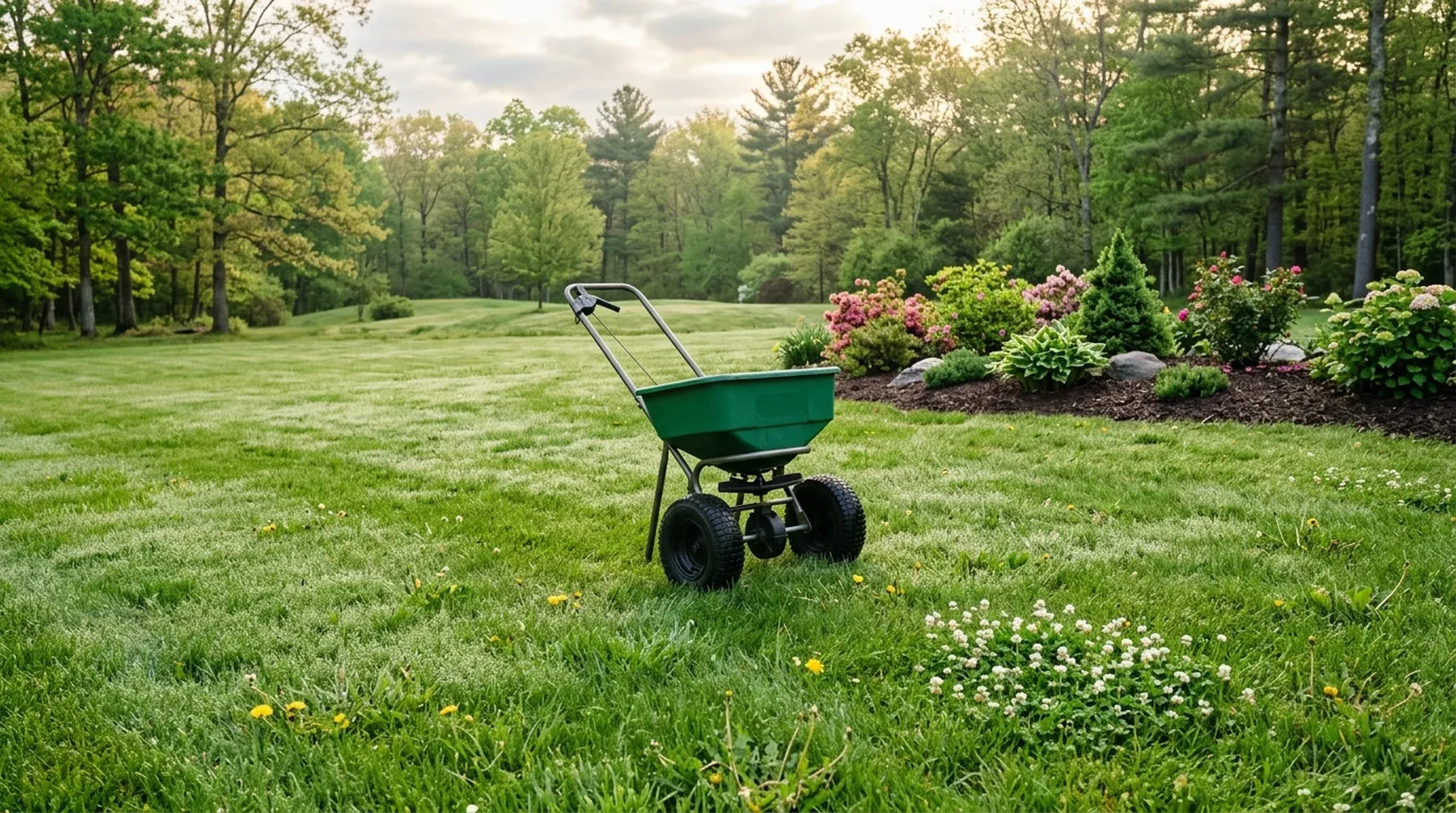
Weed and feed does work on broadleaf weeds like dandelions, clover and plantain, as long as the granules land on damp, actively growing weeds and stay there for a day or so. It won't touch crabgrass or other grassy weeds once they're up, and many extension services prefer separate products because the best time to kill weeds rarely matches the best time to fertilize. If you use it on a cool-season lawn, early fall (mid-September to mid-October) is the best window, with late spring as a backup.
Here's what's in the bag, when to apply it, how to make it work, and what to use instead.
What weed and feed is
Weed and feed is fertilizer and herbicide in one granular product you put down with a spreader. The name covers two very different products, so check which one you're buying.
|
Type |
What the herbicide does |
Typical active ingredients |
Kills existing weeds? |
|---|---|---|---|
|
Broadleaf weed and feed (post-emergent) |
Kills dandelions, clover, plantain and other broadleaf weeds that are already growing |
2,4-D, mecoprop (MCPP), dicamba |
Yes, broadleaf weeds only |
|
Crabgrass preventer plus fertilizer (pre-emergent) |
Stops crabgrass and other annual weed seeds as they sprout |
Varies by brand |
No |
The broadleaf ingredients come from Scotts' label for its Weed & Feed for Texas Lawns (2,4-D, mecoprop-p and dicamba, with 28-0-3 fertilizer). Texas A&M AgriLife notes that atrazine is often an active ingredient in many weed-and-feed products for home lawns.
Grass type matters. That Scotts product is labeled for Bermuda, zoysia, bluegrass, fescue and others, but not Floratam St. Augustinegrass, dichondra, carpetgrass, lippia or creeping bentgrass. Every brand lists its own approved grasses.
Does weed and feed work?
It can, with limits. Iowa State University Extension explains that broadleaf herbicides are absorbed by the weed's foliage, not its roots. The granules have to stick to wet leaves long enough for the weed to take the herbicide in, so dry leaves, a fresh mowing or an early rain can all undo it.
Even done right, a spray usually does better. Purdue University says spray applications are generally more effective than granular weed and feed when applied correctly.
The bigger complaints from extension services are about the combination itself:
- The timing rarely lines up. University of Illinois Extension calls weed and feed a product of convenience that sacrifices the right timing. Crabgrass preventer belongs on the lawn in early spring, while fertilizer works better after the spring growth flush, usually by mid-May in central Illinois. In North Florida, UF/IFAS says pre-emergent goes down in late February or early March, when the lawn is still too dormant to use much fertilizer.
- It treats the whole lawn. UF/IFAS says herbicides should go only on affected areas, not broadcast over the entire yard, and doesn't recommend weed and feed for Florida-Friendly landscapes.
- Trees and shrubs can take it up. Texas A&M AgriLife warns that mature tree roots extend far beyond the drip line, and that young trees can be especially harmed by the broadleaf herbicides in some weed and feed products.
What weed and feed won't kill
Broadleaf weed and feed doesn't control grassy weeds. The University of Minnesota separates lawn weeds into grassy weeds like crabgrass and quackgrass and broadleaf weeds like dandelion and clover, and selective broadleaf herbicides target only the second group. For crabgrass, timing a preventer is the answer (see when to apply pre-emergent). Nutsedge isn't a grass at all: UC IPM says nutsedges are true sedges, and they need their own plan (see how to get rid of nutsedge).
Will weed and feed kill your grass?
Not if it's labeled for your grass and you follow the rate. Trouble starts on the wrong turf, on a new lawn, or where spreader passes overlap. AgriLife says weed and feed products can stress some turfgrasses, especially St. Augustinegrass. The Scotts label says not to use it on new grass until it's well established or after the second or third mowing.
When to apply weed and feed
For broadleaf weed and feed, apply when weeds are young and actively growing. Fall is the strongest window for cool-season lawns.
|
Lawn |
Best window |
Backup window |
Source |
|---|---|---|---|
|
Cool-season (bluegrass, fescue, ryegrass) |
September 15 to October 15 |
Late April to early June |
|
|
Cool-season, Indiana weed and feed |
Mid- to late September |
Through October (for weed control) |
|
|
Warm-season (Bermuda, zoysia, labeled St. Augustine) |
Spring after the grass greens up, or early fall |
Avoid temperatures consistently above 90°F |
Why fall beats spring
In fall, perennial weeds are moving food from their leaves down to their roots for winter, and the herbicide travels down with it. Iowa State says this is why spring applications are generally less effective than fall applications. Purdue adds that October and November treatments tend to kill the entire weed rather than burning off the top, which means fewer dandelions the next spring. For many northern lawns, that makes September the best month.
Fall also fits the fertilizer half. Cool-season grass gets most of its feeding in fall anyway (see when to fertilize your lawn).
Crabgrass preventer plus fertilizer
This type has a much narrower window. Illinois Extension says crabgrass sprouts once soil stays above 55°F to 60°F for 7 to 10 days, and the preventer should go down a week or two before that. Once crabgrass is visible, it's too late for a preventer.
How to apply weed and feed so it works
- Read the label and measure your lawn. Check that your grass is listed and buy enough for your square footage (the Scotts Texas bag covers 8,000 sq ft).
- Don't mow right before. Weeds need leaf surface to catch the granules. Iowa State says skip mowing for 2 to 3 days before treatment; the Scotts label says to mow at your normal height 1 to 2 days before. Either way, never the same day.
- Apply to damp leaves. Spread in the early morning when there's dew, or water lightly first. Iowa State says the granules must stick to the weeds for the herbicide to work.
- Pick a calm day with no rain coming. Iowa State and Purdue both say no rain in the 24-hour forecast, and Iowa State says not to irrigate for 24 hours. The Scotts label says not to wash it off for 1 to 2 days, then water thoroughly.
- Use the label's spreader setting. Don't overlap passes or bump up the rate.
- Keep it off beds and away from trees. The Scotts label says not to apply it within the dripline of trees, shrubs and other ornamentals, or on flowers, vegetables and groundcovers. AgriLife's Bermudagrass calendar gives the same warning.
- Sweep up strays. Sweep granules off driveways, sidewalks and streets back onto the lawn so they don't wash into storm drains.
- Wait before you mow again. Iowa State says to let 3 or 4 days pass so the weeds can move the herbicide to their roots.
Keep kids and pets off the lawn for as long as your product's label says. The Scotts label keeps them off until the dust has settled.
How often can you apply it?
The Scotts label allows no more than 2 applications a year, about 30 days apart. Other products differ, so follow yours. Planning to seed? Scotts says reseeding can happen 3 weeks after application; see overseeding a lawn for timing.
Better options than weed and feed
If your weeds are scattered rather than everywhere, separate products usually work better and use less herbicide.
- Spot-treat with a liquid broadleaf herbicide. Iowa State says to spot treat rather than spray the whole lawn when only a few areas have weeds, and that the best products mix 2 or 3 herbicides. AgriLife suggests fertilizer without weed control plus a separate spot-treatment herbicide.
- Fertilize on the right schedule for your grass type, not on the herbicide's schedule.
- Use crabgrass preventer without fertilizer in early spring, then feed later, as Illinois Extension advises.
- Mow higher. Illinois suggests a mowing height of 3 to 4 inches to help the lawn compete with crabgrass and many other weeds.
- Pull small weeds by hand. UMN says the best time is after a good rain or thorough watering, and that a few weeds aren't a serious threat to a healthy lawn.
- Test your soil first. UF/IFAS recommends a soil test to learn what, if any, nutrients your lawn needs. See how to test your lawn soil.
Label rules and local restrictions
Weed and feed is both a pesticide and a fertilizer, so rules for both can apply. UMN notes that pesticide labels are legal documents that are enforceable by law.
- Pesticide limits. Some towns and counties restrict lawn pesticides. Montgomery County, Maryland, for example, has a law banning certain pesticides on lawns for cosmetic purposes, which a state appeals court upheld in 2019.
- Fertilizer blackouts. Hillsborough County, Florida, bans fertilizer containing nitrogen or phosphorus from June 1 through September 30. Weed and feed that contains nitrogen falls under rules like that.
- Phosphorus limits. Minnesota restricts phosphorus lawn fertilizer unless a soil test shows a need or you're establishing a new lawn. Some weed and feed products, like the 28-0-3 Scotts formula above, contain no phosphorus (the middle number).
Check with your county extension office, city and HOA before you buy.
When to call a pro
A lawn care company makes sense if weeds cover large areas, trees and beds are woven through the lawn, or you'd rather not handle herbicides. LawnStarter puts weed control at about $50 to $210 depending on lawn size and method, and prices vary by region. For more on what yard services cost, see how much lawn care costs.
Before you hire:
- Get 2 or 3 written quotes that say what product goes down, which weeds it targets, and whether fertilizer is applied separately.
- Ask about their pesticide license. The EPA notes that many states require all commercial applicators to be certified.
- Ask how they protect trees, shrubs and beds near treated turf.
- Ask for photos or references from similar lawns nearby, and check insurance where your state requires it.
- Get the visit schedule, scope and payment terms in writing.
You can find lawn care pros near you on LandscapeLookup for free, with no sign-up. Pros are ranked by their Google rating weighted by review count, plus how local they are and their main service, and you contact them directly.
Editorial team
The LandscapeLookup editorial team writes guides to help US homeowners plan yard projects and hire the right pro. Each guide is based on university extension services, government sources such as EPA WaterSense and USDA, manufacturer instructions and published cost guides, and links to them so you can check the details.
Keep reading
Types of Grass for Lawns, by Region
Lawn grasses are cool-season (Kentucky bluegrass, tall fescue, perennial ryegrass, fine fescue) for the North or warm-season (Bermuda, zoysia, St. Augustine, centipede, bahia, buffalograss) for the South. Pick by region first, then by sun, traffic and water.
October 28, 2026
When to Apply Pre-Emergent for Crabgrass
Apply crabgrass pre-emergent in spring, a week or two before the soil holds about 55°F for several days in a row, then water it in. That ranges from mid-February in the Florida Panhandle to mid-April through early May in places like Nebraska.
October 14, 2026
How to Test Your Lawn Soil (and When to Add Lime)
Mix 10 or more small soil cores from your lawn, send about 2 cups to your state's extension lab, and add lime only if the report says your pH is too low, in spring or fall, at no more than 50 lb per 1,000 sq ft at a time.
October 12, 2026