
How to Test Your Lawn Soil (and When to Add Lime)
Mix 10 or more small soil cores from your lawn, send about 2 cups to your state's extension lab, and add lime only if the report says your pH is too low, in spring or fall, at no more than 50 lb per 1,000 sq ft at a time.
By LandscapeLookup Editors7 min read
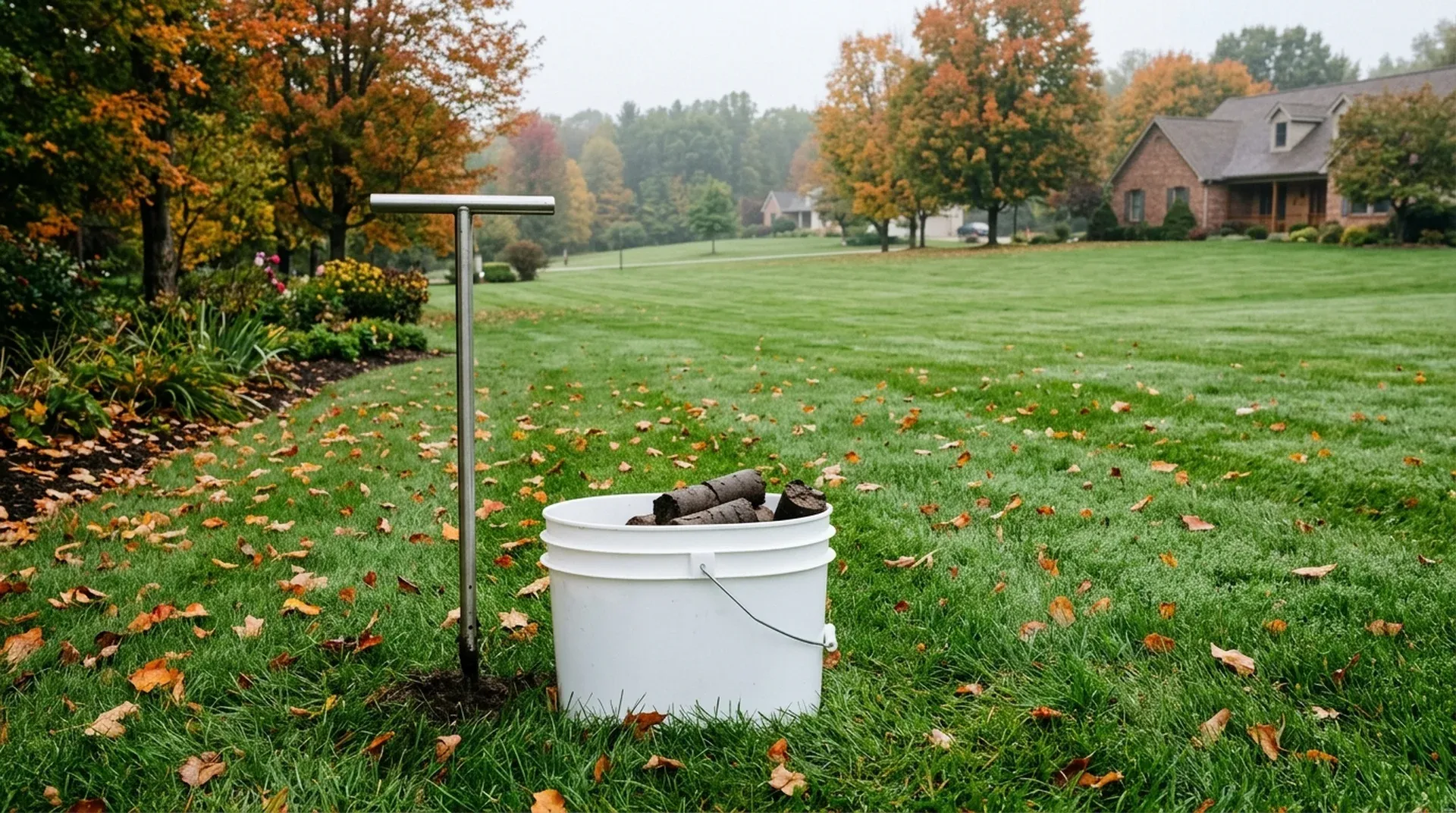
A lawn soil test tells you your soil's pH and how much phosphorus and potassium it holds, so you only buy the lime and fertilizer your grass actually needs. Collect 10 or more small cores across the lawn, mix them in a clean plastic bucket, and send about 2 cups to your state's extension soil lab, which often costs $10 to $50 per sample. Add lime only if the report says your pH is too low, and spread it in spring or fall at no more than 50 pounds per 1,000 sq ft at a time.
What does a lawn soil test tell you?
MU Extension's routine lawn test covers pH, phosphorus, potassium, calcium, magnesium, organic matter and cation exchange capacity. The report then gives you lime and fertilizer amounts per 1,000 sq ft.
Guessing goes wrong both ways. Clemson Extension notes that some soils already contain high levels of phosphorus or calcium and sit at the right pH, so adding lime or phosphorus anyway can throw nutrients out of balance.
A routine test won't give you a nitrogen number: it moves through soil too fast, so labs don't normally test for it. Your nitrogen rate comes from your grass type and season instead (see our guide on when to fertilize your lawn).
When should you test your lawn soil?
You can sample any time the ground isn't frozen. Wisconsin Extension suggests early spring or late fall so the results arrive before you buy lime and fertilizer. Clemson recommends sampling a couple of months before the optimum time for fertilizing so lime has time to react.
How often depends on what you're fixing:
|
Situation |
How often |
Source |
|---|---|---|
|
Established lawn, no problems |
Every 2 to 5 years |
NC Extension (2 to 3), MU (3), Wisconsin (3 to 5) |
|
Before seeding, sodding or sprigging a new lawn |
Once, before you start |
|
|
Correcting pH or a nutrient shortage |
Every year until it's fixed |
|
|
Sandy soil |
Every year |
MU (potassium leaches from sand) |
Clemson recommends sampling every year. Either way, NC Extension says not to sample right after applying fertilizer, lime or compost, and Wisconsin says fertilizer particles in the sample will yield incorrect soil test results.
If you're planning a new lawn, test first. It's the one time you can till lime and phosphorus into the root zone. Our guides to sod cost and hydroseeding cover the rest of that project.
How to take a lawn soil sample
Get the bag or box and form from your county extension office or state lab first, since labs differ on depth and paperwork.
- Split the yard into areas. Wisconsin Extension says to sample the front and back separately if they look different, and keep lawn and garden samples apart. Sample any problem patch on its own.
- Use clean tools. A soil probe or trowel works. Clemson warns that pesticide or fertilizer residues on tools skew results.
- Take 10 or more cores per area. Walk a zigzag pattern and take 12 or more random cores (MU) or at least 10 (Wisconsin).
- Go to your lab's depth. MU asks for 4 inches on established lawns and 6 inches before seeding. NC Extension also says 4 inches, Clemson says 2 to 4, and Wisconsin says 5 to 7. Follow the instructions on your lab's form and keep every core the same depth.
- Strip off grass and thatch from the top of each core.
- Mix in a plastic bucket. MU says metal buckets contaminate the sample with micronutrients.
- Dry and pack about 2 cups. Air dry the soil overnight. MU needs 1.5 to 2 cups and Clemson at least 2.
- Fill out the form, naming your grass type so the recommendations fit your lawn.
Expect results in about 1 to 2 weeks. Clemson's lab reports in 7 to 14 days.
Lab test or home kit: accuracy and cost
Use a lab if you can. Ohio State says the only way to know whether you need lime, and how much, is a test from a state or commercial soil testing laboratory. Store kits and pH probes don't calculate a lime rate.
Kits are also less accurate. Montana State Extension reports that when kits were compared with lab results, the simpler kits differed moderately or even highly. UNH Extension says kits typically aren't as accurate as lab tests and come with no tailored recommendations.
What testing costs, as listed in October 2026:
|
Option |
Price |
Notes |
|---|---|---|
|
Penn State lab standard kit |
Includes pH, lime requirement, P, K, Ca, Mg and recommendations |
|
|
North Carolina (NCDA&CS) |
Free April 1 to November 30, 2026; $5 per sample from December 1 |
For NC properties |
|
Lab fees in general |
Montana State Extension's range |
|
|
Home kits and meters |
Rough pH check only |
Prices vary by state and lab, and some extension offices hand out sample boxes free, as MU Extension centers do.
The vinegar test for alkaline soil
In the West, Colorado State says to moisten a heaping tablespoon of crumbled dry soil with vinegar: if it bubbles, the soil has free lime, which means it's alkaline and you can't practically lower its pH. CSU also warns that home pH kits have questionable value on alkaline soils because most are designed for acid soils.
What pH does your grass need?
On a 0 to 14 scale, 7.0 is neutral. MU says most plant nutrients are available between 6.0 and 7.0, and needs no amendments for turf between 6.0 and 7.5. Some southern grasses prefer it lower.
|
Grass |
Target pH |
Source |
|---|---|---|
|
Ohio home lawn grasses |
6.0 to 7.0 |
|
|
Tall fescue, Bermuda, St. Augustine |
5.5 to 6.5 |
|
|
Zoysia |
6.0 to 7.0 |
|
|
Centipede |
5.0 to 6.0 (UGA); 5.5 to 6.0 (Clemson) |
Region matters. Rain leaches calcium and magnesium out of soil, so high-rainfall areas trend acidic: Clemson says South Carolina soils typically run pH 4.5 to 6.0. In drier Colorado, many soils sit at pH 7.0 to 8.3. Ohio State adds that most lawn fertilizers can make soil more acidic over time.
For phosphorus and potassium, follow the pounds per 1,000 sq ft on the report. MU's tables call for no added phosphorus when the soil tests high, so pick a fertilizer with a 0 as the middle number. Check local rules too: Minnesota, for example, bans phosphorus on lawns unless a soil test shows a need or you're establishing a new lawn.
When and how to apply lime
Apply lime only when the soil test calls for it. MU calculates a lime rate when pH is below 6.0, though centipede lawns prefer lower pH (see the table above). Ohio State strongly discourages yearly liming without a test because it can push soil too alkaline. Above pH 8.0, Ohio State says nutrients like iron and phosphorus become less available, and the lawn can thin out.
When: spring or fall. MU recommends liming established lawns in the cool spring or fall following core aeration, then watering it in. Ohio State says not to lime turf that is wilted or frost-covered. Clemson's guidance for the South allows fall or winter, ideally 2 to 3 months before planting. If you're aerating anyway, pair them: our guide on when to aerate your lawn has the timing by grass type.
How much: whatever the report says, but never more than 50 pounds per 1,000 sq ft at once on an established lawn. MU, Ohio State and Colorado State all set that ceiling, and MU warns that lime can burn grass. If the report calls for more, split it between spring and fall. The exception is a new lawn, where MU says higher rates can be tilled in before seeding. Ohio State's lime table compares the common products:
|
Product |
Speed |
Max per application (lb per 1,000 sq ft) |
Notes |
|---|---|---|---|
|
Ground limestone |
Slow |
50 |
Common lawn choice |
|
Dolomitic limestone |
Slow |
50 |
Also adds magnesium |
|
Pelletized limestone |
Fast |
50 |
Easy to spread, costs more |
|
Hydrated lime |
Fast |
20 |
Hazardous, hard to apply |
|
Burned lime |
Fast |
10 |
Hazardous, hard to apply |
Source: Ohio State Extension. Pelletized lime is less likely to clog spreaders, Clemson notes. MU says hydrated lime has a high burn potential on lawns, so skip it. Gypsum isn't on the list because Ohio State says it barely changes pH.
How long: be patient. Ohio State says it may be several months before the soil pH changes. Clay soils need more lime than sandy ones to move the same amount. Retest the next year.
Lowering pH with sulfur
If your pH is above 7.5, MU suggests elemental sulfur at the report's rate, ideally before you plant, and no more than 10 pounds per 1,000 sq ft on established lawns to avoid leaf burn. Clemson says sulfur can take several months to lower pH. In soils that fizz in the vinegar test, Colorado State says sulfur is not effective, so choose grasses that tolerate alkaline soil instead. Read the label on any lime, sulfur or fertilizer product and follow it.
When to call a pro
Soil sampling is an easy DIY job, but a lawn care company can help if your yard is large, you want the report interpreted, or you're planning a renovation. For yearly service prices, see how much lawn care costs.
Before you hire:
- Get 2 or 3 written quotes for the same scope: how many samples, which lab, and what's applied afterward.
- Ask to see the lab report itself, not just a treatment plan.
- Ask for photos or references from similar lawns nearby.
- Check licensing and insurance where your state requires it for fertilizer or pesticide application.
- Get the scope, dates and payment schedule in writing.
You can find lawn care pros near you on LandscapeLookup for free, with no sign-up. Pros are ranked by Google rating weighted by review count, plus how local they are and their main service, and you contact them directly.
Editorial team
The LandscapeLookup editorial team writes guides to help US homeowners plan yard projects and hire the right pro. Each guide is based on university extension services, government sources such as EPA WaterSense and USDA, manufacturer instructions and published cost guides, and links to them so you can check the details.
Keep reading

Types of Grass for Lawns, by Region
Lawn grasses are cool-season (Kentucky bluegrass, tall fescue, perennial ryegrass, fine fescue) for the North or warm-season (Bermuda, zoysia, St. Augustine, centipede, bahia, buffalograss) for the South. Pick by region first, then by sun, traffic and water.
October 28, 2026
When to Apply Pre-Emergent for Crabgrass
Apply crabgrass pre-emergent in spring, a week or two before the soil holds about 55°F for several days in a row, then water it in. That ranges from mid-February in the Florida Panhandle to mid-April through early May in places like Nebraska.
October 14, 2026
Topdressing and Leveling a Lawn
Topdressing means spreading a thin layer of compost, topsoil or sand, no more than 1/2 inch at a time, over a growing lawn to improve the soil or fill shallow low spots. Match the material to your soil and keep the grass blades showing.
October 10, 2026