
Dethatching: Does Your Lawn Need It?
Thatch over about 1/2 inch needs managing, and core aeration often handles it. Several extension services save mechanical dethatching for about 1 inch or more: do it in early fall or spring for cool-season grass and late spring to midsummer for warm-season grass.
By LandscapeLookup Editors7 min read
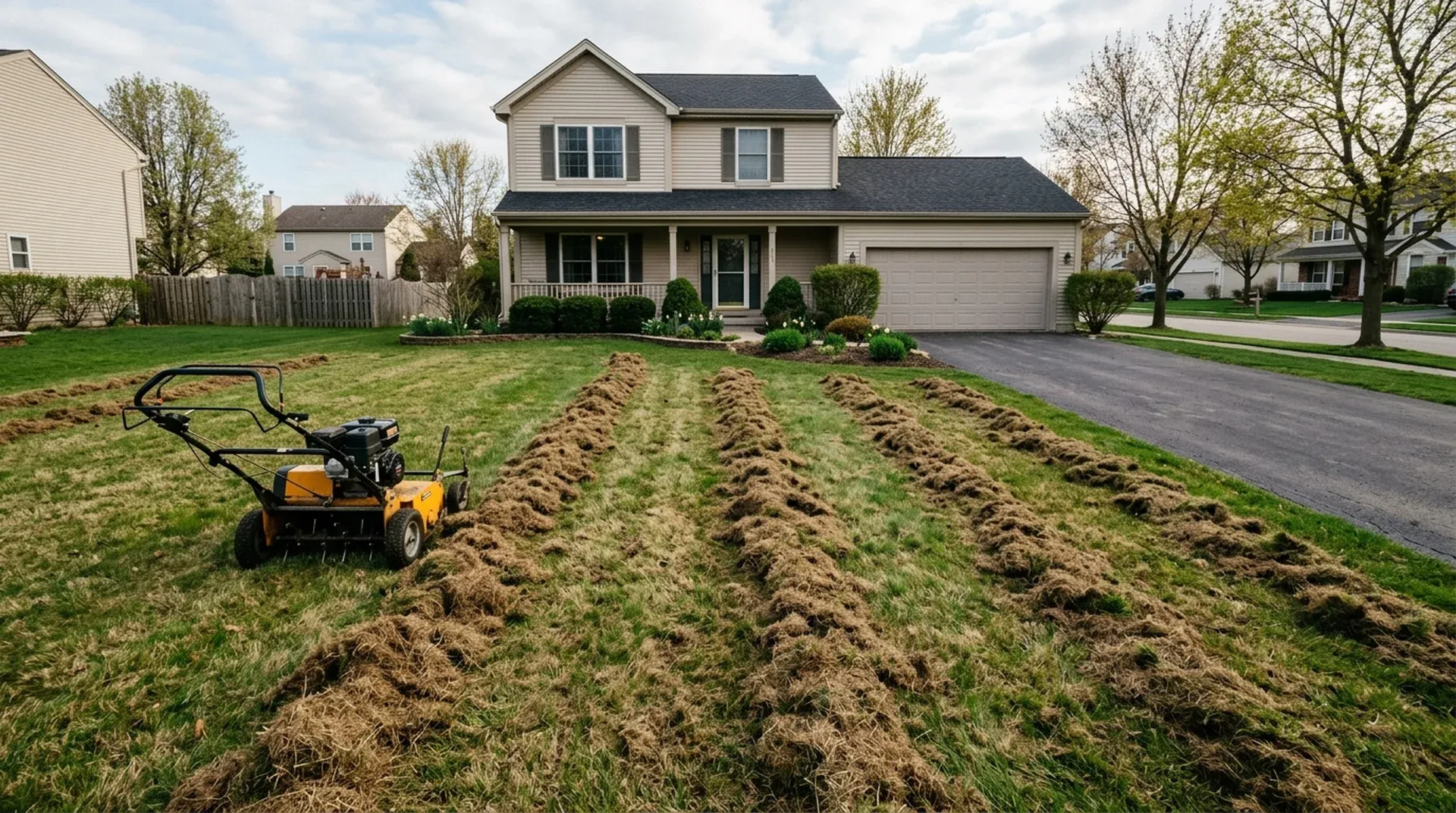
Thatch (the spongy brown mat between the soil and the green grass) over about 1/2 inch needs managing, and core aeration often handles it. Several extension services save mechanical dethatching for about 1 inch or more. If you do need it, dethatch cool-season grass in early fall or spring and warm-season grass in late spring to midsummer, when the lawn is growing fast enough to recover.
Many lawns don't need a power rake at all. If thatch is 1/2 inch or less and you want to thin it, Kansas State University recommends core aeration over power raking. Here's how to check yours and what to do about it.
What thatch is (and what causes it)
Colorado State University Extension defines thatch as the spongy, brown layer of organic matter between the leaf zone and the soil. It's made of stems, runners and roots that build up faster than soil microbes can break them down.
A little is good. UC's Integrated Pest Management program says a layer under 1/2 inch can be beneficial, and the University of Tennessee notes that some thatch improves the lawn's cushion and wear tolerance. Too much, though, keeps water, air and fertilizer from reaching the soil. Tennessee adds that thick thatch limits rooting, shelters insects and disease, and restricts water movement.
Common causes, according to Colorado State:
- Compacted soil, the main factor.
- Too much nitrogen fertilizer.
- Infrequent mowing.
- Vigorously growing grass varieties.
One thing that does not cause it: grass clippings. Colorado State says leaving clippings on the lawn does not contribute to thatch.
Which grasses build thatch
Grasses that spread by runners build thatch faster than clump-forming grasses. UC IPM names Bermudagrass, bentgrass and Kentucky bluegrass as fast thatch builders, while tall fescue and perennial ryegrass don't produce much. In the South, Mississippi State University Extension says heavily fertilized Bermuda and zoysia lawns are the most prone, and St. Augustine and centipede can develop problems after several years.
So if you have a tall fescue lawn, thatch is rarely the issue. A heavily fed Bermuda or bluegrass lawn is a different story.
How to check your thatch
You don't need special tools:
- With a shovel or knife, cut small, pie-shaped wedges of turf, a couple of inches deep, from different parts of the lawn.
- Look at the side of each wedge. The thatch is the tan, spongy layer between the green blades and the soil.
- Measure it with a ruler.
The University of Tennessee recommends this wedge method, taking several samples. Thatch is often thicker in some areas than others, so don't judge the whole lawn by one wedge.
How much thatch is too much
Sources draw the line in slightly different places:
|
Thatch depth |
What extension services suggest |
|---|---|
|
Under 1/2 inch |
Normal. No special treatment beyond routine aeration. |
|
About 1/2 inch |
Time to reduce it (Colorado State). Tennessee says mechanical dethatching is often recommended from 1/2 inch; K-State prefers core aeration at 1/2 inch or less. |
|
1 inch or more |
Dethatch (Penn State, Mississippi State) |
In short: at around 1/2 inch, start managing it, usually with core aeration. At 1 inch, it's due for mechanical removal.
How often? Not on a schedule. Penn State says it's not necessary to dethatch every year. Do it only when buildup gets excessive, so measure first each year.
The overseeding exception
K-State's advice changes when you're about to overseed, because seed needs to reach soil. For a lawn you're not seeding, it recommends core aeration over power raking at 1/2 inch or less. Before overseeding, though, it wants thatch at 1/4 inch or less:
- 1/4 to 3/4 inch: power rake to thin it before you seed.
- 3/4 inch or more: it's usually easiest to strip the lawn with a sod cutter and start over.
When to dethatch by grass type
Dethatching tears up the lawn, so do it when the grass can grow back quickly. Mississippi State says it should only be done when the turf is actively growing.
|
Grass type |
Best time |
Avoid |
|---|---|---|
|
Cool-season (Kentucky bluegrass, fescues, ryegrass) |
Early fall or spring |
Summer heat, drought, late fall |
|
Warm-season (Bermuda, zoysia, St. Augustine, centipede) |
Late spring to midsummer, after green-up |
Fall, as dormancy nears |
Tennessee says cool-season grasses recover quickly after spring or early fall dethatching, and that warm-season grasses can be done after green-up, when warming soil drives new growth. (Tennessee also allows late winter while warm-season grass is dormant, but Mississippi State prefers late spring through midsummer.) Penn State warns against dethatching in high heat, drought or late fall, when winter drying can damage the lawn.
If it's already mid-fall, think about how much growing weather you have left. A lawn that's still actively growing has time to recover. If cold weather is close, wait for spring or next September.
Dethatching vs. aeration
These two jobs overlap. Core aeration pulls plugs of soil and drops them on the surface, where soil microbes help break thatch down. K-State says aeration helps control thatch, and Colorado State recommends leaving the cores on lawns with more than 1/2 inch of thatch so they work back in.
Mechanical dethatching (also called power raking or vertical mowing) is faster but rougher. K-State calls vertical mowing the most destructive method, sometimes requiring reseeding, though it notes it works well on warm-season grasses.
A sensible order: if thatch is around 1/2 inch, aerate once or twice a year, as K-State suggests. If it's an inch or more, dethatch, then follow up with aeration. See when to aerate your lawn for timing.
How to dethatch
Can you dethatch with a rake? On a small area, yes. But Tennessee says hand raking is seldom effective when a lot of thatch has to come out. For anything bigger, rent a power rake or vertical mower (some are sold as scarifiers).
Based on UC IPM and Tennessee:
- Mow lower than usual and lightly moisten the soil. Don't work soggy ground. Flag sprinkler heads and any shallow lines, as you would before aerating, so the blades don't hit them.
- Set the blade depth for your grass. UC IPM says depth should depend on thatch thickness and your turf species. Creeping grasses like Bermuda build heavier thatch, so it suggests blades that cut about 1 inch into the soil and 1 inch apart. For clump-forming grasses, set them higher and wider. Tennessee's general rule is shallower: blades should go through the thatch and lightly touch the soil below.
- Make two passes, the second at a right angle to the first.
- Rake up and remove the debris. Tennessee notes a blower or lawn vacuum also works for the loosened material.
- Follow up. UC IPM recommends aerating, fertilizing and watering as needed, and overseeding thin spots. Dethatching is a good setup for overseeding a lawn, since seed lands on bare soil instead of thatch.
Common dethatching mistakes
- Dethatching when aeration would do. At 1/2 inch or less, K-State prefers core aeration.
- Cutting deeper than your grass type calls for. Save the 1-inch setting for heavy thatch on creeping grasses; on fescue or ryegrass, set the blades shallower.
Keep it from coming back
Tennessee's prevention list includes a soil test to see if lime is needed, measured nitrogen use, better drainage, earthworm-friendly pesticide choices, aeration and topdressing. UC IPM adds deep, infrequent watering and avoiding excess nitrogen. For fertilizer timing and rates, see when to fertilize your lawn.
What dethatching costs
Lawn Love and LawnStarter put professional dethatching at about $65 to $165; HomeAdvisor's range is higher. All three publishers connect homeowners with lawn pros.
|
Source |
Typical job |
|---|---|
|
$65–$160 |
|
|
$65–$165 |
|
|
$160–$225 |
Most crews charge a flat rate or by the hour. Lawn Love says hourly rates run about $50 to $85 per worker. A 1- or 2-person crew can usually finish a 1/4-acre yard in an hour or less. Prices vary by region and lawn size.
If you DIY, Lawn Love puts tools at about $40 to $150, from a manual thatch rake at the low end to a powered dethatcher at the high end. For other yard services, see how much lawn care costs.
When to call a pro
Dethatching a large lawn is heavy, slow work, and K-State notes that vertical mowing can tear up a lawn badly enough to need reseeding. A pro makes sense if your thatch is over an inch, your lawn is big or sloped, or you want dethatching, aeration and overseeding done as one job.
Before you hire:
- Get 2 or 3 written quotes that say whether the price covers debris removal and disposal, plus any aeration or seeding.
- Ask them to measure your thatch first. A good company will tell you if aeration alone will do.
- Ask for photos of similar lawns they've treated.
- Check licensing and insurance where your state requires it.
- Get the scope, date and payment terms in writing.
You can find lawn care pros near you on LandscapeLookup for free, with no sign-up, and contact them directly.
Editorial team
The LandscapeLookup editorial team writes guides to help US homeowners plan yard projects and hire the right pro. Each guide is based on university extension services, government sources such as EPA WaterSense and USDA, manufacturer instructions and published cost guides, and links to them so you can check the details.
Keep reading

Types of Grass for Lawns, by Region
Lawn grasses are cool-season (Kentucky bluegrass, tall fescue, perennial ryegrass, fine fescue) for the North or warm-season (Bermuda, zoysia, St. Augustine, centipede, bahia, buffalograss) for the South. Pick by region first, then by sun, traffic and water.
October 28, 2026
When to Apply Pre-Emergent for Crabgrass
Apply crabgrass pre-emergent in spring, a week or two before the soil holds about 55°F for several days in a row, then water it in. That ranges from mid-February in the Florida Panhandle to mid-April through early May in places like Nebraska.
October 14, 2026
How to Test Your Lawn Soil (and When to Add Lime)
Mix 10 or more small soil cores from your lawn, send about 2 cups to your state's extension lab, and add lime only if the report says your pH is too low, in spring or fall, at no more than 50 lb per 1,000 sq ft at a time.
October 12, 2026