Overseeding a Lawn: When and How to Do It
Overseed cool-season lawns in late summer to early fall (mid-August to late September in much of the North) at about half the new-lawn seed rate, after aerating or slit seeding, and keep the top inch of soil moist until the grass is up.
By LandscapeLookup Editors7 min read
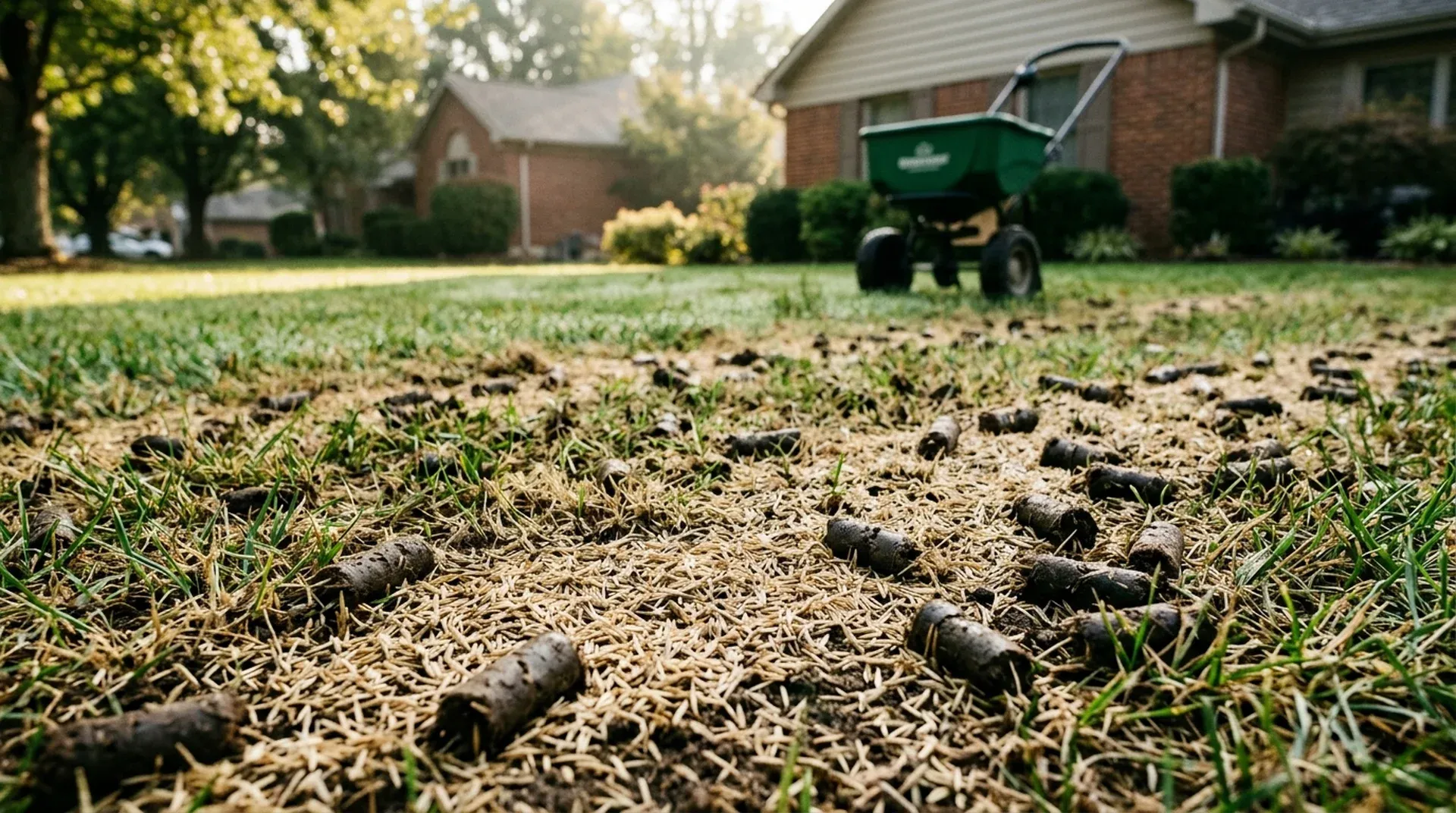
For cool-season lawns (Kentucky bluegrass, tall fescue, perennial ryegrass and fine fescue), the best time to overseed is late summer to early fall, roughly mid-August through September in much of the northern US. Spread about half the seed you'd use on bare soil, get it in contact with the soil by aerating or slit seeding first, and keep the top inch moist until the new grass is up.
Warm-season lawns play by different rules. Some get overseeded with ryegrass for winter color, and some, like St. Augustine, can't really be overseeded at all. Here's how to time and do it for your lawn.
When to overseed by grass type
Purdue and the University of Illinois call late summer to early fall the best time to seed a cool-season lawn, thanks to warm soil, adequate moisture and limited weed pressure. They add that it's critical to seed early in the window. Waiting one week can add 2 to 4 weeks before the new grass matures.
|
Region / grass |
Best window |
Notes |
|---|---|---|
|
Northern Indiana and Illinois (cool-season) |
Aug 15 – Sept 15 |
Seed early in the window |
|
Southern Indiana and Illinois (cool-season) |
Sept 1 – Sept 30 |
Seed early in the window |
|
Eastern Nebraska (cool-season) |
Aug 15 – Sept 15 |
Western NE: Aug 15 – Sept 5 |
|
Kansas (tall fescue) |
September |
For lawns thinned over summer |
|
Desert Southwest (Bermuda overseeded with ryegrass) |
October |
When highs are about 80–85°F |
Sources: Purdue, Nebraska, K-State, Arizona.
Nebraska Extension suggests seeding cool-season grass when air temperatures are around 60 to 75°F, noting seed is less likely to do well above 80°F. Arizona's warmer October target in the table is a different case: ryegrass sown into Bermuda in the low desert. The farther north you are, the earlier your window closes. Your county extension office can give you local dates.
Spring and dormant seeding
Spring is a backup, not a plan. Purdue says spring seeding is difficult and often unsuccessful. It also says to avoid summer seeding, because young grass can't handle heat, drought and summer weeds.
Instead of spring seeding, Purdue suggests "dormant seeding." You spread seed before the ground thaws (as early as Thanksgiving and as late as March in Indiana and Illinois), and it sprouts when the soil warms in April or May. Purdue says this works better in the northern half of those states, where the weather stays cold enough to delay germination until spring.
Warm-season lawns
Warm-season grasses like Bermuda, zoysia, St. Augustine and centipede go dormant in fall, so a fall overseeding works differently. Two cases come up:
- Winter color on Bermuda. In warm climates you can overseed dormant Bermuda with perennial ryegrass so the lawn stays green over winter. University of Arizona Extension recommends October, when daytime highs are about 80 to 85°F and nights about 55°F, at 12 to 15 lb of ryegrass per 1,000 sq ft. The ryegrass stays green from October through May, then has to be pushed out so the Bermuda can recover.
- St. Augustine and zoysia. Arizona lists both as not suited to overseeding, and St. Augustine usually isn't sold as seed. To fix bare spots, UF/IFAS recommends plugs (2- to 4-inch pieces of sod planted 6 to 12 inches apart) or sod.
How much seed to use
Overseeding an existing lawn takes about half the rate for a new lawn. K-State recommends about half the new-lawn rate, and about half that again in shady areas, warning that heavy seeding raises disease and stress risk.
|
Seed |
New lawn rate (lb per 1,000 sq ft) |
Overseeding rate (about half) |
|---|---|---|
|
100% Kentucky bluegrass |
1.5–2 |
about 1 |
|
85–90% bluegrass + 10–15% perennial ryegrass |
3–4 |
1.5–2 |
|
50–70% bluegrass + 30–50% fine fescue |
4–5 |
2–2.5 |
|
100% tall fescue |
6–9 |
3–4.5 |
New-lawn rates are from Purdue's seeding table. Nebraska's overseeding rates run higher for bluegrass and match for tall fescue: about 2 lb of Kentucky bluegrass or 3 to 4 lb of tall fescue per 1,000 sq ft.
Match the new seed to what's already growing so the lawn looks even. Read the label: Nebraska Extension warns against bags with "Variety Not Stated" (VNS) or annual ryegrass, which can cause problems later.
How to overseed, step by step
Seed that sits on top of thatch dries out before it roots. The whole job is about getting seed onto bare soil.
- Mow short and bag the clippings. K-State recommends cutting to about 1 to 1.5 inches so seed reaches the soil and seedlings get light. K-State also wants thatch at 1/4 inch or less before overseeding. If yours is thicker, see our guide to dethatching a lawn.
- Open up the soil. K-State lists three methods: a slit seeder that drops seed into furrows (its preferred option), verticutting twice in different directions, or 3 to 4 passes with a core aerator. Penn State goes further, suggesting 6 to 8 aerator passes before overseeding. You can seed right after aerating. For timing details, see when to aerate your lawn.
- Spread in two directions. Purdue suggests setting the spreader low and sowing half the seed in one direction and half at right angles. It recommends a drop spreader, since rotary spreaders don't spread seed evenly.
- Feed the seedlings. K-State suggests a starter fertilizer at the bag rate or per a soil test. (Follow-up feedings come later; see below.) Starter fertilizers are high in phosphorus, so check local rules: Minnesota, for example, restricts phosphorus on lawns but exempts lawns being established by seed or sod. Our guide to when to fertilize your lawn covers fertilizer timing in more detail.
- Rake lightly and water. A light raking helps seed settle into the holes or slits. Water right away.
Skip the crabgrass preventer
Most pre-emergent herbicides stop grass seed as well as crabgrass. Purdue says siduron is the only pre-emergent you can use at seeding, and to delay others until the new grass has been mowed 4 to 8 times, depending on the product. Purdue also says to hold off on broadleaf weed killers until the seedlings have been mowed at least 3 times. Always follow the label.
Watering new seed
Purdue says a newly seeded lawn needs water 2 to 4 times a day depending on the weather, enough to keep the top 0.5 to 1 inch moist without puddling. Nebraska Extension warns that too much water raises disease risk and can cost you seed.
Expect to wait. Nebraska says Kentucky bluegrass is slower to sprout than tall fescue, taking 10 to 28 days. Then ease off in two steps, per Purdue:
- Seedlings about 2 inches tall: gradually water less often and more deeply.
- After 2 or 3 mowings: switch to deep, infrequent watering.
Check your city's or water utility's watering rules before you start. If your area limits which days you can run sprinklers, plan how you'll keep seed moist (hand watering, for example) before you spread it.
Mowing and fertilizing the new grass
Start mowing earlier than you'd think. Purdue says most people wait too long, and gives one rule that ties it together:
|
Grass |
First mowing height |
Mow when seedlings reach about |
Height after 3 or 4 mowings |
|---|---|---|---|
|
Kentucky bluegrass, perennial ryegrass, fine fescue |
1.5 inches |
2.25 inches |
2 to 3.5 inches |
|
Tall fescue |
2 inches |
3 inches |
2.5 to 4 inches |
The middle column applies Purdue's 1/3 rule to the first mowing height. K-State's advice to begin mowing when seedlings are 3 to 4 inches tall lines up with it for tall fescue. For bluegrass and other fine grasses, Purdue's earlier mark keeps you within the 1/3 rule. Either way, don't let new grass get far past that mark, and keep foot and pet traffic off the area while it's tender.
For fertilizer, the starter feeding at seeding is the first step. Purdue then recommends 0.75 to 1 lb of nitrogen per 1,000 sq ft at 4 to 6 weeks after germination and again at 8 to 10 weeks. Purdue's example: for a mid-August seeding, that's mid- to late September and mid- to late October. Seed later and both feedings shift later.
Some states recommend smaller single feedings. Virginia Tech says never to apply more than 0.7 lb of water-soluble (quick-release) nitrogen at one time, so follow your state's guidance if it's lower.
What overseeding costs
LawnStarter puts professional aeration plus overseeding at about $0.07 to $0.23 per square foot, so a 5,000 sq ft lawn would run roughly $350 to $1,150 at those rates. Seed is the main material cost and varies by type: LawnStarter lists tall fescue at $2 to $6 a pound and Kentucky bluegrass at $7 to $15 a pound. Prices vary by region and lawn condition, so compare local quotes.
When to call a pro
Overseeding is a reasonable DIY job on a small lawn. Hire help if your lawn is large, thin across most of the yard, full of thatch, or if you'd need to rent both an aerator and a slit seeder. A pro also makes sense if you're not sure what grass you have and want seed that matches.
Before you hire:
- Get 2 or 3 written quotes that list the seed type and rate, the method (core aeration, slit seeding or both), and whether starter fertilizer is included.
- Ask for photos of lawns they've overseeded and how they turned out a season later.
- Check licensing and insurance where your state requires it.
- Get the scope, schedule and payment terms in writing, including who handles watering instructions and any follow-up visits.
You can find lawn care pros near you on LandscapeLookup for free, with no sign-up, and contact them directly.
Editorial team
The LandscapeLookup editorial team writes guides to help US homeowners plan yard projects and hire the right pro. Each guide is based on university extension services, government sources such as EPA WaterSense and USDA, manufacturer instructions and published cost guides, and links to them so you can check the details.
Keep reading
Types of Grass for Lawns, by Region
Lawn grasses are cool-season (Kentucky bluegrass, tall fescue, perennial ryegrass, fine fescue) for the North or warm-season (Bermuda, zoysia, St. Augustine, centipede, bahia, buffalograss) for the South. Pick by region first, then by sun, traffic and water.
October 28, 2026
When to Apply Pre-Emergent for Crabgrass
Apply crabgrass pre-emergent in spring, a week or two before the soil holds about 55°F for several days in a row, then water it in. That ranges from mid-February in the Florida Panhandle to mid-April through early May in places like Nebraska.
October 14, 2026
How to Test Your Lawn Soil (and When to Add Lime)
Mix 10 or more small soil cores from your lawn, send about 2 cups to your state's extension lab, and add lime only if the report says your pH is too low, in spring or fall, at no more than 50 lb per 1,000 sq ft at a time.
October 12, 2026