When to Aerate Your Lawn
Aerate cool-season grass (bluegrass, fescue, ryegrass) in early fall or spring, and warm-season grass (Bermuda, zoysia, St. Augustine) from late spring through midsummer, while it's actively growing and has at least 4 weeks to recover.
By LandscapeLookup Editors6 min read
The best time to aerate is when your grass is growing hard and has at least 4 weeks of good weather left to fill in the holes. For cool-season grasses like Kentucky bluegrass, tall fescue and ryegrass, that's early fall (roughly late August through September) or spring. For warm-season grasses like Bermuda, zoysia and St. Augustine, it's late spring through midsummer.
Get the timing wrong and you open up the soil right when the lawn can't recover, or right when weeds are ready to move in. Here's how to time it for your grass and region.
Best time to aerate by grass type
Extension services agree on one rule: aerate during active growth, never when the lawn is dormant or stressed by heat or drought. What that means on the calendar depends on your grass.
|
Grass type |
Examples |
Best time to aerate |
Notes |
|---|---|---|---|
|
Cool-season |
Kentucky bluegrass, tall fescue, perennial ryegrass, fine fescue |
Late August through September |
March–April also works |
|
Warm-season |
Bermudagrass, zoysiagrass, St. Augustinegrass, centipedegrass, buffalograss |
Late May through July |
Wait until the lawn is fully green and growing |
Kansas State University recommends core aerating cool-season lawns in March, April or September, and warm-season lawns from late May through July. Clemson Extension gives the same split for the South: late spring or early summer for Bermuda, centipede, zoysia and St. Augustine, and fall for fescue. Penn State simply says to aerate during cool weather, early to mid-spring or late summer to early fall. That fits cool-season lawns across the northern half of the country.
Why fall usually beats spring for cool-season lawns
Both seasons work, but fall has an edge. Colorado State University Extension suggests aerating between late August and late September because fewer weed seeds germinate in fall. Fall aeration also lines up with overseeding and fall fertilizing, so one set of holes does triple duty.
If you aerate in spring, do it before you put down crabgrass preventer. K-State notes that aeration should be done before fertilizing, seeding or applying crabgrass preventers.
If you're late in the fall window
The test is whether you still have about 4 weeks of growing weather before the ground freezes. Both K-State and Clemson call for that much recovery time.
- Transition zone and upper South: a cool-season lawn may still have that window in mid-fall.
- Upper Midwest and New England: by mid-fall, you often won't have 4 weeks of growing weather left, so waiting until spring is usually the safer call.
- Warm-season lawns: they're heading toward dormancy by fall, so hold off until late spring.
How to tell if your lawn needs aeration
K-State is blunt about it: there are no physical signs that tell you a lawn needs aeration. But compaction and thatch, the two problems aeration fixes, do leave clues:
- Thin, weak, yellow-green turf that wilts quickly in heat and recovers slowly from wear.
- Puddling and runoff after rain or watering, because water can't soak in.
- Heavy clay soil, which compacts more easily than loam or sand.
- Heavy traffic: kids, dogs, sports or cars parked on the grass.
- Thatch over 1/2 inch thick, the point where Colorado State says it's important to reduce it. Cut a small wedge of turf and measure the spongy brown layer between the soil and the green blades.
Compaction depth depends on the cause. K-State's compaction table puts it at:
|
Cause |
Depth of compaction |
|---|---|
|
Children playing, dogs |
Top 1 inch of soil |
|
Sports |
Top 2 inches |
|
Cars parked on the lawn |
Top 3 inches |
|
Heavy construction equipment |
Top 6 inches |
K-State also names the construction and grading equipment used to build homes as a cause of compaction, which is worth knowing if your house is new.
How often to aerate
K-State says it's best to aerate once or twice a year on a continual basis. Clay soils with a lot of use need it twice a year, and other soils with less activity once a year. Clemson recommends at least once a year, more often for high-traffic lawns.
A few other points from K-State:
- Bermuda, buffalograss and zoysia need more aeration than bluegrass or fescue to keep thatch in check.
- It takes about 3 years in a row of aeration to see the full effect.
So the simple rule is once a year for most lawns, and twice a year for heavily used clay.
Core aeration vs. spike aeration
Use a core aerator, the kind with hollow tines that pull plugs of soil out of the ground. Solid-tine "spike" aerators just punch holes. K-State says their effects are short term because they push soil to the sides of the hole and compact it again. Clemson adds that spiking may help briefly but can increase compaction later.
K-State describes good core aeration as cores about 3/4 inch in diameter, 2 to 3 inches deep and about 3 inches apart. Other extension services are close:
- Depth: Colorado State says holes should be 2 to 3 inches deep and no more than 2 to 4 inches apart.
- Tine size: Penn State says tines are usually 3 to 4 inches long and 1/4 to 3/4 inch wide.
- Passes: most machines need 2 or more passes to get that spacing. Clemson recommends one pass in each direction. If you're overseeding right after, K-State suggests 3 to 4 passes.
Step by step: aerating the right way
- Mark everything shallow. Colorado State says to mark all sprinkler heads, shallow irrigation lines and cable TV lines before you start so the tines don't damage them. Flag any invisible pet fence wire or low-voltage lighting cable too.
- Water the day before. Soil should be moist but not wet. K-State notes that tines won't go deep in dry soil and clog in wet soil. Colorado State recommends watering thoroughly the day before. If your town limits watering to certain days, schedule the job around them.
- Aerate in two directions. Make one pass, then a second pass at an angle to the first, focusing extra passes on high-traffic areas.
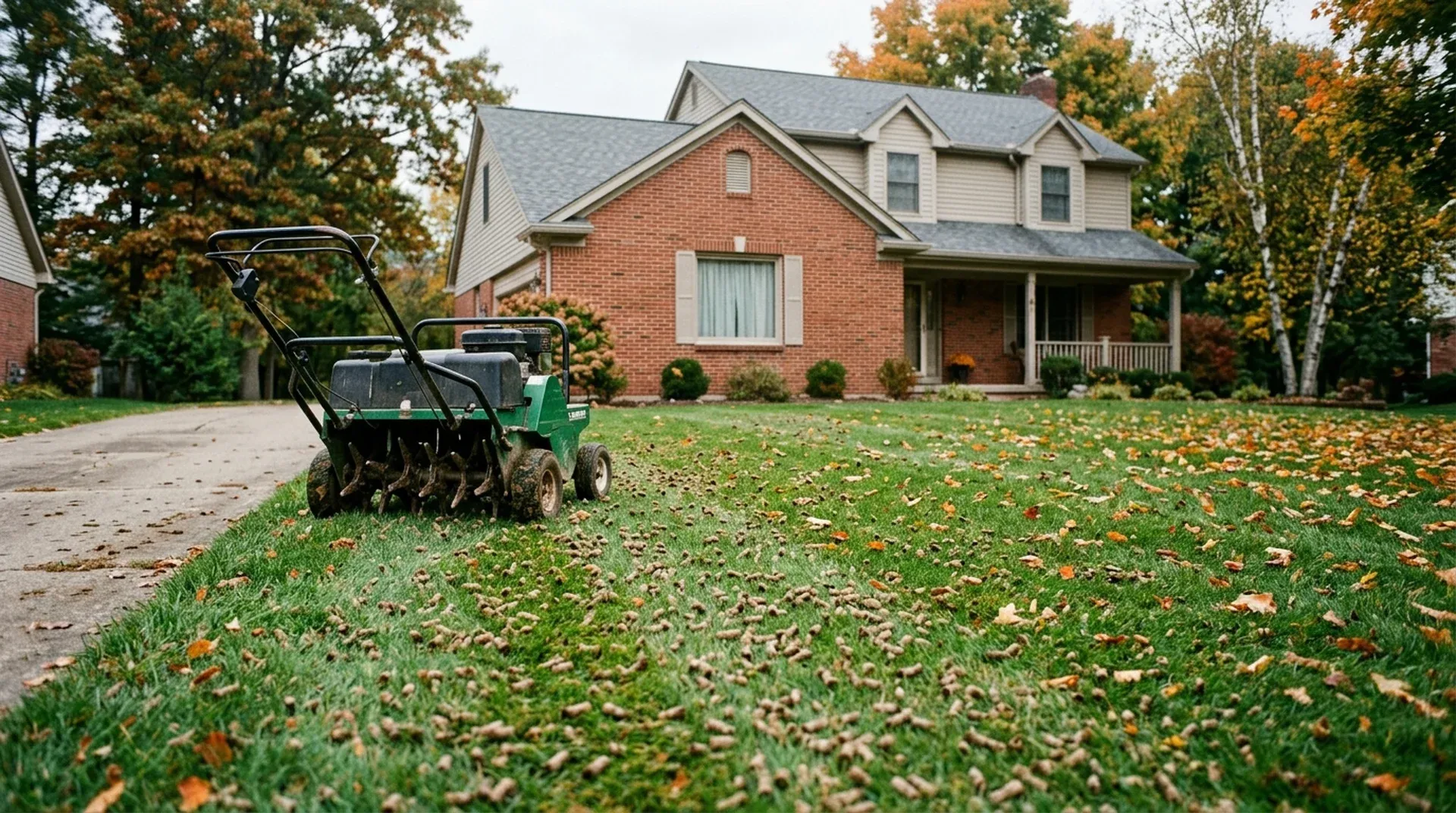
- Leave the cores. Let the plugs dry on the lawn and break down, which K-State says takes about 2 to 3 weeks. On lawns with more than 1/2 inch of thatch, Colorado State says to leave the cores so the soil works back into the thatch. Penn State suggests breaking them up once they've dried; mowing over them works.
- Follow up right away. You can fertilize and seed immediately after aeration, then water. Colorado State adds that there's no need to topdress after aerating.
Fall is the natural time to stack these jobs. If your lawn is thin, see our guide to overseeding a lawn, and pair it with the right fall fertilizer timing. If your thatch layer is thick, aeration may handle it, or you may need dethatching too.
DIY or hire it out
Renting a core aerator is doable, but the machines are heavy and hard to steer. K-State recommends a professional because the job requires heavy-duty equipment to penetrate the soil. As of October 2026, Lawn Love lists Home Depot rental rates of about $97 to $108 per day plus a $150 deposit.
Here's what hiring it out costs, according to two cost guides (both run lawn service marketplaces):
|
Source |
Price range |
|---|---|
|
Lawn Love, national average |
$104–$195 |
|
Lawn Love, core aeration |
$95–$230 |
|
Lawn Love, 1/4-acre lawn |
$115–$190 |
|
Lawn Love, 1/2-acre lawn |
$160–$250 |
|
LawnStarter, national |
$107–$202 |
Lawn Love says aeration prices track the local cost of living, with big metro areas near the top of the range, so local quotes are the only way to know what you'll pay. For the full picture of what yard services run, see how much lawn care costs.
When to call a pro
Hire a lawn care company if your yard is large, sloped or heavily compacted, or if you'd rather not haul and steer a rented machine. Since the fall window for cool-season lawns is short, call early so the job lands while the grass can still recover.
Before you hire:
- Get 2 or 3 written quotes for the same job: core (not spike) aeration, number of passes, and whether seed or fertilizer is included.
- Ask how they handle sprinkler heads and who pays if one gets broken.
- Ask for photos or references from similar lawns nearby.
- Check licensing and insurance where your state requires it.
- Get the scope, date window and payment terms in writing.
You can find lawn care pros near you on LandscapeLookup for free, with no sign-up. Pros are ranked by their Google rating weighted by review count, plus how local they are and their main service, and you contact them directly.
Editorial team
The LandscapeLookup editorial team writes guides to help US homeowners plan yard projects and hire the right pro. Each guide is based on university extension services, government sources such as EPA WaterSense and USDA, manufacturer instructions and published cost guides, and links to them so you can check the details.
Keep reading
Types of Grass for Lawns, by Region
Lawn grasses are cool-season (Kentucky bluegrass, tall fescue, perennial ryegrass, fine fescue) for the North or warm-season (Bermuda, zoysia, St. Augustine, centipede, bahia, buffalograss) for the South. Pick by region first, then by sun, traffic and water.
October 28, 2026
When to Apply Pre-Emergent for Crabgrass
Apply crabgrass pre-emergent in spring, a week or two before the soil holds about 55°F for several days in a row, then water it in. That ranges from mid-February in the Florida Panhandle to mid-April through early May in places like Nebraska.
October 14, 2026
How to Test Your Lawn Soil (and When to Add Lime)
Mix 10 or more small soil cores from your lawn, send about 2 cups to your state's extension lab, and add lime only if the report says your pH is too low, in spring or fall, at no more than 50 lb per 1,000 sq ft at a time.
October 12, 2026