
How to Get Rid of Nutsedge
Nutsedge is a sedge, not a grass, so regular weed killers miss it. Pull or spray young plants in late spring to early summer before new tubers form, use a sedge herbicide like halosulfuron, fix wet spots, and expect 2 to 3 years of follow-up.
By LandscapeLookup Editors7 min read
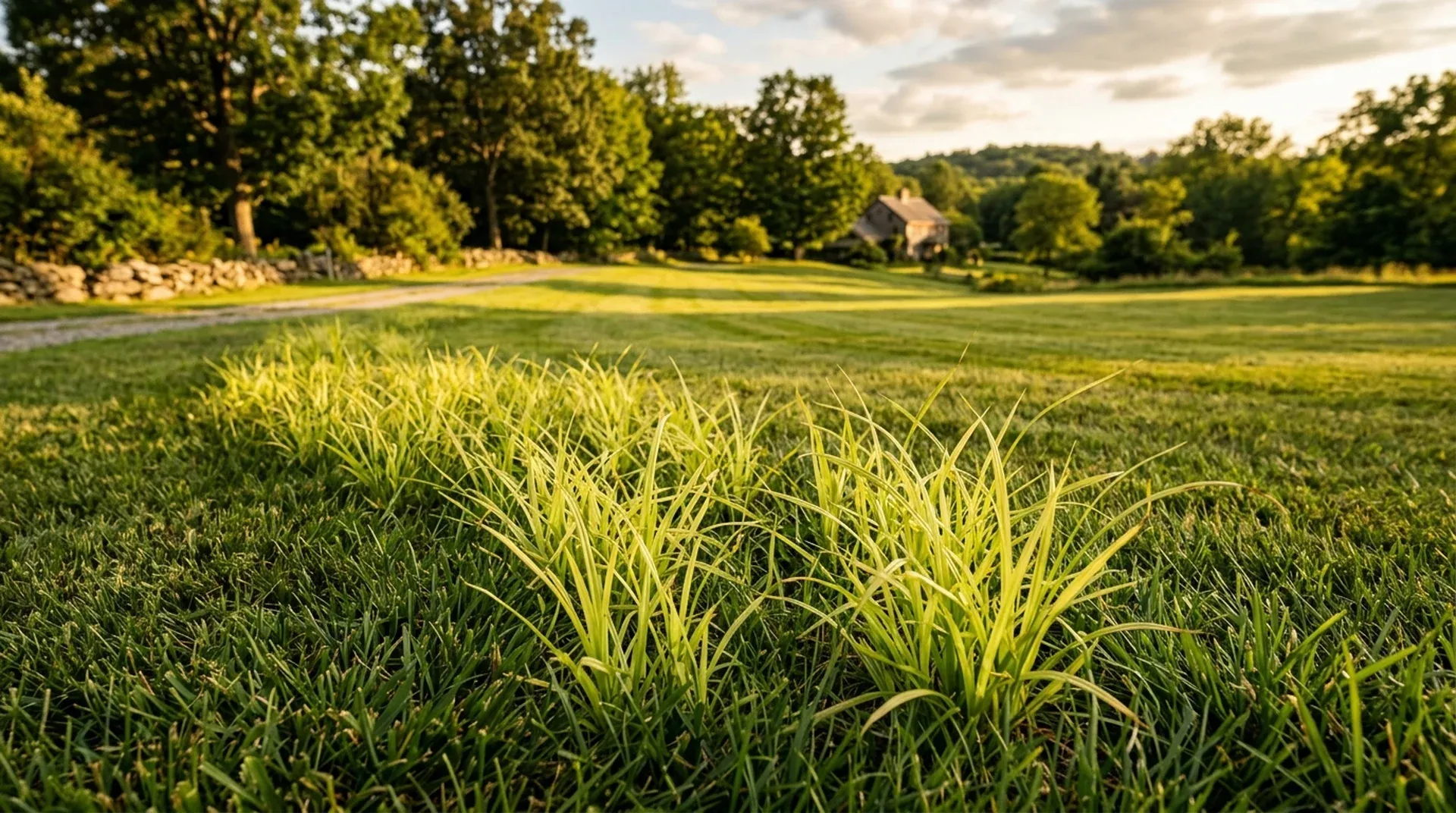
To get rid of nutsedge, pull or spray it while it's young, in late spring to early summer, before it starts making new underground tubers. Use a product made for sedges, such as halosulfuron, because the crabgrass and broadleaf killers most people already own won't touch it. Then fix the wet, thin spots it loves, and plan on 2 to 3 years of follow-up, since tubers already in the soil keep sprouting.
How to tell nutsedge from grass
Nutsedge (often called nutgrass) isn't a grass at all. It's a sedge, and that matters because most grass herbicides don't work on sedges. In a lawn, it stands out because it grows faster, more upright and lighter green than the turf around it.
Check these three things:
- Stem: Roll the stem between your fingers. Sedge stems are solid and triangular, while grass stems are hollow and round, according to UC IPM. Nebraska Extension sums it up as "sedges have edges".
- Leaves: They grow in sets of three from the base, not in pairs like grass, and they're thicker and stiffer.
- Shine: Maine's pest program describes leaves with a thick midvein that feel slick or waxy.
Yellow vs. purple nutsedge
Two species cause most of the trouble. They respond differently to some herbicides, so identification matters.
|
Trait |
Yellow nutsedge |
Purple nutsedge |
|---|---|---|
|
Leaf tip |
Long and tapered |
Blunt |
|
Leaf color |
Light green |
Darker green |
|
Seedhead |
Yellow to light brown |
Purple |
|
Tubers |
One at the tip of each rhizome |
In chains |
|
Where it grows |
Most of the US |
Mainly the South |
Sources: Clemson HGIC and UC IPM. Nebraska Extension says yellow nutsedge is documented in 48 US states. It's more widespread than purple nutsedge because it handles cold better, and Purdue says purple nutsedge is limited to the southern Midwest in that region.
Why does nutsedge keep coming back?
The "nuts" are tubers. Each plant makes them on underground stems that reach 8 to 14 inches deep, though most sit in the top 6 inches. One yellow nutsedge plant can produce several hundred to several thousand tubers a year, and new plants can pop up as far as 10 feet away.
Those tubers are the reason nothing works in one shot:
- They outlast you. UC IPM says tubers survive 1 to 3 years in the soil, and Purdue says more than 3 years.
- They don't all sprout at once. Clemson notes they break dormancy at different times, so removal is a long-term job.
- Herbicides can't reach dormant ones. Purdue says sprays won't control tubers that haven't produced plants yet, and it takes 2 to 3 years of control to cut viable tubers by 90%.
Will nutsedge go away on its own?
The leaves do. Penn State says the foliage dies back after the first hard frost, but tubers sprout again next spring once the soil stays above 43°F for yellow nutsedge and 59°F for purple. Left alone, patches can spread to 10 feet or more across. The good news: Nebraska Extension says that with steady pulling, spraying and thickening the turf, it can eventually be eliminated.
When should you treat nutsedge?
Timing beats product choice. Clemson says new tubers start forming 4 to 6 weeks after a new shoot emerges, and Purdue calls spraying too late in the season, after plants are big and making tubers, the most common mistake.
|
Region or source |
When it emerges |
Treat by |
|---|---|---|
|
Midwest (Purdue) |
Late April or May |
Late spring to early summer |
|
Nebraska (Nebraska Extension) |
Mid to late May in a typical year |
Before June 21 |
|
Pennsylvania (Penn State) |
Spring |
Before tubers start forming in late June or early July |
Because tubers sprout as the soil warms, the season starts earlier in the South, so start watching as soon as your lawn greens up. Once it's late summer or fall, you're mostly waiting for next spring.
Pulling and digging nutsedge
Hand pulling works if you start early and keep at it. UC IPM says to pull small plants before they have 5 to 6 leaves, which in summer means about every 2 to 3 weeks. Each pull forces the tuber to spend stored energy on a new shoot, and repeated pulling eventually drains it.
You may have heard that pulling nutsedge makes it worse. Pulling does leave tubers behind if you miss the nutlet, which is why the University of Arkansas says it just comes back. The fix is to pull young and often, not to stop pulling.
For a small patch:
- Contact 811 first. Some utility lines are buried just a few inches deep, so request marking a few business days before you dig.
- Dig deep and wide. Clemson says to go at least 10 inches deep and 8 to 10 inches beyond the leaves, ideally early in spring.
- Refill and reseed. UC IPM suggests refilling, then seeding or sodding the spot and watching it through summer.
- Don't till it. Tilling mature plants moves tubers around and spreads the infestation.
Herbicides that work on nutsedge
Regular crabgrass and dandelion products are ineffective against yellow nutsedge, and a standard crabgrass pre-emergent won't stop it either. That's also why a typical weed and feed product or pre-emergent isn't the answer here. You need an active ingredient labeled for sedges. Clemson rates the home-lawn options this way:
|
Active ingredient |
Example products |
Yellow / purple control |
Rated safe on |
|---|---|---|---|
|
Halosulfuron |
SedgeHammer Plus |
Good to excellent / good to excellent |
Tall fescue, Bermuda, centipede, zoysia, St. Augustine |
|
Sulfentrazone |
Ortho Nutsedge Killer for Lawns |
Fair / poor to fair |
Same five grasses |
|
Imazaquin |
Image Nutsedge Killer |
Fair / good |
Bermuda, centipede, zoysia, St. Augustine (not tall fescue) |
|
Bentazon |
Basagran products |
Good / poor |
Same five grasses |
Source: Clemson HGIC, which also lists other brands for each ingredient. For northern lawns, Penn State lists halosulfuron and sulfentrazone products among those labeled for cool-season turf. Glyphosate (Roundup) kills grass too, so keep it to spot use in beds, and UC IPM says even there it gives only limited suppression.
Does SedgeHammer kill grass?
Not when you use it as labeled on a listed grass. Purdue says halosulfuron gives excellent yellow nutsedge control with very good tolerance across turf species. It needs a surfactant unless you buy SedgeHammer+, which has it premixed.
Does Image kill nutsedge?
Yes, on southern grasses. Clemson rates imazaquin better on purple than yellow nutsedge, and says you must water in 1/2 inch afterward and can't seed the area for 6 weeks. Don't use it on tall fescue.
How long does nutsedge killer take to work?
It depends on the ingredient. In Penn State trials, sulfentrazone showed injury in 2 days and plants were gone in 10, while SedgeHammer took about a week to show symptoms and three more to finish. Image's maker says to expect discoloration in 1 to 2 weeks and dead weeds in 3 to 5. Plan on a repeat: Clemson says halosulfuron may need a second spray 6 to 10 weeks later.
How to spray for best results
- Hit young plants. UC IPM says selective herbicides must go on before the fifth-leaf stage to reach the tubers.
- Water the day before and skip spraying in drought or above 90°F.
- Don't mow for 2 to 3 days before and after.
- Follow the label for rates, grass types and repeat timing. Some places restrict lawn pesticides: Montgomery County, Maryland, for example, bars synthetic pesticides for cosmetic lawn use. Check your state and town rules.
Fix the conditions nutsedge loves
Spraying without fixing the cause means fighting it every summer. Nutsedge often signals poor drainage, watering too often or leaky sprinklers.
- Water deeply but less often so the surface dries between waterings. Our guide to the best time to water your lawn covers how much. Follow any local watering-day rules.
- Fix soggy spots with grading or drains. See yard drainage solutions.
- Mow higher. Purdue says nutsedge is worst in turf mowed too short, and Nebraska suggests 3 to 3.5 inches for cool-season lawns. Warm-season grasses compete with it better than cool-season ones.
- Watch what you bring in. Tubers ride in on sod, topsoil and nursery plants, and on tillers that aren't cleaned.
In beds, plastic sheeting fails because the leaf tips poke through it. UC IPM says thick nonwoven fabric under mulch can suppress it, while Nebraska Extension says even landscape fabric doesn't. Our guide to landscape fabric covers the tradeoffs. Tall, dense shrubs that shade the soil help more, since nutsedge doesn't grow well in shade.
When to call a pro
Hire a lawn care company if nutsedge covers large areas, keeps coming back after a season of treatment, or you're not sure which species or grass you have. UC IPM notes that many sedge herbicides are available only to licensed professionals. LawnStarter puts weed control at about $50 to $210 per treatment, and post-emergent herbicide at $75 to $170 (2026). Prices vary by region and lawn size. See lawn care cost for other services.
Before you hire:
- Get 2 or 3 written quotes that name the product, number of visits and whether repeat sprays are included.
- Ask for photos or references from lawns with the same problem.
- Check licensing and insurance where your state requires it, including a pesticide applicator license.
- Get the scope and payment schedule in writing.
You can find lawn care pros near you on LandscapeLookup for free, with no sign-up. Pros are ranked by Google rating weighted by review count, plus how local they are and their main service, and you contact them directly.
Editorial team
The LandscapeLookup editorial team writes guides to help US homeowners plan yard projects and hire the right pro. Each guide is based on university extension services, government sources such as EPA WaterSense and USDA, manufacturer instructions and published cost guides, and links to them so you can check the details.
Keep reading

Types of Grass for Lawns, by Region
Lawn grasses are cool-season (Kentucky bluegrass, tall fescue, perennial ryegrass, fine fescue) for the North or warm-season (Bermuda, zoysia, St. Augustine, centipede, bahia, buffalograss) for the South. Pick by region first, then by sun, traffic and water.
October 28, 2026
When to Apply Pre-Emergent for Crabgrass
Apply crabgrass pre-emergent in spring, a week or two before the soil holds about 55°F for several days in a row, then water it in. That ranges from mid-February in the Florida Panhandle to mid-April through early May in places like Nebraska.
October 14, 2026
How to Test Your Lawn Soil (and When to Add Lime)
Mix 10 or more small soil cores from your lawn, send about 2 cups to your state's extension lab, and add lime only if the report says your pH is too low, in spring or fall, at no more than 50 lb per 1,000 sq ft at a time.
October 12, 2026