How Much Does Sod Cost?
Sod itself runs about $0.35 to $1 per sq ft ($150 to $450 a pallet). Installed on prepared bare soil, most pros charge about $1 to $2.60 per sq ft, and $2 to $4.50 if the old lawn has to come out first.
By LandscapeLookup Editors7 min read
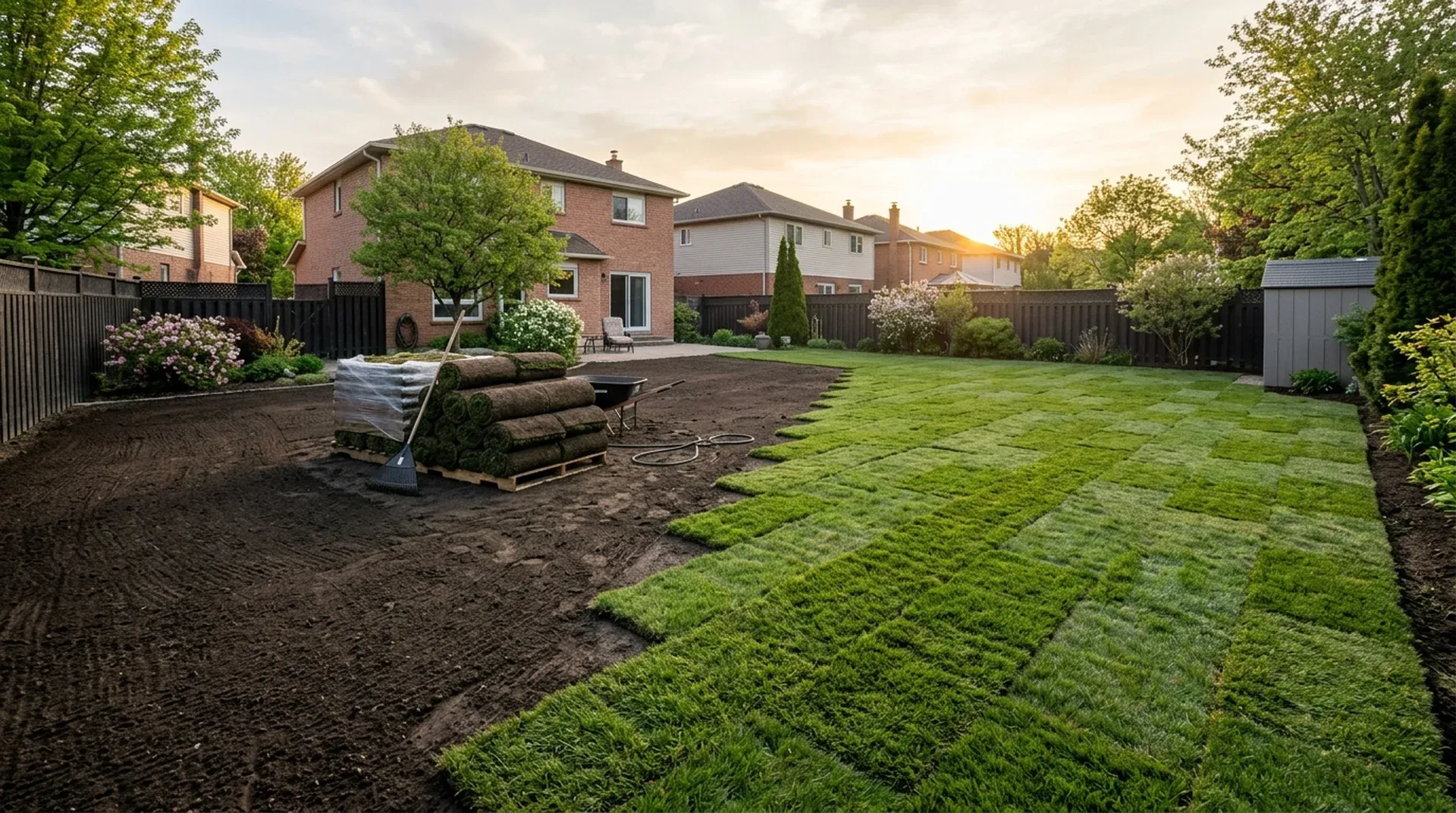
Professional sod installation usually costs about $1 to $2.60 per square foot on prepared bare soil, so a 1,000 sq ft yard runs roughly $1,000 to $2,600. The sod alone is about $0.35 to $1 per sq ft, or $150 to $450 a pallet. If an old lawn has to be stripped and hauled away first, expect closer to $2 to $4.50 per sq ft.
Your grass type, yard size, site prep and local labor rates move the price the most. Here's what each one adds and how to read a quote.
How much does sod cost per square foot?
National cost guides agree on the material price but differ on installed totals, mostly because they count prep differently. All figures below were checked in October 2026, and costs vary by region.
|
Source |
Sod only |
Installed |
|---|---|---|
|
$0.35–$1 per sq ft (avg. $0.60) |
$1–$2.50 new lawn; $2–$4.50 resod |
|
|
about $0.60 per sq ft |
about $1.65 per sq ft |
|
|
$0.20–$1.05 by grass type |
$1.70–$2.60 per sq ft |
HomeAdvisor puts the typical project at $1,080 to $3,073, with an average of $2,077. It says laying sod on bare, new-build soil is cheaper because there's no old lawn to remove, while resodding costs more because crews strip and haul away the old grass first.
Location matters too. LawnStarter's city ranges run from $1.15 to $2.10 per sq ft in Dothan, Alabama to $2.20 to $3.50 in New York. Lawn Love notes installation may cost more in colder climates where sod is less readily available.
Cost by yard size
These are HomeAdvisor's average installed totals, with Lawn Love's figures for comparison.
|
Yard size |
New lawn (HomeAdvisor) |
Resod existing yard (HomeAdvisor) |
Lawn Love |
|---|---|---|---|
|
500 sq ft |
$500–$1,300 |
$1,000–$2,300 |
n/a |
|
1,000 sq ft |
$1,000–$2,500 |
$2,000–$4,500 |
$1,700–$2,600 |
|
2,000 sq ft |
$2,000–$5,000 |
$4,000–$9,000 |
$3,400–$5,200 |
|
5,000 sq ft |
$5,000–$12,500 |
$10,000–$22,500 |
$8,500–$13,000 |
Pallets, rolls, labor and delivery
Most sod is sold by the pallet. Purdue Extension says a pallet holds about 450 sq ft and suggests ordering about 10% extra for waste from cutting around corners and edges. For a 2,000 sq ft lawn, that's 2,200 sq ft, or 5 pallets.
- Pallets: $150 to $450 according to LawnStarter, which says bulk orders can drop the per-foot price 15% to 40%. Lawn Love's range is $110 to $375 for 400 to 500 sq ft. A pallet weighs 1,500 to 3,000 pounds, per HomeAdvisor, so most people pay for delivery.
- Rolls: LawnStarter says a 10 sq ft roll costs $4 to $7.50, handy for patches.
- Labor: LawnStarter puts labor at $37.50 to $77.50 an hour, or $0.55 to $1 per sq ft. By our math, that's about $250 to $450 of labor per 450 sq ft pallet. Lawn Love's labor range is lower, at $0.35 to $0.80 per sq ft.
- Delivery: $65 to $230 per LawnStarter and HomeAdvisor, or $55 to $180 per Lawn Love, which says large orders sometimes ship cheaper or free.
How much does each type of sod cost?
The grass you need depends mostly on climate. HomeAdvisor groups Kentucky bluegrass, ryegrass and fescue as cool-season grasses for the northern half of the U.S., and St. Augustine, Bermuda and zoysia as warm-season grasses for the South. It adds that suppliers may charge a premium for grasses that aren't suited to the local climate.
|
Grass |
Season |
Sod only (LawnStarter) |
Installed (LawnStarter) |
Per pallet (HomeAdvisor) |
|---|---|---|---|---|
|
Bahia |
Warm |
$0.20–$0.33 |
$0.77–$1.26 |
$90–$180 |
|
Kentucky bluegrass |
Cool |
$0.29–$0.43 |
$0.86–$1.36 |
$135–$270 |
|
Perennial ryegrass |
Cool |
$0.28–$0.58 |
$0.85–$1.51 |
$180–$385 |
|
Fescue |
Cool |
$0.32–$0.67 |
$0.89–$1.60 |
$270–$295 (tall fescue) |
|
St. Augustine |
Warm |
$0.41–$0.86 |
$0.98–$1.79 |
$200–$405 |
|
Bermuda |
Warm |
$0.44–$0.83 |
$1.01–$1.76 |
$200–$380 |
|
Zoysia |
Warm |
$0.47–$0.72 |
$1.04–$1.65 |
$225–$360 |
|
Centipede |
Warm |
$0.78–$0.85 |
$1.35–$1.78 |
$360–$405 |
Per-square-foot prices are from LawnStarter; pallet prices assume about 450 sq ft per pallet, per HomeAdvisor. Your local choice may be narrow. The University of Nebraska says that in the northern Great Plains, Kentucky bluegrass and tall fescue are the only cool-season grasses sold as sod, and buffalograss the only warm-season one. Shade also limits sod: UNH Extension says it needs 4 to 5 hours of direct sun a day.
Site prep: the cost most quotes vary on
HomeAdvisor warns that prep can raise the total by 30% or more. It's also what decides whether the sod takes. UF/IFAS turfgrass specialist Laurie Trenholm says success depends more on how well the ground is prepped than on the time of year, and that sod on compacted, uneven construction soil has lower odds.
|
Prep task |
Typical cost |
Source |
|---|---|---|
|
Remove weeds and old grass (with disposal) |
$0.88–$1.84 per sq ft |
LawnStarter |
|
Till and grade |
$0.90–$2 per sq ft |
LawnStarter |
|
Grading only |
$1–$3 per sq ft |
HomeAdvisor |
|
Soil test |
$12–$30 (DIY kit) to $20–$100 |
LawnStarter, HomeAdvisor |
|
Topsoil |
$12–$50 per cubic yard |
LawnStarter |
Prep figures are from LawnStarter and HomeAdvisor. Odd shapes and tight access add more: LawnStarter says 15% to 20%, and HomeAdvisor says slopes and irregular shapes can add up to 10%.
Can you lay sod on bare dirt or over old grass?
You can lay sod on bare soil, but not straight onto hard, unprepared dirt. The University of Nebraska says sod prep is identical to prep for seeding: clear debris, kill perennial grassy weeds, set the grade so water drains away from the house, test the soil, and till 4 to 6 inches deep. Where the grade changes a lot, it calls for at least 4 inches of topsoil.
None of the extension guides cited here suggest laying sod on top of an existing lawn. They all start from cleared, tilled soil. Get a soil test before you buy amendments.
Two money-savers: put in any sprinkler system before the sod, since Purdue says irrigation goes in after rough grading and before sodding (see sprinkler system costs). And because tilling and trenching are digging, contact 811 a few business days ahead. It's free.
DIY vs. hiring a pro
For a 1,000 sq ft yard, LawnStarter estimates $732 to $1,354 to do it yourself, including sod and tool rentals, versus $1,000 to $2,200 for a pro, not counting removal of old grass. Lawn Love puts DIY tools and rentals at $330 to $420 plus the sod. HomeAdvisor is less optimistic, saying DIY lands near the same $2,000 you'd pay a pro once rentals, soil tests and materials are added.
If you do it yourself, extension guides from Nebraska and Purdue agree on the basics:
- Lay sod within 24 hours of harvest, on lightly moistened soil.
- Stagger the seams like bricks and butt edges tight, without stretching or overlapping.
- On slopes, start at the bottom and run the strips across the slope. Nebraska says slopes of 10% or more may need pegs or staples.
- Roll lightly for good soil contact, then water thoroughly right away.
Is sod worth it compared with seed?
Seed is far cheaper: about $0.10 to $0.20 per sq ft per HomeAdvisor, or $0.09 to $0.19 per LawnStarter. What sod buys you is time and reliability. Nebraska lists an instant lawn you can use quickly, no soil tracking or erosion, and the option to plant outside ideal seeding windows. UNH adds that sod works more dependably on slopes and high-traffic areas and gives crabgrass little chance compared with spring seeding.
For a new lawn on a budget, compare hydroseeding vs. sod vs. seed. If you already have grass that's just thin, overseeding costs much less than replacing it.
Best time to lay sod and how to keep it alive
Sod can go down almost any time the soil isn't frozen, but timing changes how much water it needs.
|
Grass |
Best window |
Why |
|---|---|---|
|
Cool-season (bluegrass, fescue) |
Early fall, then early spring |
Purdue says fall gives roots time to develop before summer; Nebraska prefers spring or fall because it needs less water than summer |
|
Warm-season (Bermuda, zoysia) |
Early summer |
Purdue says these grasses root fast in early to midsummer, before cold weather |
Purdue adds that sod laid when temperatures top 90°F may not grow new roots until it cools.
Watering. Nebraska says new sod needs daily watering for the first 2 weeks and usually roots in 10 to 14 days. After that, water less often but more deeply. Our guide to the best time to water your lawn covers the switch to a regular schedule. Check your local watering rules: some places allow extra watering for new sod if you register it. Manatee County, Florida, for example, lets registered new lawns be watered any day for the first 30 days.
Walking on it. Purdue says to keep people off for 3 to 4 weeks. UNH allows light use after 2 to 3 weeks but no rough play for 4 weeks.
Feeding and weed control. Purdue suggests nitrogen about a month after installation and says to hold off on preemergence herbicides until the turf is established. UF/IFAS advises no fertilizer for 30 to 60 days in Florida. Follow product labels, and check state and local rules: Minnesota, for example, limits phosphorus on lawns but makes an exception for new lawns established by seed or sod.
When to call a pro
Hire a lawn care or landscaping company if the yard needs an old lawn removed, regrading, new topsoil or a sprinkler system, or if you can't handle several pallets at up to 3,000 pounds each in a single day. LawnStarter recommends scheduling delivery for installation day to keep the sod healthy, which a crew can plan around.
Before you hire:
- Get 2 or 3 written quotes that list square footage, grass type, prep work (removal, tilling, grading, topsoil) and delivery, so you can compare like for like.
- Ask for photos of similar sod jobs and who handles watering on day one.
- Check licensing and insurance where your state requires it.
- Get the scope, start date and payment schedule in writing, plus any guarantee on the sod taking root.
You can find lawn care pros near you or landscapers for bigger regrading jobs on LandscapeLookup for free, with no sign-up. Pros are ranked by Google rating weighted by review count, plus how local they are and their main service, and you contact them directly.
Editorial team
The LandscapeLookup editorial team writes guides to help US homeowners plan yard projects and hire the right pro. Each guide is based on university extension services, government sources such as EPA WaterSense and USDA, manufacturer instructions and published cost guides, and links to them so you can check the details.
Keep reading
Types of Grass for Lawns, by Region
Lawn grasses are cool-season (Kentucky bluegrass, tall fescue, perennial ryegrass, fine fescue) for the North or warm-season (Bermuda, zoysia, St. Augustine, centipede, bahia, buffalograss) for the South. Pick by region first, then by sun, traffic and water.
October 28, 2026
When to Apply Pre-Emergent for Crabgrass
Apply crabgrass pre-emergent in spring, a week or two before the soil holds about 55°F for several days in a row, then water it in. That ranges from mid-February in the Florida Panhandle to mid-April through early May in places like Nebraska.
October 14, 2026
How to Test Your Lawn Soil (and When to Add Lime)
Mix 10 or more small soil cores from your lawn, send about 2 cups to your state's extension lab, and add lime only if the report says your pH is too low, in spring or fall, at no more than 50 lb per 1,000 sq ft at a time.
October 12, 2026