
Topdressing and Leveling a Lawn
Topdressing means spreading a thin layer of compost, topsoil or sand, no more than 1/2 inch at a time, over a growing lawn to improve the soil or fill shallow low spots. Match the material to your soil and keep the grass blades showing.
By LandscapeLookup Editors7 min read
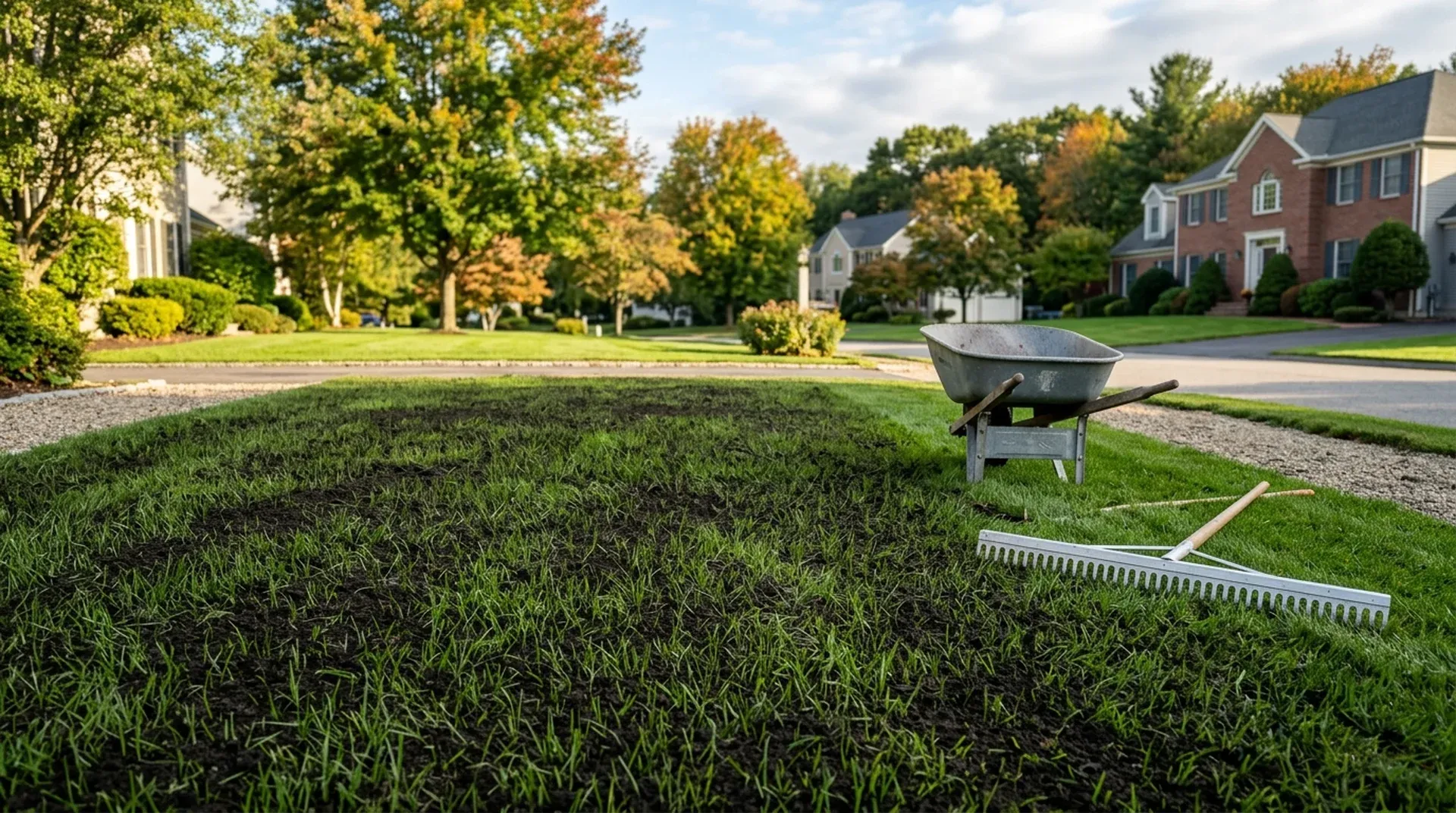
Topdressing is spreading a thin layer of compost, topsoil or sand over an established lawn, no more than 1/2 inch at a time, to improve the soil or fill shallow low spots. Do it while your grass is actively growing, match the material to the soil you already have, and keep the grass blades showing so the lawn can grow up through it.
It's not a must-do every year. Here's when it helps, what to spread, how much, and how to level a bumpy yard without smothering the grass.
What topdressing does and when it's worth it
Clemson Extension defines topdressing as placing a thin layer of material on top of an established lawn, which slowly works into the soil. Topsoil or sand fills gaps and low spots. Compost adds organic matter, helps the lawn recover from aeration and dethatching, and can improve drainage in clay and water holding in sand.
Clemson also says topdressing evens out small areas that aren't level from poor soil prep, or gaps between sod pieces that weren't laid tight.
Not every lawn needs it. The University of Wisconsin calls topdressing quite expensive and says regular, uniform applications are rarely appropriate for home lawns, though small additions help constantly wet spots and bumpy lawns. Colorado State adds that there's no need to topdress after aerating. It's worth the effort when:
- Your lawn has shallow dips, ruts or uneven sod seams.
- The soil is poor (hard clay or droughty sand) and you want to add organic matter over time.
- You're overseeding thin areas and want to cover seed lightly. See our guide to overseeding a lawn.
Compost, topsoil or sand: what to use
The rule from extension services is simple: match what you already have. Wisconsin says to use soil that matches the underlying soil to prevent layering, and Clemson warns that heavy topdressing over time can create a layered soil that slows water movement.
|
Material |
Best for |
Watch out for |
|---|---|---|
|
Compost |
Adding organic matter on any soil; recovery after aeration |
Quality varies; buy screened, mature compost |
|
Topsoil |
Filling low spots and gaps |
Must match your native soil; may carry weed seeds |
|
Sand |
Lawns already growing on sandy soil |
Don't use on clay or loam |
|
Sand and topsoil blend |
Sandy loam soils |
Same matching rule |
Is sand or topsoil better?
For most home lawns, topsoil or compost. Clemson says sand should only be used when the native soil is sandy. Golf greens get sand because they're built on an all-sand base, not native soil. An Ask Extension answer for a Michigan homeowner adds that a topsoil and sand mix suits sandy loam, and the topping should match the soil underneath.
Compost: helpful, but check it
Clemson calls compost the best choice for the average home lawn. Wisconsin is more cautious: compost varies so much that some may seal off the soil. Wisconsin also warns that a layer of "black dirt" (muck soil) can trap water and kill turf.
Before you buy:
- Get a soil test. Clemson recommends testing your soil and the compost or topsoil, since pH and nutrients vary. Results take about two weeks. Our lawn soil test guide explains how.
- Look at the load. Wisconsin says to reject topsoil with rocks, debris or weeds like quackgrass, and to avoid farm soil, which may hold herbicide residues. Clemson notes topsoil and river sand can bring in weed seeds.
- Mind the nutrients. Compost carries nutrients, and some states limit phosphorus on lawns. Minnesota bans phosphorus fertilizer on lawns unless a soil test shows a need, and ten other states had similar laws by 2012. Check your state and town rules.
When to topdress by grass type
Topdress during active growth so the grass can push up through the new layer. Clemson's timing:
|
Grass type |
Examples |
Best time |
Avoid |
|---|---|---|---|
|
Cool-season |
Kentucky bluegrass, tall fescue, ryegrass |
Spring and fall |
Summer heat stress |
|
Warm-season |
Bermuda, zoysia, St. Augustine, centipede |
Summer growing season |
Dormancy |
The seasons and the summer heat caution come from Clemson's cultivation factsheet. Wisconsin adds: don't add soil during hot, dry periods or when the turf is dormant.
For cool-season lawns, fall lets you stack jobs. The Michigan Ask Extension answer suggests that by late September you core aerate, topdress with compost and overseed, then keep leveling in spring. Check when to aerate your lawn for regional windows.
How much to spread and what it costs
Keep each layer thin. Clemson says no more than 1/2 inch at a time, since more can stunt or shade the grass. Wisconsin says 1/4 to 1/2 inch, with at least half of the leaf height visible.
A University of California Cooperative Extension study on Bermudagrass backs this up. Compost at 1/2 and 1 inch buried the turf and lowered quality for months. Four 1/4-inch applications a year gave consistently higher quality and less crabgrass, though the grass grew fast enough to need more mowing.
How much material to order
Wisconsin's formula: square feet times depth in feet, then divide by 27 for cubic yards. Per 1,000 sq ft:
|
Depth |
Cubic feet |
Cubic yards |
|---|---|---|
|
1/8 inch |
About 10 |
About 0.4 |
|
1/4 inch |
About 21 |
About 0.77 |
|
1/2 inch |
About 42 |
About 1.5 |
Lawn Love uses the same 0.77 cubic yards per 1,000 sq ft at 1/4 inch. A 5,000 sq ft lawn needs nearly 4 cubic yards for one 1/4-inch pass.
Material and labor costs
As of October 2026, Lawn Love lists topsoil at $10 to $50 per cubic yard, sand at $15 to $40, and screened compost at $30 to $80. For hired work, Earth & Turf, which makes topdressing machines, says it has heard rates of 15 to 35 cents per sq ft or more, depending on the job. Prices vary by region and supplier, so get local quotes. If you're adding aeration, our lawn care cost guide covers that price.
How to topdress a lawn, step by step
- Find the cause of the bumps or thin grass. Wisconsin lists frost heaving, moles, ant mounds, equipment ruts and buried rocks. Fix the cause or the problem returns.
- Core aerate if the soil is compacted. Clemson says aeration often goes with topdressing but isn't needed if compaction isn't a concern.
- Use dry material. Wisconsin says topdressing must be fairly dry or it won't spread evenly.
- Spread it. Fling it from a shovel, or use a large drop spreader on big areas, per Wisconsin.
- Work it in. Rake lightly and evenly so it sifts between the leaf blades, or pull a drag mat.
- Check the blades. At least half the leaf height should show. If the grass is fully buried, Wisconsin says to overseed.
- Water thoroughly to settle the soil, as the Ask Extension answer recommends. Follow your local watering rules.
- Repeat as needed. Wisconsin says several additions over months may be needed, letting the turf grow through each one.
How to level a lawn
Will grass grow through topdressing? Yes, if you don't cover the crowns (the base where new growth starts). The Michigan Ask Extension answer gives three ways to level:
- Small or scattered low spots: add thin layers of matching soil every week or two. Slow, but deep spots may take into the next season.
- Large low areas: peel back or cut the grass in strips of even thickness, fill the low area, then replace the strips.
- Fill and reseed: fill the low spots completely, then reseed, since buried grass won't come back.
Can you put topsoil over existing grass? Only in thin layers. For a deeper dip, lift the sod first, as a second Ask Extension answer suggests. If you'll cut sod or dig, contact 811, the free before-you-dig service, a few business days ahead.
If the whole lawn is bumpy
Wisconsin's approach: core aerate, then drag the dried cores so soil falls into the low spots, and roll when the soil is moist. It warns rolling can compact soil. Iowa State is firmer: don't roll with a heavy roller. It suggests core aerating, power raking and reseeding thin areas in late August to mid-September. If thatch is part of the problem, see dethatching a lawn.
A low spot that keeps holding water is a drainage problem, not just a leveling job. See our guide to yard drainage solutions.
When to call a pro
Hire a lawn care company for a large lawn, many low spots, or several cubic yards of material to move. Pros can spread with topdressing machines, which Wisconsin notes are not generally available to homeowners. For deep dips, regrading or water pooling near the foundation, call a landscaping contractor.
Before you hire:
- Get 2 or 3 written quotes for the same scope: material, depth, square footage, and whether aeration or seeding is included.
- Ask what material they'll use and whether it matches your soil.
- Ask for photos of similar work or local references.
- Check licensing and insurance where your state requires it.
- Get the scope, dates and payment schedule in writing.
You can find lawn care pros or landscaping contractors near you on LandscapeLookup for free, with no sign-up. Pros are ranked by Google rating weighted by review count, plus how local they are and their main service, and you contact them directly.
Editorial team
The LandscapeLookup editorial team writes guides to help US homeowners plan yard projects and hire the right pro. Each guide is based on university extension services, government sources such as EPA WaterSense and USDA, manufacturer instructions and published cost guides, and links to them so you can check the details.
Keep reading

Types of Grass for Lawns, by Region
Lawn grasses are cool-season (Kentucky bluegrass, tall fescue, perennial ryegrass, fine fescue) for the North or warm-season (Bermuda, zoysia, St. Augustine, centipede, bahia, buffalograss) for the South. Pick by region first, then by sun, traffic and water.
October 28, 2026
When to Apply Pre-Emergent for Crabgrass
Apply crabgrass pre-emergent in spring, a week or two before the soil holds about 55°F for several days in a row, then water it in. That ranges from mid-February in the Florida Panhandle to mid-April through early May in places like Nebraska.
October 14, 2026
How to Test Your Lawn Soil (and When to Add Lime)
Mix 10 or more small soil cores from your lawn, send about 2 cups to your state's extension lab, and add lime only if the report says your pH is too low, in spring or fall, at no more than 50 lb per 1,000 sq ft at a time.
October 12, 2026