Chinch Bugs: How to Spot and Treat Them
Chinch bugs are tiny black-and-white bugs that suck sap from grass and leave yellow-to-brown patches that don't green up with water. Confirm them with a can test at the edge of the damage, fix thatch and watering, and spot-treat only if you count about 20 or more per square foot.
By LandscapeLookup Editors8 min read
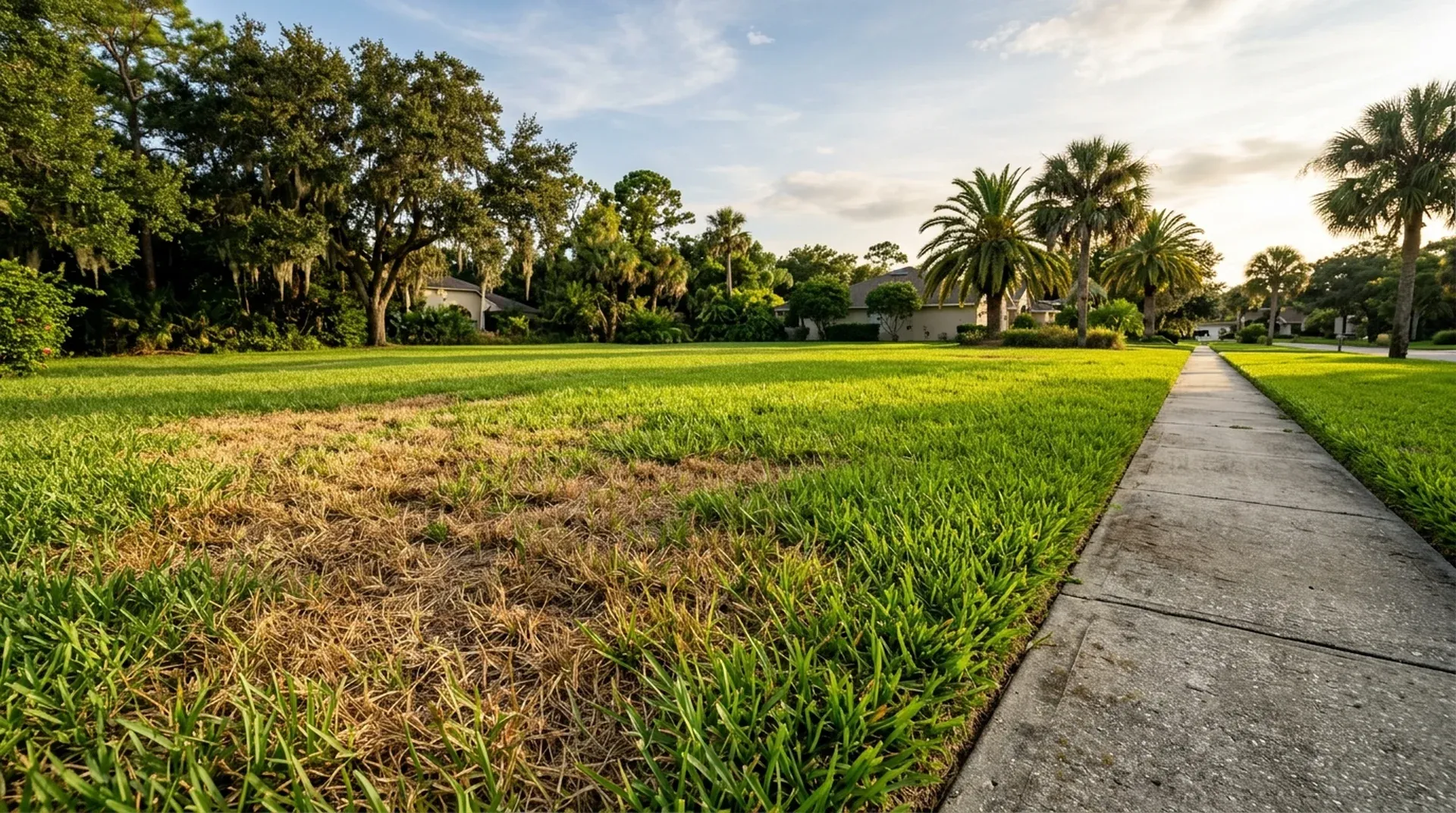
Chinch bugs are tiny black-and-white insects, about 1/8 inch to 1/5 inch long, that suck sap from grass and leave yellow-to-brown patches in hot, sunny spots. The damage looks like drought, but it keeps spreading even after you water. Confirm them with a can test at the edge of a patch. Then fix the thatch and watering problems they love, and treat only if you find about 20 or more per square foot.
What do chinch bugs look like?
You can see chinch bugs, but you have to get down on the grass. Adults are black with white wings marked by a small black triangle, and UF/IFAS says they're about the length of a grain of rice. Penn State describes young nymphs as brick-red with a white band across the back, turning gray and then black as they grow.
Two look-alikes trip people up:
- Big-eyed bugs are predators that eat chinch bugs. K-State warns that chinch bug adults resemble big eyed bugs, so check the eyes: Colorado State notes big-eyed bugs have much larger eyes. Leave those alone.
- False chinch bugs are a different insect. They're the ones that sometimes swarm yards in large numbers in late spring or early summer as nearby weeds dry out.
Which chinch bug you have depends on where you live
NC State lists four species that damage turf in North America, and your region and grass type mostly decide which one you have.
|
Species |
Where it's found |
Grasses it attacks |
|---|---|---|
|
Southern chinch bug |
The South, especially the Southeast |
Mainly St. Augustine; also centipede, zoysia, bahia and Bermuda |
|
Hairy chinch bug |
Northeast, northern Midwest, southern Canada |
Kentucky bluegrass, fine fescue, perennial ryegrass, bentgrass, zoysia |
|
Common chinch bug |
South Dakota to Virginia, south to mid-Texas and mid-Georgia |
Grain crops first, but also Bermuda, fescues, bluegrass, ryegrass, zoysia |
|
Western chinch bug |
Western states |
Turf in places like Utah, especially in heat and drought |
Ranges and hosts are from Ohio State, NC State and Utah State. UF/IFAS calls the southern chinch bug the most damaging insect pest of St. Augustinegrass in the US.
Signs of chinch bug damage
Chinch bug damage starts as irregular yellow patches that turn brown and expand outward. Ohio State says the patches keep growing and the turf dies regardless of irrigation, and that feeding can give grass a purplish tint. That's the clearest clue: Utah State notes chinch bug damage won't respond to increased watering the way a drought-stressed lawn would.
- Hot, sunny spots go first. UF/IFAS says injury shows up first in grass that's water-stressed or in full sun.
- Thick thatch. UF/IFAS says southern chinch bugs prefer thick thatch layers for food and shelter.
- Bugs on pavement. Penn State says that on sunny days you'll see adults crawling across driveways, sidewalks and foundation walls.
Brown patches have other causes, too. UC IPM says uneven watering is the most common cause of lawn damage. Disease, dog urine and fertilizer or herbicide misuse can all look like insect damage. If you don't find bugs, see our guide to lawn fungus and brown spots.
When damage shows up
|
Region |
Typical timing |
|---|---|
|
North (hairy chinch bug) |
Damage from early July through late August (Penn State) |
|
North Carolina |
Southern chinch bug infestations peak in early July (NC State) |
|
North Florida |
Active about March to October, 3 to 4 generations (UF/IFAS) |
|
South Florida |
7 to 10 generations a year, damage possible year-round (UF/IFAS) |
How do you check for chinch bugs?
Extension services agree on the coffee can test:
- Cut both ends out of a large can. Utah State uses a 6-inch coffee can; Penn State and Ohio State use a 1-gallon can.
- Push it 2 to 3 inches into the soil in yellowing grass right at the edge of the damage. Colorado State says not to look at the dead grass inside the patch, because the bugs have moved on.
- Fill it with water and keep topping it up as it soaks in. Stir the thatch to knock bugs loose.
- Count what floats up over 5 to 10 minutes. If you find none, UF/IFAS suggests checking 3 to 4 other areas.
Utah State says to estimate bugs per square foot from the area the can covers. A 6-inch can covers about 0.2 sq ft, so multiply your count by 5.
No can? UF/IFAS suggests a handheld vacuum over about 1 square foot of half-dead, half-living grass, then dumping it on white paper. UC IPM's soap drench works too. Mix 2 to 4 tablespoons of dish soap per gallon of water, pour it over 1 square yard and count for 10 minutes.
Does dish soap kill chinch bugs?
The soap drench is a detection method: UC IPM uses it to drive insects to the surface so you can count them. UF/IFAS does list insecticidal soap (a labeled product, not kitchen detergent) among the products available for southern chinch bugs. But it also notes that contact products depend on touching the bugs, and even coverage is hard to get in a lawn.
How many is too many?
A few chinch bugs are normal. UF/IFAS estimates that about 1/3 of St. Augustine lawns have some. Here's when extension services say treatment is warranted:
|
Source |
Treat at about |
|---|---|
|
20 to 25 per sq ft |
|
|
Penn State (hairy) |
15 to 20 per sq ft economic threshold; 20 to 30 may warrant control |
|
Ohio State and Colorado State (hairy) |
25 to 30 per sq ft; more than 25 |
|
K-State (common) |
5 to 10 per sq ft may cause damage |
How to get rid of chinch bugs
Fix the conditions that let them build up first, then treat if your count is over the threshold. Thick thatch also reduces insecticide efficacy, according to UC IPM, so cultural fixes make any spray work better.
Change the conditions they like
- Water properly. K-State lists regular irrigation as step one, and UF/IFAS says to avoid poor irrigation distribution. Follow local watering restrictions; our guide to the best time to water your lawn covers how much.
- Cut the thatch. UC IPM says thatch over 1/2 inch encourages chinch bug populations and blocks insecticides. Colorado State says removing it can limit chinch bug activity for 1 or 2 years. See our guide to dethatching a lawn.
- Go easy on nitrogen. UF/IFAS links over-fertilizing to more southern chinch bugs and more thatch. Ohio State warns that lush turf only attracts more chinch bugs. Check when to fertilize your lawn for sensible rates.
- Don't mow too short. UF/IFAS lists mowing too short as a stress that invites them.
Plant grass that resists them
For cool-season lawns, Ohio State says perennial ryegrass, fine fescue and tall fescue with endophytes are highly resistant. Lawns with 50 percent or more bluegrass are the most likely to be attacked.
For St. Augustine, the choices are narrower. UF/IFAS says Florida chinch bugs overcame Floratam's resistance within 15 years of its 1973 release, and that Captiva was the only resistant St. Augustine on the market as of its 2018 revision. NC State suggests avoiding highly susceptible Raleigh where pest pressure is high.
When and how to use insecticide
- Sample first. Colorado State says preventive treatments make sense only for a recurring problem, after sampling.
- Spot-treat. NC State prefers treating the off-color turf and the area around it when the problem is localized.
- Hit them young. Penn State says small chinch bugs are easier to control than adults. In the North, Ohio State says early sprays work from April or early May to early June where chinch bugs are a yearly problem.
- Know what to expect. Ohio State reports pyrethroids gave the fastest knockdown, in 3 to 5 days, with neonicotinoids working in 7 to 10 days.
- Water it in only if the label says so. Ohio State says most liquids should not be watered in, though some granules need water to activate. K-State suggests 1/2 inch of water after applying. The label wins.
- Rotate products. UF/IFAS says southern chinch bugs have developed resistance to pyrethroids, neonicotinoids and other classes, and recommends rotating insecticides with different modes of action.
Utah State lists bifenthrin, lambda-cyhalothrin, cyfluthrin and imidacloprid as active ingredients available to homeowners. UC IPM cautions that carbaryl and pyrethroids also kill beneficial insects and pollute waterways, and advises against fertilizer-plus-insecticide products for prevention.
Always read and follow the label, including when kids and pets can go back on the lawn. Rules also vary: California made carbaryl a restricted-use material in 2020, and Montgomery County, Maryland, prohibits synthetic pesticides for cosmetic use on lawns. Check your state and town before you buy.
Are chinch bugs harmful to people or pets?
No. Ventura County's environmental health office says chinch bug problems do not pose a health risk because they don't carry disease. It adds that the false chinch bugs that swarm yards don't normally bite or sting. Utah State notes they give off a foul odor when crushed, like stink bugs.
Seeing them on your foundation is normal in summer, since Penn State says adults climb walls on sunny days. Ventura County says swarming false chinch bugs may wander into homes.
Fixing the damage
Ohio State says slightly damaged turf recovers rather quickly with light fertilizer and regular water. Heavily damaged cool-season lawns need overseeding with endophytic seed, often just when crabgrass is most active, so you may need weed control too. Our overseeding guide covers timing.
For St. Augustine, patch with sod or plugs: UF/IFAS says the grass is quick to establish from sod or plugs. See what sod costs if you're replacing large areas.
When to call a pro
Call a lawn care company if patches keep spreading after you've fixed watering and thatch, the problem returns every summer, or you'd rather not handle insecticides. UF/IFAS notes many pros rely on calendar-based cover sprays of the whole lawn, which raises cost and resistance risk. Ask how they decide when to treat.
Before you hire:
- Get 2 or 3 written quotes for the same scope: inspection, spot or whole-lawn treatment, and any follow-up visit.
- Ask whether they count bugs before treating, and which active ingredient they'll use.
- Ask for photos or references from similar lawns nearby.
- Check licensing and insurance where your state requires it, including a pesticide applicator license.
- Get the scope, schedule and payment terms in writing.
You can find lawn care pros near you on LandscapeLookup for free, with no sign-up. Pros are ranked by Google rating weighted by review count, plus how local they are and their main service, and you contact them directly.
Editorial team
The LandscapeLookup editorial team writes guides to help US homeowners plan yard projects and hire the right pro. Each guide is based on university extension services, government sources such as EPA WaterSense and USDA, manufacturer instructions and published cost guides, and links to them so you can check the details.
Keep reading
Types of Grass for Lawns, by Region
Lawn grasses are cool-season (Kentucky bluegrass, tall fescue, perennial ryegrass, fine fescue) for the North or warm-season (Bermuda, zoysia, St. Augustine, centipede, bahia, buffalograss) for the South. Pick by region first, then by sun, traffic and water.
October 28, 2026
When to Apply Pre-Emergent for Crabgrass
Apply crabgrass pre-emergent in spring, a week or two before the soil holds about 55°F for several days in a row, then water it in. That ranges from mid-February in the Florida Panhandle to mid-April through early May in places like Nebraska.
October 14, 2026
How to Test Your Lawn Soil (and When to Add Lime)
Mix 10 or more small soil cores from your lawn, send about 2 cups to your state's extension lab, and add lime only if the report says your pH is too low, in spring or fall, at no more than 50 lb per 1,000 sq ft at a time.
October 12, 2026