Brown Spots in the Lawn: Fungus or Something Else?
Many brown spots come from drought, dog urine, grubs or fertilizer spills, not fungus. Rule those out with a screwdriver and a tug, then match the spot, season and grass type to red thread, dollar spot, brown patch or large patch.
By LandscapeLookup Editors7 min read
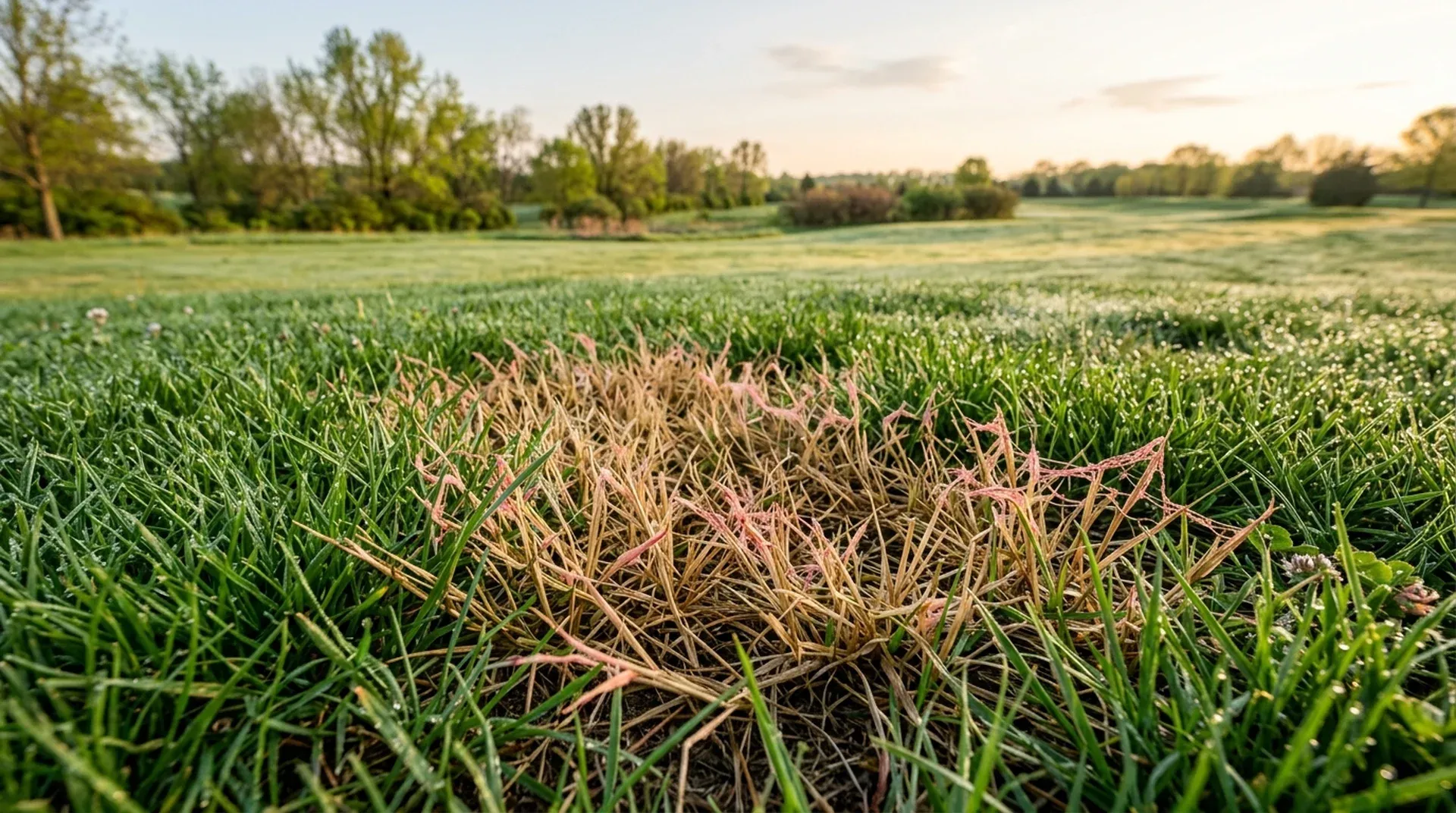
Many brown spots in a lawn aren't fungus at all. Drought, dog urine, grubs and fertilizer spills cause plenty of them, and a screwdriver and a firm tug will rule most of those out in a few minutes. If it does turn out to be disease, the spot's look, the season and your grass type usually point to the culprit, and some of the most common, like red thread, are mostly cosmetic.
Rule out the usual suspects first
Utah State University Extension notes that lawn diseases don't spread overnight, so when whole neighborhoods brown out at once, weather is usually to blame. Work through these checks before you buy a fungicide:
- Screwdriver test. Push a screwdriver with a 6-inch shaft into the soil. Utah State says that if it slides in easily, the soil is moist enough and watering isn't the problem. If it won't go in, think drought. Utah State adds that lawns browning after a sudden heat wave are often just dormant and recover in a few weeks with normal watering.
- Tug test. Pull on the grass at the edge of the spot. If it lifts easily, something has eaten the roots, usually grubs or sod webworms, according to Utah State. See our guides to lawn grubs and chinch bugs.
- Look for a green ring. Purdue Extension describes classic dog urine damage as a brown center 3 to 6 inches across inside a dark green ring 6 to 12 inches across. Unlike fungus, urine spots show no cottony growth in the morning and no water-soaked, matted blades. Watering the spot where the dog went helps.
- Think back to spills. Purdue notes that a fertilizer spill causes damage similar to animal urine.
If the soil is moist, the grass doesn't pull up and there's no green ring, Utah State says it may be a lawn fungus.
Common lawn fungus diseases at a glance
|
Disease |
What you see |
When it shows up |
Grasses most affected |
|---|---|---|---|
|
Red thread |
Tan or pink patches with red, antler-like threads on blade tips |
Cool, wet spring and fall weather |
Fine fescue, perennial ryegrass, Kentucky bluegrass, tall fescue |
|
Dollar spot |
Straw-colored spots 2 to 6 inches across that can merge |
Late spring through fall, warm days, cool nights, heavy dew |
Bermuda, zoysia, tall fescue, ryegrass, bentgrass |
|
Brown patch |
Light brown patches from a few inches to several feet, tan leaf lesions with dark borders |
Midsummer, hot humid nights |
Tall fescue, perennial ryegrass, bentgrass |
|
Large patch |
Patches that often show up as the lawn greens up in spring |
Fungus active in fall and again at spring green-up |
Centipede, St. Augustine, zoysia |
|
Rust |
Orange to reddish-brown flecks and raised pustules on blades |
Warm, humid weather on stressed lawns |
Bluegrass, tall fescue, ryegrass, zoysia |
|
Fairy ring |
Ring of dark green grass 1 to 12 or more feet across, sometimes mushrooms |
Mushrooms pop up after long wet spells |
All grasses |
Sources: Purdue and Wisconsin (red thread), Clemson (dollar spot and rust), Penn State (brown patch), Clemson (large patch), UC IPM (fairy ring).
Grass type is the big regional clue. Red thread and brown patch mostly hit cool-season grasses, while large patch is a warm-season lawn disease of the South. Washington State notes brown patch is relatively rare west of the Cascades.
Red thread: pink threads, mostly cosmetic
Red thread gets its name from the red or pink antler-like structures the fungus grows on the tips of infected blades, which Purdue says are visible without magnification. Penn State puts the strands at 1/16 to 1/4 inch long. Wisconsin Extension says those thick red tendrils are what set it apart from look-alike pink patch.
It shows up in mild, wet weather in spring and fall. Penn State says it tends to develop at 65°F to 75°F with long rainy or humid spells, mostly on lawns that don't get enough nitrogen.
The good news: Purdue says red thread doesn't infect crowns or roots, so turf eventually will recover. What helps:
- Feed it. For lawns with a history of red thread, Purdue suggests a light 0.2 lb of nitrogen per 1,000 sq ft in mid to late spring. Penn State cautions that too much nitrogen can bring on brown patch later, so stick to a sensible fertilizer schedule.
- Water less often. Wisconsin says red thread often follows frequent watering and advises watering only when you see wilting.
- Skip the fungicide. Purdue says fungicides are not usually advised for red thread on home lawns because the damage is largely cosmetic.
- Reseed smarter. When seeding, Wisconsin suggests less susceptible grasses such as Kentucky bluegrass and hard fescue.
Dollar spot vs. brown patch
These two are easy to mix up, but size and season usually settle it.
Dollar spot
Clemson describes straw-colored spots about the size of a silver dollar, 2 to 6 inches across, that can merge. Blades show tan spots with reddish-brown edges, and you may see cobwebby growth early in the morning. Like red thread, it's a low-nitrogen disease: Purdue says on home lawns it usually accompanies the normal drop in nitrogen in late spring or early summer, and adequate nitrogen speeds recovery.
Brown patch
Brown patch is a hot-weather disease. Penn State says it shows up when nights stay above 68°F and days average 80°F or more, with patches from a few inches to several feet across. K-State adds that affected tall fescue may look drought stressed even when the soil is moist, and blades show tan lesions with a brown border.
Here the nitrogen advice flips. Penn State says brown patch is worse on lush, irrigated turf given high amounts of nitrogen and on lawns less than a year old. K-State's tips for tall fescue: don't fertilize during active brown patch, put most fertilizer down in fall, mow at 3 to 3.5 inches, and don't overseed at heavy rates. The lawn usually recovers in a few weeks once nights cool off.
Large patch in warm-season lawns
In the South, a relative of the brown patch fungus causes large patch. Clemson calls it probably the most common and damaging disease of warm-season turfgrass in South Carolina, worst on centipede, then St. Augustine and zoysia. Early spring or fall nitrogen, frequent watering, low mowing, thatch and poor drainage all favor it. Once it takes hold, Clemson says it likely will take fungicide: start in fall when soil temperatures drop to 70°F, repeat 3 weeks later, and treat once more at spring green-up.
Mushrooms and fairy rings
Mushrooms are usually just a nuisance. UC IPM says they often grow from buried wood or dead roots, and most lawn fungi are beneficial because they break down organic matter. Picking them won't kill the fungus underground, but do it anyway: some are poisonous to children and pets.
Fairy rings are a different story when the grass inside the ring dies. UC IPM suggests breaking up the fungal mat by core aerating, starting 2 feet outside the ring, watering deeply and washing the aerator afterward. It calls this faster and more effective than fungicide.
How to treat lawn fungus
Washington State's advice is to make non-chemical fixes your first choice. Start here:
- Water early in the morning, never in the evening. K-State says evening watering creates a long wet period overnight. See our guide to the best time to water your lawn, and follow any local watering-day rules.
- Match nitrogen to the disease. Feed for red thread and dollar spot, and hold back for brown patch and large patch.
- Deal with thatch and compaction. Washington State lists removing thatch and aerating as basic prevention. Our dethatching guide covers how to tell if you need it.
- Fill in dead areas. Once the weather turns, overseed bare spots so weeds don't move in.
Can mowing spread lawn fungus? A little. Penn State says red thread can be carried by mowers and foot traffic, and Purdue says dollar spot moves on infected leaf blades during mowing and core aeration.
When a fungicide makes sense
Fungicides won't fix the watering or feeding that caused an outbreak, and store products have limits. K-State cites an Oklahoma State study in which ready-to-use homeowner fungicides did not reduce brown patch compared with untreated grass, while some commercial products did.
If you use one:
- Read the label. K-State says to confirm the label lists home lawns as an allowed site and to follow every instruction.
- Rotate products. Wisconsin advises alternating at least two ingredients with different modes of action to slow resistance.
- Water in granules. Clemson says granular fungicides need at least 1/2 inch of irrigation.
- Check local rules. Some states and towns restrict lawn pesticides. Your state pesticide regulatory agency can tell you what's registered and allowed.
Not sure what you have? K-State suggests asking your local Extension office for a diagnosis. Utah State's lab, for example, charges $10 to $20 per sample.
When to call a pro
Call a lawn care company if patches keep spreading after you've fixed watering and feeding, or if large patch returns every spring. Purdue says that when a home lawn truly needs fungicide, it should be applied by licensed applicators, and K-State says products available to lawn companies tend to perform better than homeowner versions.
Before you hire:
- Get 2 or 3 written quotes that name the disease, the product and how many applications are included.
- Ask what cultural changes they recommend, such as watering or fertilizer timing, not just spraying.
- Ask for photos or references from similar lawns nearby.
- Check pesticide licensing and insurance where your state requires it.
- Get the scope, schedule and payment terms in writing.
You can find lawn care pros near you on LandscapeLookup for free, with no sign-up. Pros are ranked by their Google rating weighted by review count, plus how local they are and their main service, and you contact them directly.
Editorial team
The LandscapeLookup editorial team writes guides to help US homeowners plan yard projects and hire the right pro. Each guide is based on university extension services, government sources such as EPA WaterSense and USDA, manufacturer instructions and published cost guides, and links to them so you can check the details.
Keep reading
Types of Grass for Lawns, by Region
Lawn grasses are cool-season (Kentucky bluegrass, tall fescue, perennial ryegrass, fine fescue) for the North or warm-season (Bermuda, zoysia, St. Augustine, centipede, bahia, buffalograss) for the South. Pick by region first, then by sun, traffic and water.
October 28, 2026
When to Apply Pre-Emergent for Crabgrass
Apply crabgrass pre-emergent in spring, a week or two before the soil holds about 55°F for several days in a row, then water it in. That ranges from mid-February in the Florida Panhandle to mid-April through early May in places like Nebraska.
October 14, 2026
How to Test Your Lawn Soil (and When to Add Lime)
Mix 10 or more small soil cores from your lawn, send about 2 cups to your state's extension lab, and add lime only if the report says your pH is too low, in spring or fall, at no more than 50 lb per 1,000 sq ft at a time.
October 12, 2026