Flagstone Patios: Cost and How They're Built
A flagstone patio usually costs $15 to $27 per square foot installed, or about $3,600 on average. Most are dry-laid on compacted gravel and sand; mortared stone on a concrete slab costs more and can crack in freeze-thaw climates.
By LandscapeLookup Editors7 min read
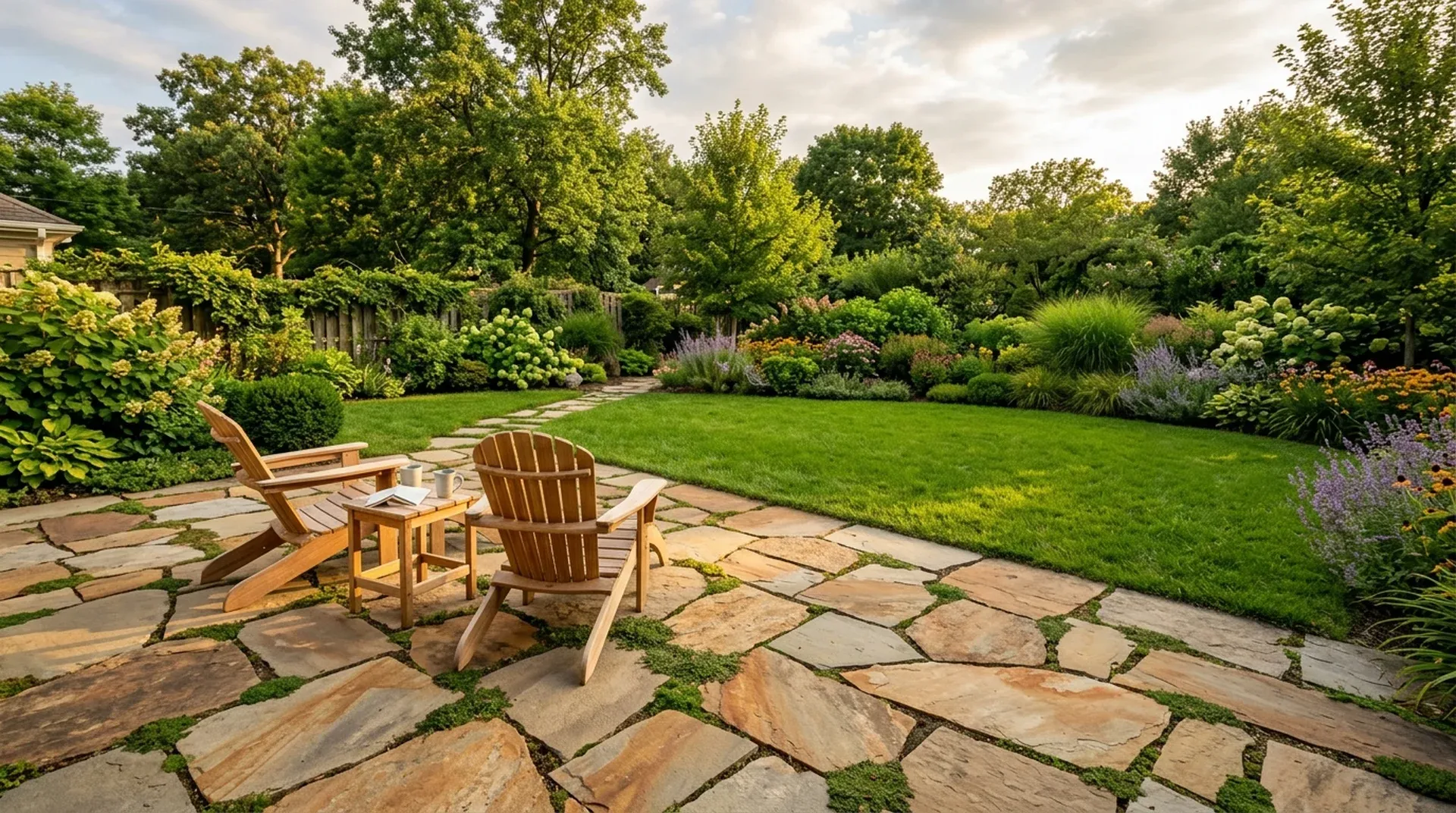
A professionally built flagstone patio usually costs $15 to $27 per square foot, or about $3,600 for an average project, according to Lawn Love's 2026 cost guide. That makes it pricier than poured concrete or concrete pavers. Most are dry-laid: irregular slabs of natural stone set on compacted gravel and a thin bed of sand or fine gravel. The joints get sand, gravel or plants.
How much does a flagstone patio cost?
Lawn Love puts the typical range at $750 to $8,265, with labor alone at about $11 to $15 per square foot. Here's its breakdown by size:
|
Patio size |
Installed cost |
|---|---|
|
7 x 7 ft (49 sq ft) |
$750-$1,325 |
|
10 x 8 ft (80 sq ft) |
$1,200-$2,160 |
|
12 x 12 ft (144 sq ft) |
$2,160-$3,890 |
|
16 x 18 ft (288 sq ft) |
$4,320-$7,775 |
|
20 x 20 ft (400 sq ft) |
$6,000-$10,800 |
Source: Lawn Love, updated October 2026. Prices vary by region.
So how much does a 20 x 20 flagstone patio cost? Roughly $6,000 to $10,800 by that math. Other cost guides run higher at the top. This Old House lists flagstone at $15 to $30 per square foot and says an install can reach $50 per square foot. Bob Vila's 2023 figures put it at $16 to $30 installed.
What pushes a quote up:
- Irregular stone. Landscaping Network says stone with factory-cut edges is cheaper to install than irregular pieces, which have to be chipped and fitted like a puzzle.
- Shipping and location. Stone trucked a long way costs more, and Lawn Love says New England and California run above average.
- Mortar and a concrete slab. Mortared work costs more than dry-laid (more on that below).
To save, Lawn Love suggests mixing flagstone with pavers, simplifying the design or buying stone direct from a quarry.
Is flagstone more expensive than pavers or concrete?
Yes, usually by a wide margin. Lawn Love's patio cost guide puts plain poured concrete at $4 to $10 per square foot and pavers at $8 to $25. Flagstone starts about where pavers top out.
|
Material |
Typical installed cost per sq ft |
|---|---|
|
Poured concrete |
$4-$10 |
|
Stamped concrete |
$8-$25 |
|
Pavers |
$8-$25 |
|
Flagstone |
$15-$27 |
Sources: Lawn Love patio costs and Lawn Love flagstone costs.
You pay for a natural look and easy spot repairs: Landscaping Network notes that a cracked or stained stone can be replaced on its own. For the alternatives, see our guides to paver patio cost, pavers vs. concrete and stamped concrete patios.
Which type of flagstone is best?
The best flagstone for you is a dense stone with a track record in your climate. "Flagstone" isn't one rock: Fine Homebuilding calls it any big, flat, quarried stone used for walks and patios, and hardness and porosity vary a lot.
|
Stone |
What to know |
|---|---|
|
Bluestone |
Durable sedimentary stone quarried in Pennsylvania and Connecticut, per Landscaping Network; Fine Homebuilding calls it the most common choice for walks in the Northeast |
|
Sandstone |
Light, pale and slow to absorb heat, so it's popular in the Southwest, but porous: it can flake, stain and shift in hard freezes (Landscaping Network) |
|
Quartzite |
A harder metamorphic stone that one California contractor prefers around pools because softer flagstones degraded quickly |
|
Limestone |
Sedimentary, like sandstone; Landscaping Network says the hardness of sedimentary stone varies considerably |
|
Slate |
Nonslip and often used around pools, but Bob Vila says it isn't considered a long-lasting patio stone |
Landscaping Network suggests picking a stone with a long track record in local yards, ideally quarried nearby, and being wary of brightly colored stone, which may be softer. In cold-winter regions, ask how the stone handles freeze-thaw. In hot ones, Rosie on the House notes flagstone can get very hot and slippery when wet.
Thickness matters too. Lawn Love says patio flagstone is typically 1.5 to 2 inches thick. Hunker suggests 1.5 to 4 inches over sand, but only 1/2 to 1.5 inches over a concrete slab.
Dry-laid vs. mortared flagstone
There are two main ways to build a flagstone patio, per Landscaping Network.
|
|
Dry-laid |
Mortared |
|---|---|---|
|
Base |
Compacted gravel plus sand or fine gravel |
A concrete slab, or sometimes compacted gravel and sand |
|
Joints |
Sand, polymeric sand, gravel or plants |
Mortar or grout |
|
Cost |
Lower |
Higher |
|
Repairs |
Lift a stone and re-bed it |
Chip out and regrout cracked joints |
|
Best fit |
Most yards, especially cold climates |
Formal look, smooth surface |
Fine Homebuilding says a dry-laid walk is less expensive and less prone to cracking from freeze-thaw cycles, and that concrete-set stone is prone to cracking in colder climates. A stone that moves in a dry-laid patio is simple to reset.
Mortared flagstone gives a smoother, more solid surface and is the way to cover an existing concrete slab. In cold country it takes extra care. A Colorado Springs contractor quoted by Landscaping Network uses a 4-inch reinforced, sloped concrete base. He also seals the finished patio to keep water and ice out of the joints.
How a flagstone patio is built
Before anyone digs, call 811. It's free, and 811 Before You Dig says to contact them a few business days ahead. Then a dry-laid patio goes in roughly like this:
- Lay out and plan the slope. Supplier Kreitmaker recommends a slope of about 1/4 inch per foot. That matches ENERGY STAR guidance cited by the Building America Solution Center. Hard surfaces within 10 feet of the house should drop at least 1/4 inch per foot away from the foundation.
- Excavate. Depth depends on soil and frost. Kreitmaker calls for 6 to 8 inches, depending on soil and load. A Vermont stoneworker writing in Fine Homebuilding digs about 16 inches below finished grade, less where the soil is hard and the ground doesn't freeze. He extends the base 1 foot past each edge.
- Build and compact the base. Fine Homebuilding recommends clean, angular crushed stone with no fines, which block drainage, compacted in thin layers. Stone quarrier Polycor's paver installation guide calls for at least 4 inches of compacted base over well-drained soil and 6 to 8 inches over clay or silty soil. It also says never to build on frozen ground.
- Add the bedding. Fine Homebuilding sets stone in 1 to 2 inches of bedding, such as 3/8-inch pea gravel for larger flags. Kreitmaker uses 1 to 2 inches of sand or stone dust.
- Set the stones. Landscaping Network says to work from the perimeter inward and to put large stones at doorways and the bottom of steps, where traffic is heaviest.
- Fill the joints (see below).
On clay or where roof runoff hits the patio, Fine Homebuilding pitches the subgrade 1/4 inch per foot to a perforated pipe that drains to daylight. See yard drainage solutions for more options.
Can you lay flagstone directly on soil?
For a lightly used spot, yes. Landscaping Network describes setting flagstone directly on topsoil when the joints will be planted with groundcover such as woolly thyme. It suggests plant or gravel joints for low-traffic sitting areas and walkways. For a main patio with furniture on it, plan on a compacted base. Fine Homebuilding notes that settling comes from poor compaction or erosion, and heaving from freezing water and tree roots.
What to put between flagstones
- Sand or stone dust: the simplest fill, but Kreitmaker says to top it up every couple of years.
- Polymeric sand: locks joints and resists weeds. Alliance Gator rates its Maxx G2 for natural stone with joints up to 4 inches wide on a gravel base, or 2 inches over a slab. See our polymeric sand guide for how to apply it.
- Gravel: Landscaping Network's Colorado contractor beds the stone on compacted decomposed granite and fills joints with gravel.
- Groundcover: see ground cover plants for low growers that handle some foot traffic.
- Mortar: standard over a concrete slab.
DIY cost and upkeep
You can build a dry-laid patio yourself, but the savings may be small. Lawn Love's DIY estimate for a 144-square-foot patio, buying stone, base, joint sand, sealer and every tool, is $2,171 to $2,421. That's close to its $2,160 to $3,890 for hiring it out. Renting a plate compactor runs about $83 a day or $333 a week, per Lawn Love.
The stone is heavy. Hunker's coverage chart says a ton of 1.5-inch flagstone covers about 150 square feet, and a ton of 2-inch stone about 100 square feet. Hunker adds 10 to 15% for waste; Landscaping Network says contractors order at least 25% extra so they have pieces left to finish the puzzle. Line up helpers, as Rosie on the House advises.
For upkeep, sweep often so debris doesn't stain the stone, and re-bed stones that sink. On sealing, advice splits:
- Landscaping Network recommends a matte penetrating sealer when the patio is finished, reapplied every year.
- Rosie on the House, based in Arizona, warns that sealed flagstone in hot sun can deteriorate faster because moisture gets trapped underneath.
- Kreitmaker notes that not every sealer suits every stone.
Ask your stone supplier what works for your stone and climate. Lawn Love puts resealing at about $115 to $245, recommended every 18 to 36 months.
When to call a pro
Hire a hardscaping contractor if the patio is large, sloped, over clay, mortared onto a slab, or tied into steps, walls or a fire pit. Check with your city and HOA first, and leave any gas or electrical work to a licensed pro.
- Get 2 or 3 written quotes that spell out stone type and thickness, base depth, bedding and joint material, so you can compare line by line.
- Ask for photos of similar work, ideally flagstone patios a few years old in your climate.
- Check licensing and insurance where your state requires it for landscape or masonry work.
- Get the scope and payment schedule in writing, including cleanup, leftover stone and any warranty on settling.
You can find local stone and patio installers on LandscapeLookup for free, with no sign-up. Pros are ranked by Google rating weighted by review count, plus how local they are and their main service, and you contact them directly. Find a hardscaping pro near you, or browse outdoor living pros if the patio is part of a bigger project.
Editorial team
The LandscapeLookup editorial team writes guides to help US homeowners plan yard projects and hire the right pro. Each guide is based on university extension services, government sources such as EPA WaterSense and USDA, manufacturer instructions and published cost guides, and links to them so you can check the details.
Keep reading
How to Lay Pavers: Base, Sand and Steps
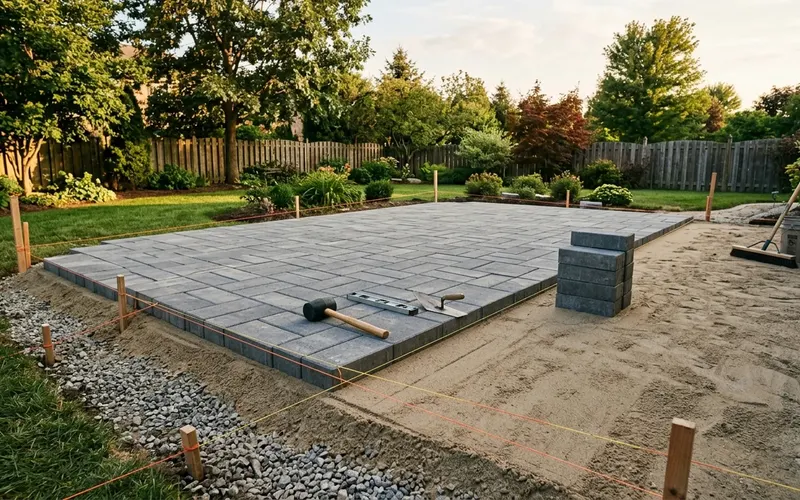
Lay pavers on at least 4 inches of compacted crushed-stone base (more on clay or in freezing climates), then 1 inch of screeded concrete sand. Set the pavers, add edge restraints, compact and sweep in joint sand, with a slope of 1/8 to 1/4 inch per foot.
September 24, 2026
Driveway Costs for Asphalt, Concrete, Pavers and Gravel
A new asphalt driveway usually costs $7 to $15 per square foot installed, or about $3,100 to $7,400 for a typical job. Gravel costs less, concrete a bit more, and pavers the most.
September 20, 2026
Stamped Concrete Patios: Cost, Pros and Cons
A stamped concrete patio usually costs about $8 to $25 per square foot installed, so a 20 x 20 ft patio often runs $4,000 to $8,000. It looks like stone or brick for less than pavers, but it can crack and needs resealing every 2 to 3 years.
September 15, 2026