How to Lay Pavers: Base, Sand and Steps
Lay pavers on at least 4 inches of compacted crushed-stone base (more on clay or in freezing climates), then 1 inch of screeded concrete sand. Set the pavers, add edge restraints, compact and sweep in joint sand, with a slope of 1/8 to 1/4 inch per foot.
By LandscapeLookup Editors7 min read
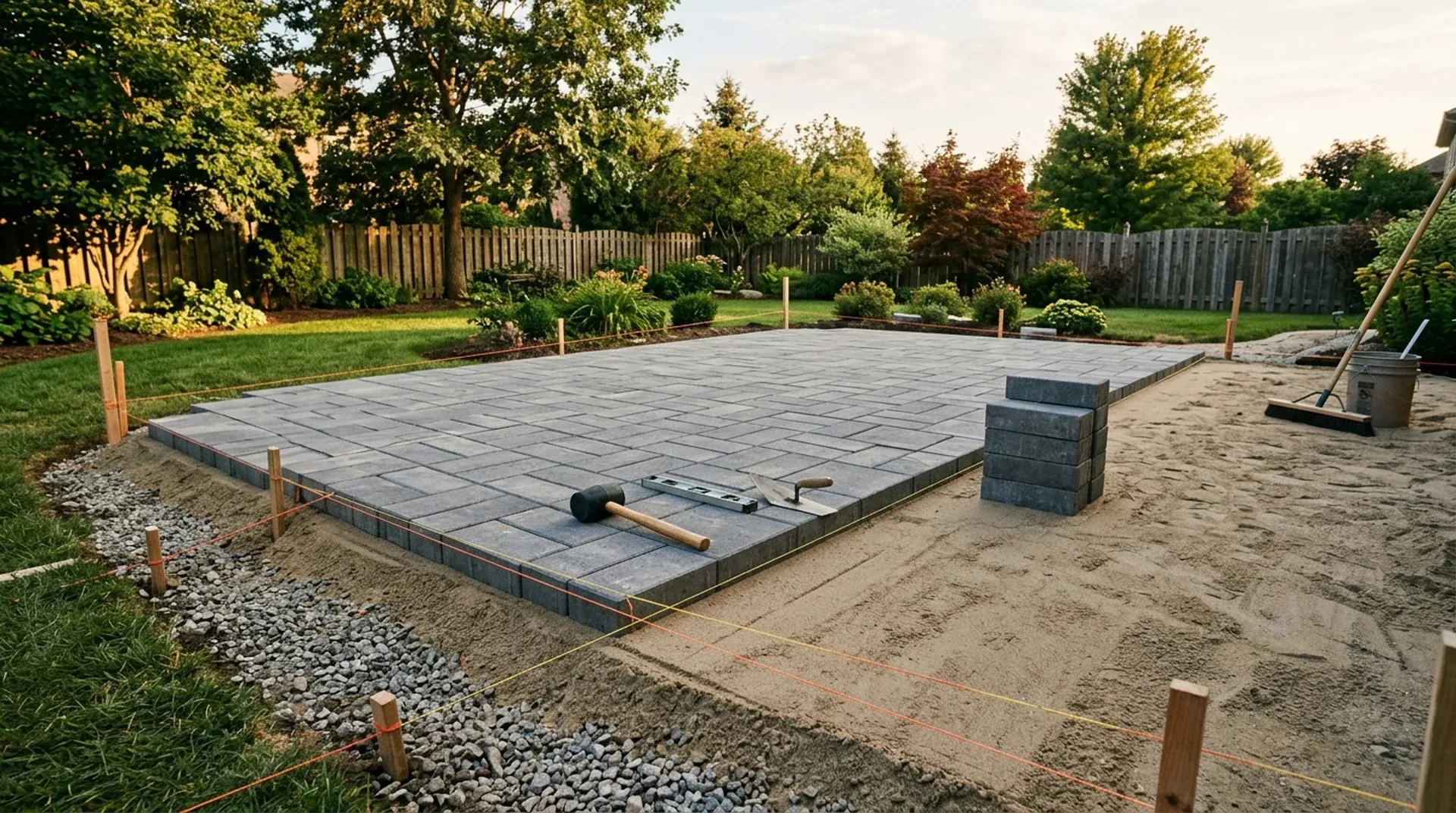
To lay pavers that stay flat, build in layers: compacted soil, a paver base of at least 4 inches of compacted crushed stone (more on clay or where the ground freezes), and 1 inch of screeded concrete sand under the pavers. Edge restraints, a plate compactor and joint sand lock everything together. Slope the surface 1/8 to 1/4 inch per foot away from the house.
What goes under pavers?
A standard paver patio is "sand-set": no concrete or mortar underneath. The Concrete Masonry & Hardscapes Association (CMHA, formed from ICPI and NCMA) calls pavers a semi-flexible system that shares loads between units. Here are the layers, from the bottom up:
|
Layer |
Material |
Thickness |
|---|---|---|
|
Subgrade |
Your native soil, leveled and compacted |
n/a |
|
Base |
3/4-inch minus crushed stone (angular, with fines) |
4 inches or more after compaction |
|
Bedding |
Washed concrete sand, or 1/8-inch chip stone (ASTM No. 9) |
1 inch, not compacted |
|
Pavers |
Concrete, clay or stone pavers |
Often 2 3/8 inches for concrete |
|
Joints |
Joint sand or polymeric sand |
Fills the gaps |
Layers from Unilock, Mutual Materials and Rochester Concrete Products, all paver makers.
Best base for pavers, and what to avoid
Use crushed stone with sharp, mixed-size pieces. Oregon State University Extension notes that 3/4 minus gravel compacts easily because of those sharp edges and varied sizes. The CMHA says to never use stone dust or screenings, and to skip rounded stone like river rock or pea gravel.
Common shortcuts don't hold up:
- Pavers on dirt: Unilock says no, because soil lacks the stability and drainage of a gravel base.
- Sand instead of a base: sand is only the thin leveling layer. Iowa State University Extension (in a 1995 article) warns that using sand to fill low spots in the base is a common error. More than 1 1/2 inches of sand gives a "washboard" surface.
- The wrong sand: Rochester says to use washed concrete sand, not play sand or mason sand. Polycor's installation guide warns that fine mason's sand can leave the surface wavy.
How deep should a paver base be?
Base depth depends on traffic, soil and climate. The CMHA gives these minimums for ideal conditions, meaning strong, well-drained soil in a climate that doesn't freeze:
|
Project |
CMHA minimum base |
What manufacturers suggest |
|---|---|---|
|
Patio or walkway |
4 inches |
4 to 6 inches (Unilock tips); 6 to 10 inches (Unilock base guide) |
|
Patio on clay or silty soil |
Add depth |
6 to 8 inches (Polycor) |
|
Residential driveway |
6 inches |
8 to 12 inches (Unilock tips) |
The CMHA's quick estimate is to add 50% of the minimum for each condition your site lacks: strong soil, good drainage or a non-freezing climate. For a patio, that means 6 inches if one is missing, 8 for two and 10 for all three. By that rule, weak, poorly drained clay in a cold-winter state works out to 10 inches. Firm, well-drained soil in a frost-free area can stay at the 4-inch minimum.
To find your total dig depth, add the base, 1 inch of sand and the paver thickness, per Oregon State. With a 4-inch base and 2 3/8-inch pavers, that's about 7 1/2 inches, which lines up with Mutual Materials' minimum of 7 inches. Dig wider than the patio, too: Unilock and Polycor both say the base should extend past the paver edge by a distance equal to its depth.
What about paver base panels?
Plastic panels such as Brock PaverBase replace most of the gravel. Brock's instructions put landscape fabric, 1/2 inch of leveling sand and the panels over compacted soil, with about 3 inches of digging in its example. They also say not to plate-compact the finished pavers. Brock's listed uses include patios and walkways, not driveways. Follow the panel maker's directions rather than mixing systems. Brock also publishes overlay instructions for laying pavers over an old concrete slab.
Tools and materials
Beyond a shovel, rake and wheelbarrow, you'll need stakes, string and a 4-foot level. For screeding, get two 1-inch pipes and a straight 2x4. Add a rubber mallet, a diamond-blade saw or paver splitter, edging with spikes, a broom and a plate compactor with a rubber pad. Western Interlock lists plate compactor rentals at around $85 a day or $340 a week (a 2022 figure, so check local rates).
|
Material |
Rule of thumb |
10 x 12 ft patio (120 sq ft) |
|---|---|---|
|
Base gravel, 4 inches |
1 cu yd per 80 sq ft (Western Interlock) |
About 1 1/2 cu yd |
|
Base gravel, 4 inches |
About 1 ton per 100 sq ft (Rochester) |
About 1 1/4 tons |
|
Bedding sand, 1 inch |
1 cu yd per 200 sq ft (Western Interlock) |
About 0.6 cu yd |
|
Pavers |
Area plus 5% to 10%; 15% to 20% with curves |
126 to 132 sq ft |
The patio column is simple multiplication of each source's rule. A 6-inch base needs 1 1/2 times the gravel. Waste allowances are from Western Interlock, Oregon State and Rochester.
For what a finished patio costs if you hire it out, see our paver patio cost guide.
How to lay pavers, step by step
- Call 811 and mark the area. Contact 811 a few business days before you dig; it's free. Then mark the outline with paint. Mutual Materials sets its stakes at least 12 inches outside the area to leave room for edging. Western Interlock uses a 3-4-5 triangle to square the first corner.
- Set the slope. Run string lines at finished height, sloping away from the house. Guides range from at least 1/8 inch per foot (Western Interlock) to 1/4 inch per foot (Rochester), which equals Oregon State's 1 inch per 4 feet. Unilock's trick: tape a 1/2-inch spacer under one end of a 4-foot level, and when the bubble centers, you have about a 1% slope.
- Dig and compact the soil. Excavate to full depth and compact the soil. On clay, Unilock suggests geotextile fabric under the base to keep clay from mixing in, but not plastic sheeting, which traps water.
- Build the base in lifts. Spread gravel 2 to 4 inches at a time and compact each layer (Polycor). Unilock says most standard plate compactors won't compact more than about 4 inches, so a thick single layer will settle later. Dampen dry gravel to help it pack. Polycor's tolerance for the finished base is plus or minus 3/8 inch over 10 feet. Fix low spots with more base rock, not sand (Mutual Materials).
- Screed the sand. Lay the 1-inch pipes on the base, fill between them with sand and pull the 2x4 across. Remove the pipes, fill the grooves and don't compact or walk on the sand. Unilock advises screeding only what you can cover with pavers that day.
- Lay the pavers. Start at a square corner. Use the "click and drop" method: touch each paver against its neighbor, then set it straight down without sliding it (Rochester). Mutual Materials says not to hammer pavers into the sand and to pull from several pallets to blend colors. Check rows with a string line and cut edge pieces last. Wear safety glasses and a dust mask or respirator; Rochester warns that dry cutting releases silica dust.
- Install edge restraints. Any edge not held by a wall or slab needs plastic, metal or concrete edging. Polycor says to drive the spikes into the compacted base, not the soil, and that soil backfill doesn't count as an edge restraint. Mutual Materials uses 10-inch spikes every 8 to 12 inches.
- Compact and fill the joints. Run the plate compactor, with a rubber pad, over the pavers. Sweep joint sand in, then compact again in perpendicular passes until the joints stay full (Mutual Materials). If you use polymeric sand, follow the bag's dry-surface and watering steps exactly. Sealing is optional; see whether you should seal pavers.
In cold-winter regions, plan the job before the ground freezes. Polycor says base material should never be compacted frozen or placed over frozen soil.
Common mistakes that make pavers sink or shift
|
Problem |
Likely cause |
Prevention |
|---|---|---|
|
Low spots and settling |
Base too thin, or compacted in one thick layer |
Size the base for your soil; compact in 2- to 4-inch lifts |
|
Wavy or washboard surface |
Sand used to level the base, or the wrong sand |
Level with base rock; 1 inch of concrete sand |
|
Pavers spreading at the edges |
No edge restraint, or spikes in soil |
Spike edging into the base |
|
Puddles, staining, mold |
Poor slope or drainage |
1/8 to 1/4 inch per foot fall away from the house |
|
Weeds in joints |
Joints not full |
Fill with polymeric sand to within 1/8 inch of the top (Unilock) |
Oregon State also notes that power washing dislodges joint sand. The upside of pavers is that failures are fixable: the CMHA notes the pavers themselves can be reused when a base is dug out and rebuilt. For how that compares with a poured slab, see pavers vs. concrete.
When to call a pro
A small, flat patio or walkway is a realistic DIY job. Hire a hardscaping contractor for driveways (Mutual Materials says vehicle areas need separate guidelines), large patios, clay or wet soil, or a sloped yard. If the patio needs a retaining wall over about 4 feet tall, use a licensed pro; see retaining wall costs.
Bob Vila's 2023 guide says paver patios generally don't need a permit unless they involve significant excavation, grading or drainage work. Check with your city and HOA before you start.
- Get 2 or 3 written quotes that list base depth and material, bedding material, edging and joint sand.
- Ask for photos of similar work, ideally patios a few years old.
- Check licensing and insurance where your state requires them for hardscape contractors.
- Get the scope and payment schedule in writing, including haul-away and any warranty on settling.
LandscapeLookup is free for homeowners, with no sign-up. Pros are ranked by Google rating weighted by review count, plus how local they are and their main service, and you contact them directly. Find a hardscaping pro near you.
Editorial team
The LandscapeLookup editorial team writes guides to help US homeowners plan yard projects and hire the right pro. Each guide is based on university extension services, government sources such as EPA WaterSense and USDA, manufacturer instructions and published cost guides, and links to them so you can check the details.
Keep reading
Flagstone Patios: Cost and How They're Built
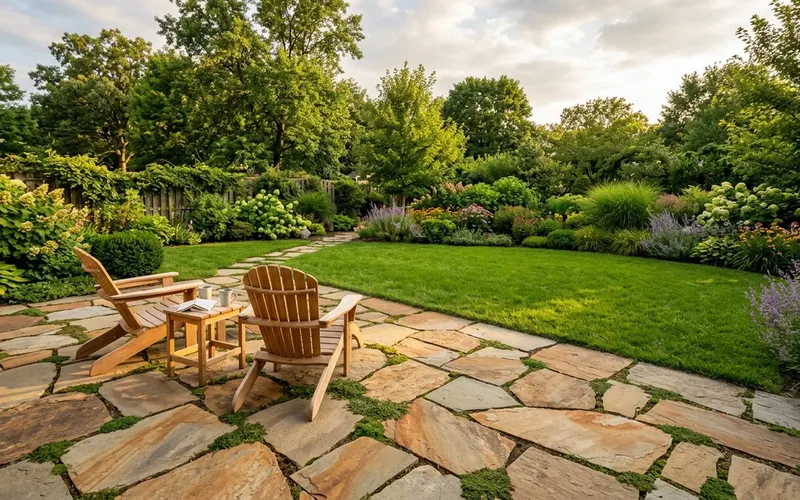
A flagstone patio usually costs $15 to $27 per square foot installed, or about $3,600 on average. Most are dry-laid on compacted gravel and sand; mortared stone on a concrete slab costs more and can crack in freeze-thaw climates.
October 3, 2026
Driveway Costs for Asphalt, Concrete, Pavers and Gravel
A new asphalt driveway usually costs $7 to $15 per square foot installed, or about $3,100 to $7,400 for a typical job. Gravel costs less, concrete a bit more, and pavers the most.
September 20, 2026
Stamped Concrete Patios: Cost, Pros and Cons
A stamped concrete patio usually costs about $8 to $25 per square foot installed, so a 20 x 20 ft patio often runs $4,000 to $8,000. It looks like stone or brick for less than pavers, but it can crack and needs resealing every 2 to 3 years.
September 15, 2026