

Landscape Fabric: Is It Worth It?
Landscape fabric is worth it under rock and gravel, where it keeps stones from sinking into the soil. In permanent beds under bark or wood chips, many extension experts say skip it: weeds root on top, plant roots grow into it and it's hard to remove.
By LandscapeLookup Editors7 min read
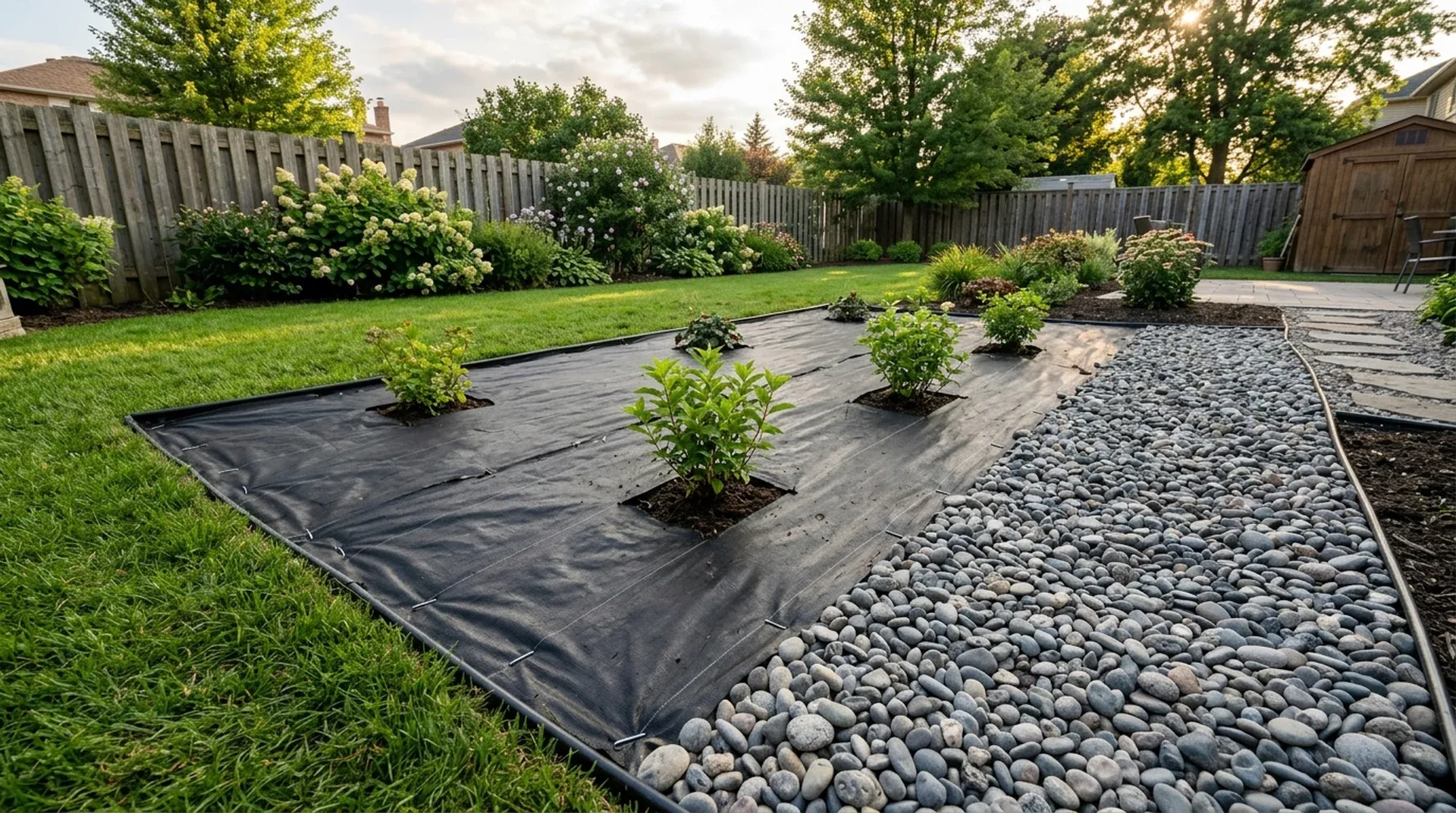
Landscape fabric is worth it under rock, gravel paths and dry creek beds, where it keeps stones from sinking into the soil and keeps soil from working up into the stone. Under bark or wood chips in permanent shrub and flower beds, many extension horticulturists say skip it. Weeds take root in the debris on top, plant roots grow into it, and pulling it out later is a big job.
There are middle cases, like a vegetable garden where you lift the fabric every fall. Here's where it pays off and what to use instead.
Where is landscape fabric worth it?
It comes down to what goes on top and how long it stays.
|
Where |
Worth it? |
Why |
|---|---|---|
|
Under rock mulch and gravel paths |
Yes |
Keeps rock from sinking and soil from rising into it |
|
Dry creek beds and under downspouts |
Yes |
Same reason; UF/IFAS says rock sinks into sandy soil without it |
|
Long-term tree and shrub beds |
Sometimes |
Can pay off if the planting stays 4+ years, but roots grow into it |
|
Perennial beds under bark or wood chips |
Usually not |
Weeds root in the mulch on top; organic mulch alone works better |
|
Annual flower beds |
No |
Replanting means constant cutting and patching |
|
Under spreading ground covers |
No |
Blocks them from rooting and filling in |
|
Vegetable rows, one season at a time |
Yes, if you lift it |
Works when it's removed and reused each year |
UC IPM recommends fabric under rock mulch because it stops the rock from sinking and keeps soil from moving up, which would bring weed seed to the surface. UF/IFAS limits rock mostly to pathways, dry creek beds and spots under downspouts and says to lay fabric first or the rock will sink into sandy soil. Rock has limits, though: EPA WaterSense advises against rock mulch in sunny spots or around plants not adapted to dry climates, since it radiates heat and can lead to scorching. Our guide to landscape rock covers types and costs.
For beds, the experts disagree a bit. UC IPM says fabric becomes cost-effective if a planting stays in place 4 or more years, mainly around woody trees and shrubs, and that fabric under mulch controls more weeds than mulch alone. Washington State University's Linda Chalker-Scott is blunter: geotextiles are not effective weed control for permanent landscapes and work best in farm fields and annual beds where they get replaced. UNH Extension says organic mulch alone is the best weed control in almost all perennial and shrub beds.
Seasonal use is the exception. NDSU Extension notes that a Master Gardener group lays woven fabric in a garden each season, then removes and stores it for the next year.
What are the disadvantages of landscape fabric?
UNH says fabric does a wonderful job at first. The trouble builds over time.
- Weeds grow on top. Any soil or mulch on the fabric becomes a seedbed. NDSU says organic material builds up and gives weeds a place to germinate, and WSU says this rules out covering it with anything but inorganic mulch like pebbles.
- Tough weeds push through. Taprooted weeds such as thistles and dandelions can break through, and NDSU says they're harder to pull because the fabric holds them. UC IPM warns that yellow nutsedge grows through most geotextiles. See our nutsedge guide if that's your weed.
- Plant roots grow into it. Tree and shrub roots penetrate the fabric, and UC IPM says removal can damage them, a concern after about 5 years.
- It clogs. Soil fills the pores over time. UNH says this reduces the water reaching the soil, and WSU Yakima County Extension says it can lead to compacted soil, nutrient deficiencies and root rot.
- It shows. UNH notes fabric seems to always work its way to the surface, and once exposed, it's nearly impossible to tack back down.
How long does landscape fabric last?
It depends on what covers it. Fabric left in the sun can degrade in as little as one year, WSU says. Buried under rock or mulch it lasts much longer, long enough that UC IPM flags root damage on removal after about 5 years.
Will grass grow through landscape fabric?
Some grasses will. Bermudagrass pushes up through wood chips alone, and UC IPM says fabric under the mulch can control it only if the sheets are overlapped so the runners can't slip between them. Any hole or gap lets it back in.
Removing old fabric
If you've inherited a bed with weeds rooted through old fabric, UNH says the best fix is usually to remove the fabric entirely, which is no small task and may tear some plant roots. Then mulch the bare soil with organic mulch.
Types of landscape fabric
Woven and nonwoven fabrics are both polypropylene, and NDSU explains that both let water and air through. Nonwoven has a feltlike texture made by heat-bonding or needle-punching fibers, and woven is stronger and more durable. Roll prices below are from LawnStarter's landscape fabric guide (page updated December 2024) and vary by brand, store and region.
|
Type |
What it is |
Roll price (LawnStarter) |
|---|---|---|
|
Woven |
Interlocked polypropylene strands; strong |
$35 (3 x 100 ft) to $280 (10 x 300 ft) |
|
Nonwoven |
Feltlike, heat-bonded or needle-punched |
$20 (3 x 50 ft) to $180 (10 x 300 ft) |
|
Spunbonded |
A tough nonwoven of bonded fibers, sold in weights such as 1.5, 3 or 8 oz |
$20 (thin, 3 x 100 ft) to $300 (8 oz, 6 x 100 ft) |
|
Perforated |
Lightweight, with precut planting holes |
Under $10 (4 x 8 ft sheet) to $80 (3 x 300 ft) |
Thickness and weave matter. UC IPM says thin, lightweight or open-mesh fabrics let more weeds through than closely woven or nonwoven (spunbonded) fabrics. Against nutsedge, UC IPM suggests a thick nonwoven fabric covered with bark or gravel, plus pulling any sprouts that still come up.
Landscape fabric vs. plastic
Fabric beats solid black plastic in beds. UC IPM says plastic restricts air and water movement and can promote root rots, and it tears apart fairly quickly. Clemson HGIC says fabric's advantage is that it lets water and air reach the roots.
How to install landscape fabric the right way
These steps follow UC IPM's instructions:
- Call 811 if you'll dig. Excavating for a gravel path or dry creek bed counts. 811 is free; contact it a few business days before you start.
- Control perennial weeds first. UC IPM says to control existing weeds, especially perennials such as bindweed and nutsedge, before any grading starts.
- Plant first if you can. Lay the fabric over the bed, cut an X over each plant, and pull the plant through. If the fabric is already down, cut an X and dig through it.
- Keep soil off the fabric. Soil from planting holes left on top brings weed seed with it. Fold the X flaps back down afterward.
- Overlap every seam and pin it tight. Use long U-shaped staples. Weeds find any gap.
- Cover it completely. UC IPM suggests about 1 inch of mulch over fabric in beds to block the UV light that breaks it down. Under rock, use enough stone to hide it fully.
- Keep the top clean. WSU says fabric needs continual upkeep to stay free of debris. Pull weeds while they're small, before they tear holes in it.
What to use instead in planting beds
For most flower and shrub beds, these work without having to be dug out later.
- Organic mulch. EPA WaterSense recommends 3 to 4 inches for most plants, and says to pull weeds first. UC IPM says coarse mulch can go up to 4 inches deep, fine mulch about 2 inches, with pieces about 1/4 to 3/4 inch weeding best. Arborist wood chips are often free, WSU notes. Our guide to how much mulch you need has a coverage chart.
- Cardboard or heavy paper (a plastic-free option). UC IPM describes sheet mulching: knock weeds down, lay cardboard or heavy paper, and cover it with coarse mulch. The downsides: paper slows air and water, and it tears if walked on.
- Dense planting. UC IPM says plantings set close together shade the soil and reduce weeds. Mature woody ground covers should exclude most weeds, UC IPM adds; see our guide to ground cover plants.
- Pre-emergent under mulch. UC IPM says home gardeners generally shouldn't need herbicides if they mulch and hand-weed. If you use one, follow the label and check local rules: some places restrict pesticides, such as Montgomery County, Maryland, which bans cosmetic synthetic pesticides on lawns. Our pre-emergent guide covers timing.
How much does landscape fabric cost?
As of May 2026, Homewyse estimates professional installation at $0.48 to $0.99 per sq ft, national average, for basic work on an easy site. That covers the fabric, labor and supplies, not the rock or mulch on top, and Homewyse says costs vary by ZIP code. For a DIY job, you mainly pay for the roll (see the table above) and the staples.
If you're lining a drainage trench, see our guide to yard drainage solutions, since French drains use fabric differently.
When to call a pro
Hire a landscaper if you're converting a large area to rock, building a gravel path that needs excavation, or clearing out an old bed full of weed-tangled fabric. A hardscaping contractor is the better fit for paths, dry creek beds and anything tied into drainage. If the project includes a retaining wall over about 4 ft, use a licensed pro.
Before you hire:
- Get 2 or 3 written quotes for the same scope: fabric type, prep and weed removal, and the depth of rock or mulch on top.
- Ask for photos of similar work, ideally a few years old.
- Check licensing and insurance where your state requires it.
- Get the scope and payment schedule in writing, including haul-away of old fabric.
- Check HOA rules if you're swapping lawn for rock in a front yard.
You can find landscapers near you or hardscaping pros on LandscapeLookup for free, with no sign-up. Pros are ranked by their Google rating weighted by review count, plus how local they are and their main service, and you contact them directly.
Editorial team
The LandscapeLookup editorial team writes guides to help US homeowners plan yard projects and hire the right pro. Each guide is based on university extension services, government sources such as EPA WaterSense and USDA, manufacturer instructions and published cost guides, and links to them so you can check the details.
Keep reading
How Much Does Artificial Turf Cost?
Professional artificial turf installation runs about $5 to $20 per sq ft, with recent cost guide averages running about $13 to $20. A typical 500 sq ft yard costs roughly $2,700 to $10,000, depending on turf quality, prep work and where you live.
October 15, 2026
How to Build a Rain Garden
Pick a spot at least 10 feet from the house where runoff flows but water doesn't already pond, dig a level basin 3 to 8 inches deep (usually 100 to 300 sq ft), berm the low side and plant natives that handle wet and dry.
October 13, 2026
Landscape Rock: Types, Costs and Where to Use It
Common landscape rock like pea gravel, crushed stone, river rock and lava rock runs about $10 to $220 per ton in 2026 cost guides. It works best on paths, dry creek beds and in desert or wildfire-prone yards, and less well in most planting beds.
October 11, 2026