
Lawn Grub Worms: Signs, Damage and When to Treat
Grub worms are beetle larvae that eat grass roots, leaving brown patches that peel up like carpet in late summer. Treat only if you find about 5 to 10 or more per square foot: preventive products go down in late spring to midsummer, curative ones in late summer before grubs reach full size.
By LandscapeLookup Editors7 min read
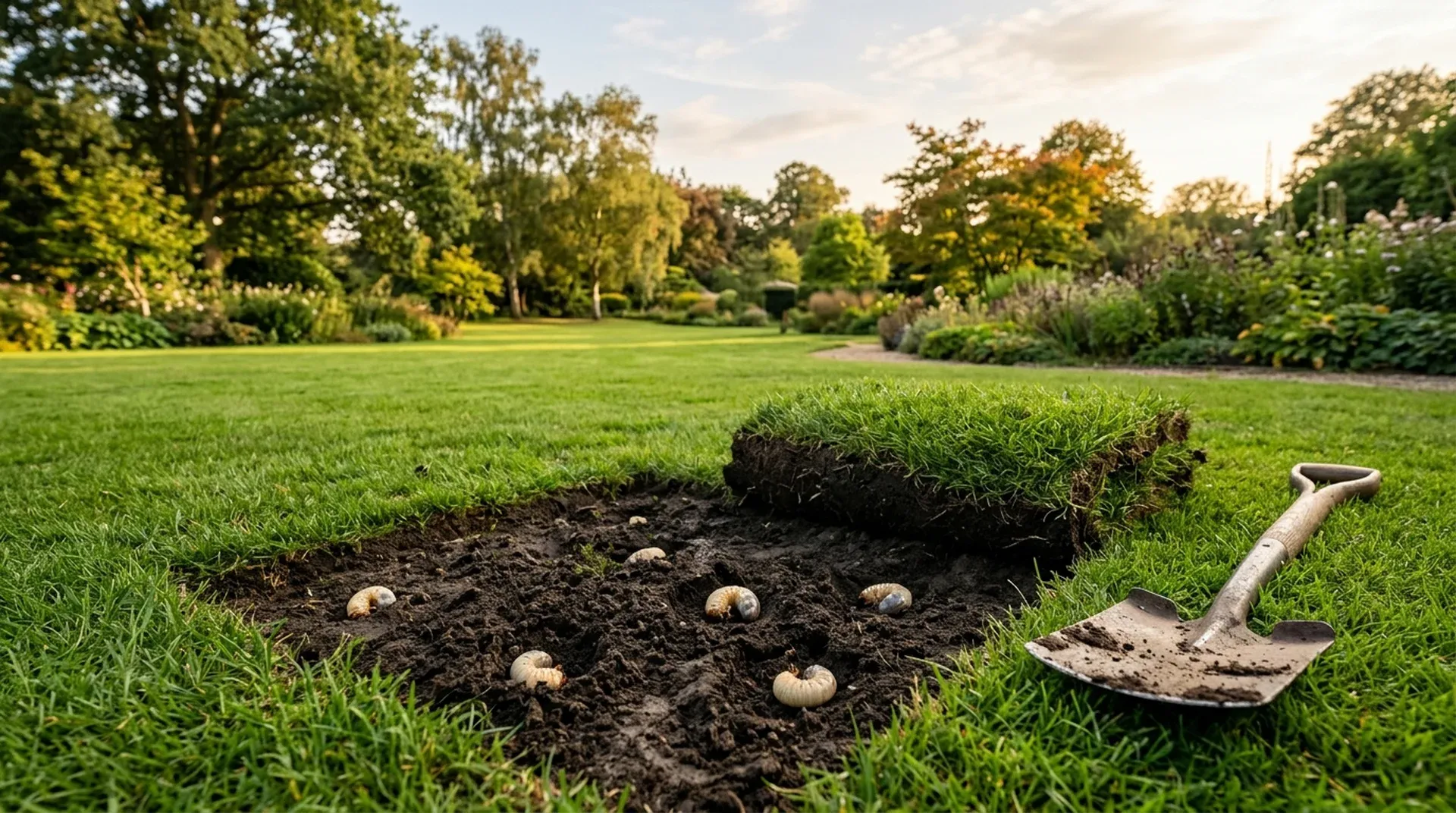
Grub worms are the C-shaped white larvae of beetles like Japanese beetles, chafers and June beetles, and they damage lawns by eating grass roots. The telltale sign is brown, wilted patches in late summer or early fall that peel back like loose carpet. Only treat if you find roughly 5 to 10 or more grubs per square foot, and time the product to the grub's life cycle: preventive products from late spring to midsummer, curative products in late summer.
Most lawns carry a few grubs without any harm, so the real work is confirming you have enough to matter and picking the right window. Here's how.
What grub worms are (and what they turn into)
White grubs are the larvae of scarab beetles. Purdue Extension describes them as white, C-shaped insects with a chestnut-colored head and 3 pairs of legs, usually 1/4 to 1-1/2 inches long when mature. The University of Maryland puts full-size larvae at 3/4 inch to 2 inches, depending on the species.
The grubs in your lawn turn into one of several beetles. Purdue lists the main turf pests as the Japanese beetle, masked chafers, European chafer, Asiatic garden beetle, Oriental beetle, green June beetle and May/June beetles. More than one species can live in the same lawn.
The grub life cycle through the year
Most lawn grubs are "annual" grubs with one generation a year. May/June beetles are slower: Purdue says they need 2 to 3 years to develop, and do the most damage in their second season.
|
Time of year |
What annual grubs are doing |
|---|---|
|
Spring |
Move back up to the root zone and feed briefly, then pupate in late spring |
|
Early to mid-summer |
Adult beetles emerge, mate and lay eggs in the soil |
|
Late July to August |
Eggs hatch and small grubs start eating roots |
|
August to November |
Large grubs feed hard; this is when damage shows |
|
Late fall and winter |
Grubs move deeper into the soil to overwinter |
Source: Purdue Extension. The University of Maryland adds that grubs burrow 6 to 18 inches deep around mid-October. Timing runs earlier in the South: Texas A&M says June beetles and southern masked chafers emerge from late May in South Texas to early July in North Texas.
Signs of grub damage
Texas A&M says grub damage can resemble drought stress. Watch for these signs:
- Wilting that water doesn't fix. Purdue says early damage shows as patchy wilting or discolored turf that doesn't respond to irrigation, sometimes with a blue or purple cast before it dies.
- Turf that lifts like carpet. With the roots eaten, damaged areas feel spongy and lift easily off the soil.
- Animals digging. Skunks, raccoons, turkeys and armadillos tear up turf to eat grubs, and Purdue notes this can be the first obvious sign of an infestation.
- Late-summer timing. Missouri Botanical Garden says damage is most evident from mid-August through September. In the South, Mississippi State flags patches that fail to green up in spring.
Grass type matters. In Maryland, Kentucky bluegrass, perennial ryegrass and creeping red fescue are the most susceptible, while tall fescue, zoysia and Bermuda usually show little damage. Texas A&M notes grubs do feed on Bermuda, zoysia, buffalograss and St. Augustine, so warm-season lawns aren't immune.
Two things that don't prove you have grubs: beetles at your porch light, and moles. Purdue says adults at lights shouldn't be used to predict grub damage, and Maryland notes moles have a varied diet and can live in a lawn without grub problems. Brown patches can also come from chinch bugs or lawn fungus, so check before you treat.
How to check for grubs (and how many is too many)
A shovel test tells you in a few minutes. UGA Extension recommends this method:
- Cut three sides of a 1-foot square, 2 or 3 inches deep. Texas A&M suggests digging at the edge of dying grass.
- Fold the sod back on the uncut side like a hinge.
- Break up the soil and roots and count the grubs.
- Lay the sod back down.
- Repeat in several spots and average the counts.
Here's when extension services say treatment may be worth it:
|
Source |
Treatment threshold (grubs per sq ft) |
|---|---|
|
Under 5 rarely needs treatment; European chafer can damage at 5; Japanese beetle usually needs 10 or more |
|
|
5 to 10 |
|
|
5 to 10 in nonirrigated turf; over 20 in irrigated, well-kept turf |
|
|
3 to 5 for large May and June beetle grubs |
|
|
More than 10 masked chafer or more than 5 May/June beetle grubs |
Purdue suggests sampling for annual grubs in July and August, before damage shows. If counts are low, skip the insecticide.
When to apply grub control
There are two strategies. Preventive products last weeks in the soil and go down before or as eggs hatch. Curative products kill grubs that are already feeding. Either way, Texas A&M says chemical control works best when grubs hatch or in their first few weeks.
|
Product type |
Active ingredient (example) |
When to apply |
|---|---|---|
|
Preventive |
Chlorantraniliprole (GrubEx for homeowners) |
|
|
Preventive |
Imidacloprid, clothianidin, thiamethoxam |
Mid-June to early August (UMass); early to mid-July is "almost always" best (Purdue) |
|
Curative |
Trichlorfon |
Late August or early September (Maryland) |
|
Curative |
Trichlorfon or carbaryl |
Late July through August (Missouri Botanical Garden) |
In the South, the window comes earlier. Texas A&M says June in South Texas and early July in North Texas, after the June beetle flights end. Mississippi State recommends June to early July.
A few timing traps:
- Spring treatment rarely pays off. Texas A&M says spring feeding isn't significant and control is not recommended then.
- Late is weak. Once grubs reach full size, often by mid-September, UMass says curative products seldom give more than a 50% reduction.
- Species matters. UMass notes imidacloprid isn't effective against Asiatic garden beetle grubs.
- Preventive only where grubs recur. MU Extension says grub populations are sporadic, so preventive control isn't justified except where they show up year after year.
Water it in
Grub products have to reach the root zone. Texas A&M recommends 1/4 to 1/2 inch of water the day before if the soil is dry, then 1/2 to 1 inch right after a liquid treatment. Granules don't work until they're watered in. If thatch is over 1/2 inch, Maryland says to remove it first because it ties up the insecticide. See our guide to dethatching a lawn. Schedule watering around any local watering-day rules.
Read the label and check local rules
Texas A&M points out that following the label is the applicator's legal responsibility, and the label takes precedence over any extension advice, this guide included. Some states go further. Maryland limits neonicotinoids to certified applicators, not home gardeners, and Massachusetts bans trichlorfon and carbaryl on school grounds. Check your state and town rules before you buy.
Protect bees, too. Purdue advises against systemic insecticides on lawns with lots of flowering clover. UMass says carbaryl is very toxic to bees, while chlorantraniliprole has no activity against bees. Maryland suggests treating only damaged areas, not the whole lawn.
Natural grub control options
- Beneficial nematodes. Heterorhabditis bacteriophora attacks grubs. Purdue says to refrigerate them, spray in early morning or evening, and water right away. They work best on larger grubs. Maryland notes they struggle in dry soils and clay.
- Milky spore. It only works on Japanese beetle grubs, and Purdue says products haven't proven effective as a single application.
- Bt galleriae. This bacterial insecticide gave 35% to 100% control in Purdue's summary, depending on species.
- Healthy turf. Maryland says healthy grass tolerates more grub feeding. Missouri Botanical Garden recommends mowing high. Maryland also suggests turning off outdoor lights when you can, since several night-flying beetles are drawn to them.
Can grass come back after grubs?
Often, yes, if you catch it early. Maryland says most lawns can lose 10% to 15% of their grass without a real loss in quality, and grass handles root loss better if you water it during dry spells. Purdue says a late curative treatment ideally lets turf recover before winter. For more on watering, see the best time to water your lawn.
Where the grass has died, Maryland's advice is to reseed or re-sod the dead areas, raking away matted grass so seed or sod touches the soil. For cool-season lawns, fall is the time to overseed thin areas. Then keep an eye on those spots: Purdue says damaged areas are likely candidates for future infestation.
When to call a pro
Call a lawn care company if damage keeps coming back, the lawn is large, or your state limits the products homeowners can buy. A licensed applicator can sample, identify the species and time the treatment.
Before you hire:
- Get 2 or 3 written quotes that name the active ingredient, the application date and whether it's preventive or curative.
- Ask if they count grubs first rather than treating every lawn by default.
- Ask for photos or references from lawns they've repaired.
- Check pesticide licensing and insurance where your state requires it.
- Get the scope and payment schedule in writing, including any reseeding.
For typical prices on other lawn services, see how much lawn care costs. You can find lawn care pros near you on LandscapeLookup for free, with no sign-up. Pros are ranked by Google rating weighted by review count, plus how local they are and their main service, and you contact them directly.
Editorial team
The LandscapeLookup editorial team writes guides to help US homeowners plan yard projects and hire the right pro. Each guide is based on university extension services, government sources such as EPA WaterSense and USDA, manufacturer instructions and published cost guides, and links to them so you can check the details.
Keep reading

Types of Grass for Lawns, by Region
Lawn grasses are cool-season (Kentucky bluegrass, tall fescue, perennial ryegrass, fine fescue) for the North or warm-season (Bermuda, zoysia, St. Augustine, centipede, bahia, buffalograss) for the South. Pick by region first, then by sun, traffic and water.
October 28, 2026
When to Apply Pre-Emergent for Crabgrass
Apply crabgrass pre-emergent in spring, a week or two before the soil holds about 55°F for several days in a row, then water it in. That ranges from mid-February in the Florida Panhandle to mid-April through early May in places like Nebraska.
October 14, 2026
How to Test Your Lawn Soil (and When to Add Lime)
Mix 10 or more small soil cores from your lawn, send about 2 cups to your state's extension lab, and add lime only if the report says your pH is too low, in spring or fall, at no more than 50 lb per 1,000 sq ft at a time.
October 12, 2026