Outdoor Shower Ideas and What They Cost
A hose-fed portable outdoor shower costs about $50 to $300, while a plumbed shower with hot water, an enclosure and drainage can run into the thousands. The cheapest spot is usually an exterior wall behind a kitchen or bathroom.
By LandscapeLookup Editors8 min read
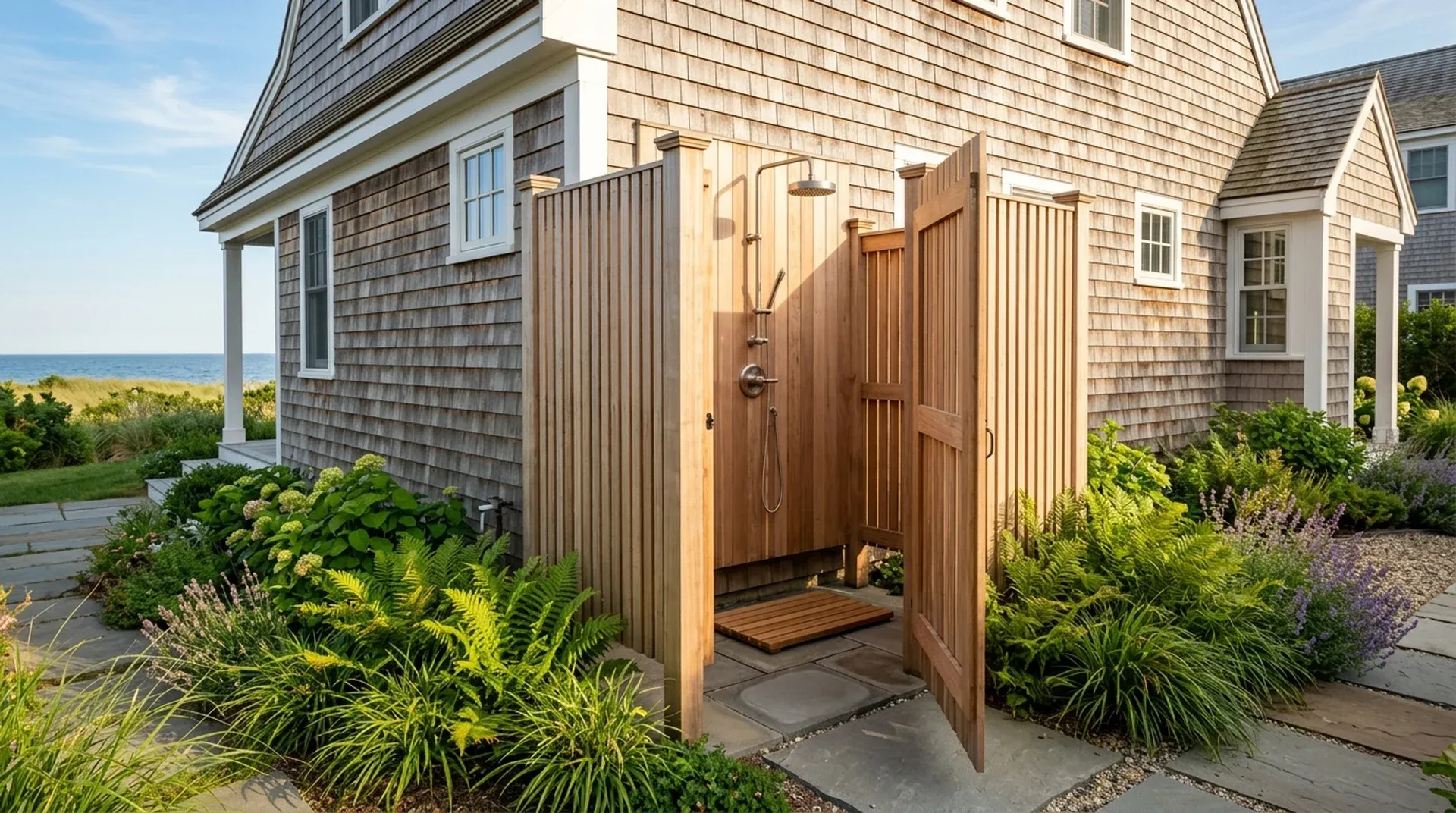
An outdoor shower can be as simple as a portable hose-fed unit for $50 to $300 or as involved as a plumbed hot-and-cold shower with an enclosure and its own drain. Family Handyman puts installation anywhere from $500 to $8,000. The price climbs with a longer plumbing run, hot water, an enclosure and a drain.
The cheapest, easiest spot is usually an exterior wall with a kitchen or bathroom on the other side. Below are the main types, design ideas, what each piece costs, and the drainage, permit and winter questions to settle before you build.
Types of outdoor showers
Most outdoor showers fall into three groups. Family Handyman gives these price ranges for the shower unit itself, as of 2024:
|
Type |
Water source |
Hot water? |
Unit price (Family Handyman) |
|---|---|---|---|
|
Portable |
Garden hose |
No, unless solar |
$50–$300 |
|
Wall-mounted |
House plumbing through an exterior wall |
Yes, if tied to house lines |
$100–$500 |
|
Freestanding (stationary) |
Underground line or an outdoor faucet |
Yes, with a hot line or solar |
$500–$2,000 |
Homes & Gardens gives higher ranges: $100 to over $1,000 for wall-mounted and $800 to over $3,000 for standalone units.
Getting hot water outside
- Tap the house lines. This Old House says a shower on an exterior wall lets your plumber tap the existing hot and cold lines that feed the house.
- Add an outdoor hot water faucet. Angi notes a plumber can install one next to your cold-water faucet. Family Handyman says this is usually cheaper, though the above-ground lines may be an eyesore.
- Go solar. Solar showers heat water in a dark tank. One model Bob Vila reviewed holds 9.3 gallons and can reach a theoretical 140°F, well above the usual comfort range of 105°F to 110°F, so test the water before stepping in.
- Propane. Bob Vila also mentions showers that hook up to a propane tank.
Outdoor shower ideas
Is one worth it? This Old House lists the practical case: a place to rinse off sand, chlorine or dirt before going inside, and to wash up after gardening. If that matches how you use your yard, start with where the shower will be used. Angi suggests a spot near a back or side entrance so sand and dirt stay out of the house, and near existing faucets to save on plumbing. Then pick the pieces:
- Poolside or deck shower. Angi's idea list includes a shower on the deck for rinsing off after a swim. If you're building a new deck around it, see our composite vs. wood deck guide.
- Wood enclosure. This Old House recommends pressure-treated wood, cedar, teak or Brazilian ironwood. Raise the walls about a foot off the ground so air can circulate and the shower dries between uses.
- Budget screens and kits. Angi lists folding screens, corrugated metal, plywood and ready-made enclosure kits, some with benches, towel racks and a changing area.
- Stone, brick or tile walls. Angi's ideas include stone walls with greenery, painted brick and tile backdrops.
- A living screen. This Old House suggests trees or hedges for privacy, but deciduous ones may not leaf out enough until late spring. Angi suggests evergreen plants for year-round screening; see our privacy hedge guide.
- Fragrant plants. Angi suggests rosemary or mint, planted far enough back that the roots don't stay waterlogged.
- A floor that drains. Options from This Old House include wood decking, bluestone or tumbled river rock, and a slatted teak mat. Over grass, Angi recommends a rinse pad of concrete, wood pallets, stones or gravel. For a stone floor that ties into a patio, see flagstone patios.
- Fixtures that age well. This Old House likes bronze and copper for their patina, and 304-rated stainless steel near the coast, where salt air pits most metals.
- Extras. Shelves, hooks, a rainfall head, an outdoor sink or a pergola overhead. Angi suggests solar-powered lighting; for wired lighting, see our landscape lighting guide.
Pick a sunny site if you can. Family Handyman notes sun keeps you warmer on cool days and dries the area to prevent mold.
How much an outdoor shower costs
Total cost depends on the unit, the plumbing run, drainage and the enclosure. Here are figures from cost and home guides. They vary by region, and Angi notes that urban areas and higher-cost states run higher.
|
Cost item |
Typical range |
Source |
|---|---|---|
|
Installation, simple to complex |
$500–$8,000 |
Family Handyman (2024) |
|
New plumbing for a shower |
$600–$1,600 or more |
Angi co-founder Angie Hicks, in Homes & Gardens (2024) |
|
Plumber labor |
$50–$150 per hour |
Angi (2026) |
|
Frost-free outdoor spigot (replacement) |
$180–$350 |
Angi (2026) |
|
Building or plumbing permit |
Around $250 per permit |
Angie Hicks, in Homes & Gardens (2024) |
|
Leveling the site |
$1,000 or more |
Angie Hicks, in Homes & Gardens (2024) |
Homes & Gardens also suggests setting aside an extra 10 percent for surprises. If you need a dry well or French drain, our yard drainage guide has typical costs for both.
Family Handyman says wall-mounted showers are usually more affordable than standalone ones, and cheaper still on the far side of a kitchen or bathroom wall, since the water pipes are already there. A freestanding shower out in the yard usually means trenching an underground line, which adds excavation.
Do you need a drain for an outdoor shower?
Ask about drainage early, because it's the part most likely to be regulated. This Old House says local codes may dictate how you dispose of gray water from a shower. Most outdoor showers drain into the ground, but some cities or states require routing it to the sewer. Bob Vila warns that letting water soak into the ground might violate local codes.
Common drainage setups, from This Old House and Family Handyman:
- Gravel bed or dry well. A pit lined with landscape fabric and filled with gravel under a permeable floor such as pavers or slats, so water soaks in instead of puddling.
- Pitched floor to a gravel trench. For grouted stone or other solid floors, slope the floor away from the house toward a gravel-filled trench.
- French drain. A perforated pipe in a gravel trench that spreads water out or carries it to a dry well.
- Shower pan to a drain line. Collects water and sends it to the home's sewer or septic, a French drain, or a dry well.
Whatever you choose, Angi says to send water away from your home's foundation. Letting it run into the yard can work if the shower is well away from the house and the soil is porous. Houzz adds that a gravel pit may need new gravel every 5 or 6 years, and that soapy water should drain away from plants.
State rules differ. Arizona, for example, counts shower water as gray water and lets homeowners use it for irrigation if it doesn't run off the property, isn't sprayed, and surface pooling is kept to a minimum. Check with your local building or health department before you dig.
Any dry well, trench or buried line means digging, so contact 811 a few business days before you start to have buried utilities marked. It's free.
Permits, scald safety and winterizing
Do you need a permit?
Houzz says you'll probably need a plumbing permit, and whether you need a building permit depends on the design and your town. It also warns that some jurisdictions don't allow outdoor showers at all. Angi recommends checking local building codes because you might need a building permit. If you have an HOA, check its rules on structures and screening before you buy an enclosure.
Scald protection
If the shower has hot and cold water, This Old House recommends a pressure-balance valve to prevent scalding. For water use, EPA WaterSense labeled showerheads use no more than 2.0 gallons per minute, compared with 2.5 for standard heads.
Using it in cold weather
In four-season climates, the biggest concern is being able to drain the pipes. Water left inside can freeze and crack them. This Old House recommends shutoff valves inside the house with pipes sloping downward, plus a riser and showerhead that unscrew. Angi suggests frost-proof fixtures with winter shutoff valves, and blowing out and draining the lines with an air compressor before cold weather. It's a lot like winterizing a sprinkler system.
Before the first freeze:
- Shut off the supply and drain all lines.
- Remove handles and showerheads and store them indoors.
- Wrap any exposed pipe you can't drain with electric heat cable.
In mild-winter areas you may skip most of this. Wherever you live, Houzz says the best time to build is anytime the ground isn't frozen.
If a shower sits against the house, Houzz notes the siding will get more water than it was designed for, so use cedar, mahogany or teak with a waterproof membrane behind it, or move the shower away from the wall.
When to call a pro
Family Handyman says experienced DIYers can do most or all of an install, and a hose-fed shower needs no plumbing at all.
Anything tied into your home's supply or drain lines is plumbing work, so hire a licensed plumber where your state or town requires one. This Old House recommends a pro for hot water lines, drainage and custom enclosures, and a general contractor for the enclosure and any electrical work.
Hardwired lighting or electric heating needs a licensed electrician. Houzz suggests a general contractor who has built outdoor showers before, since the job can involve digging, slab work, plumbing and changes to the house wall.
Before you hire:
- Get 2 or 3 written quotes for the same scope: unit, hot water or not, drainage method, floor and enclosure.
- Ask for photos of outdoor showers they've built, ideally in your climate.
- Ask who pulls the permits and whether the drainage plan meets local code.
- Check licensing and insurance where your state requires it.
- Get the scope, timeline and payment schedule in writing, including who handles winterizing the first year.
You can find outdoor living pros near you on LandscapeLookup, or look for hardscaping pros for a stone floor or patio around the shower. It's free, with no sign-up. Pros are ranked by Google rating weighted by review count, plus how local they are and their main service, and you contact them directly.
Editorial team
The LandscapeLookup editorial team writes guides to help US homeowners plan yard projects and hire the right pro. Each guide is based on university extension services, government sources such as EPA WaterSense and USDA, manufacturer instructions and published cost guides, and links to them so you can check the details.
Keep reading
Deck Repair or Replace? How to Decide and What It Costs
Repair a deck when the frame, ledger and posts are sound and the damage is limited to boards, railings, stairs or the finish. Replace it when rot or insects have spread through the framing. Repairs average about $1,465; replacement often runs $5,420 to $14,540.
October 5, 2026
Fire Pit Ideas and Costs
Fire pit ideas run from a portable steel bowl on gravel to a stone pit or gas fire table built into a patio. HomeAdvisor puts the average at about $850, with most projects between $200 and $3,000.
September 29, 2026
Patio Covers: Types, Materials and Costs
A patio cover can be a $120 shade canopy or a $30,000 gable roof. This Old House puts most patio roofs at $14,000 to $31,000, and the right type depends on whether you need shade, rain cover or snow strength.
September 27, 2026