87 landscape pros in Miami, FL, with an average Google rating of 4.7. Listings are ranked by rating weighted by review volume, so a 4.9 from hundreds of customers ranks above a 5.0 from three.
87 pros, ranked by rating and review volume






Local guide
Miami yards grow on limestone rock and face hurricane season every year, and both the City of Miami and Miami-Dade County set rules for yard work. This guide covers the local rules and conditions. For the statewide picture, see the Florida guide.
UF/IFAS Extension Miami-Dade's article on South Florida soils describes local ground as some sand, some marl and a lot of Miami Limestone, an oolitic limestone. What that means:
UF/IFAS's Selecting Tropical and Subtropical Tree Species for Wind Resistance ranks trees by hurricane damage. Its highest-rated group includes gumbo limbo, live oak, sand live oak, buttonwood, geiger tree, lignum vitae and sabal palm. Its lowest-rated group includes Australian pine, melaleuca, weeping banyan, queen palm and avocado. Native trees survived better than non-natives in three South Florida hurricanes, and pruned trees, trees with more rooting space and trees planted in groups held up better.
Miami-Dade County's hurricane tree preparation page says not to start pruning during a Hurricane Watch or Warning, not to remove more than 25 percent of the canopy, and never to top or "hatrack" a tree.
Miami-Dade County requires a tree removal or relocation permit for any tree not specifically exempt, but the City of Miami enforces its own tree ordinance. Inside city limits, you deal with the city.
The City's standalone tree permit covers removing, relocating or trimming a tree on private property or in the right-of-way swale. Trimming needs a permit only when it removes 25 percent or more of the tree. You apply in iBuild with a written reason, a tree survey, a replacement planting plan, and photos or an arborist report. Prohibited or dead trees will most likely not need replacement planting or a permit fee. Questions go to Environmental Resources at (786) 570-2934.
Want a tree in your swale? Request one through 311: the city's Urban Forestry Program plants and waters it, and after the warranty period 311 still handles trimming.
In unincorporated Miami-Dade, the county will tell you whether a tree needs a permit if you email leaf photos, the address and the trunk diameter to [email protected], according to its permit package.
Under section 163.045 of the Florida Statutes, no local government can require a permit or replanting for a residential tree that an ISA certified arborist or Florida licensed landscape architect documents as an unacceptable risk. The county has also made certain prohibited plants illegal to sell, propagate or plant.
Miami-Dade's fertilizer regulations apply throughout the county, including inside the City of Miami:
The South Florida Water Management District sets the regional rule (see the Florida guide), and Miami-Dade's outdoor water restrictions set the days:
The rules cover every water source, including private wells. Single-family homes with a working in-ground system can get a free irrigation evaluation and retrofit rebates of up to $500 a year for five years (786-552-8974).
The UF/IFAS Extension Miami-Dade County office is at 18710 SW 288 Street in Homestead, (305) 248-3311. For plant problems, email a Master Gardener at [email protected] or call 305-679-0222. It also offers home gardening workshops and the Florida Yards & Neighborhoods program.
Quotes vary with lot size, access and the work involved. These national ranges from our cost guides are a starting point:
Inside the City of Miami, yes in most cases: the city enforces its own tree ordinance, and its standalone tree permit covers removing, relocating or trimming a tree on private property or in the swale. You apply online through iBuild, and the city's Environmental Resources Division answers questions at (786) 570-2934. Under state law, a permit can't be required for a residential tree that an ISA certified arborist or Florida licensed landscape architect documents as an unacceptable risk.
Only if the trimming removes 25 percent or more of the tree, according to the city's tree permit page. Miami-Dade County also advises never topping or hatracking a tree and not removing more than 25 percent of the canopy in its hurricane tree preparation advice.
Miami-Dade County bans fertilizer containing nitrogen or phosphorus from May 15 through October 31, and the rule applies inside the City of Miami. The rest of the year, the county limits nitrogen to 4 pounds per 1,000 square feet a year, allows phosphorus only when a soil test shows a deficiency, and bans fertilizer within 20 feet of any water body, including Biscayne Bay.
Odd-numbered addresses can water on Wednesday and Saturday, and even-numbered addresses on Thursday and Sunday, before 10 a.m. or after 4 p.m. New landscaping can be watered every day except Fridays for the first 90 days. Properties on 100 percent reclaimed water and drip or micro-jet systems are exempt.
UF/IFAS research rates gumbo limbo, live oak, sand live oak, buttonwood, geiger tree, lignum vitae and sabal palm among the most wind-resistant trees for tropical and subtropical Florida. Australian pine, melaleuca, weeping banyan, queen palm and avocado rate among the least. Native trees survived better than non-natives in three South Florida hurricanes.
UF/IFAS Extension Miami-Dade says local ground is some sand, some marl and a lot of Miami Limestone, an oolitic limestone with a pH of about 7.8 to 8.4 that holds little water or nutrients. The high pH keeps many plants from taking up some micronutrients, so Extension recommends slow-release fertilizer, plenty of mulch and compost, and foliar sprays or a chelated iron drench for micronutrients.
Other cities in Florida
More landscape pros in the area
Guides

Plant in fall after leaf drop or in early spring before bud break. Dig a hole 2 to 3 times wider than the root ball but no deeper, set the root flare at or just above grade, backfill with the soil you dug out, water well and mulch 2 to 3 inches deep without touching the trunk.
October 30, 2026

Lawn grasses are cool-season (Kentucky bluegrass, tall fescue, perennial ryegrass, fine fescue) for the North or warm-season (Bermuda, zoysia, St. Augustine, centipede, bahia, buffalograss) for the South. Pick by region first, then by sun, traffic and water.
October 28, 2026
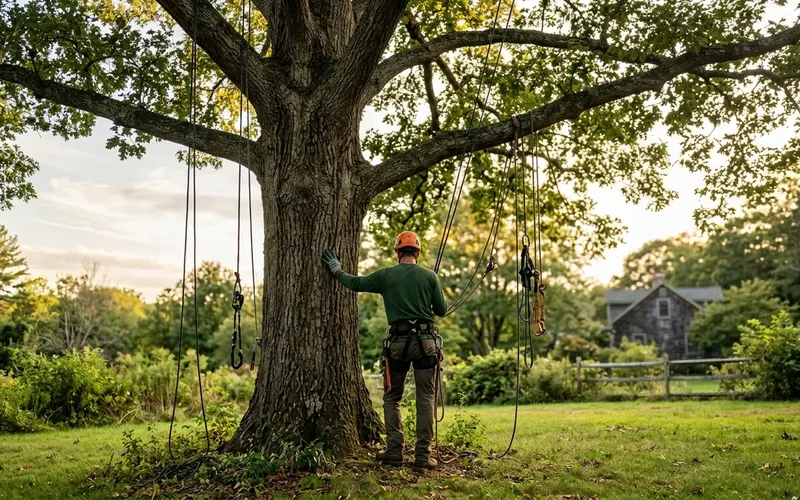
An ISA Certified Arborist has at least 3 years of tree care experience, passed a 200-question exam and keeps up with continuing education. Hire one for large-tree pruning, risk checks, removal decisions and sick trees.
October 26, 2026
For landscape pros
Claim your free listing to keep your details right, add photos and earn the Verified badge. Not listed yet? Add your business.