69 landscape pros in St. Petersburg, FL, with an average Google rating of 4.7. Listings are ranked by rating weighted by review volume, so a 4.9 from hundreds of customers ranks above a 5.0 from three.
69 pros, ranked by rating and review volume











Local guide
St. Petersburg adds its own rules to the state's: tree permits that start at 4 inches of trunk diameter, its own watering schedule, a large reclaimed water system and brush sites with rules for lawn services. Fertilizer falls under Pinellas County's ordinance. For zones, statewide grasses and licensing, see the Florida guide.
The city's urban forestry page and tree protection handout set three categories by diameter at breast height (DBH):
Removing any of these takes a permit, and so does trimming a grand tree branch 8 inches in diameter or larger. For one- and two-unit homes, the application lists a $25 inspection by the city's staff arborist and a $25 permit. The permit is posted where it's visible from the street and is valid for six months. Skipping it costs more: the handout's example for a 30-inch grand tree on a home lot totals up to $6,855 in after-the-fact fees, payment in lieu of replanting and a fine.
The state's dangerous-tree exemption covers only single-family detached homes, and the city asks owners with a qualifying arborist or landscape architect assessment to email it to [email protected]. Permit questions go to that address or 727-463-5680.
Owners maintain trees on their lot and in the abutting street and alley right-of-way. For new trees, the city suggests a spot on private property at least 10 feet from the house, driveway or sidewalk.
The city's stormwater page points residents to Pinellas County's fertilizer ordinance. Its main rules:
The city's watering restrictions cover its water customers inside city limits and tighten when the Southwest Florida Water Management District issues a water shortage order. Under a Modified Phase III order, for example, lawns on city water, private wells or private lake and pond connections could be watered once a week, if necessary:
Repeat violations can reach $500 plus court costs. The Water Watch line, 727-892-5300, has the current rules.
The city says its reclaimed water system was the first built in the United States and is one of the largest in the world, though it doesn't reach every neighborhood. Its year-round schedule is three days a week (even addresses Tuesday, Thursday and Saturday; odd addresses Wednesday, Friday and Sunday), 5 to 9 a.m. or 7 to 11 p.m. Reclaimed water carries nitrogen and phosphorus, isn't allowed on edible crops, and can't be cross-connected with drinking water. Service starts only after a final inspection.
City water customers can get rebates through Tampa Bay Water Wise for irrigation evaluations, efficient nozzles, rain sensors and weather-based controllers, while funding lasts.
The city's five brush sites take yard waste from residents with proof of residency. Loads from lawn services are prohibited unless the account holder comes along with ID and a utility bill, or the owner and the company sign a consent form for that day's delivery. Each load must come from one address. Mulch is free at any site.
The UF/IFAS Pinellas County Extension office is at 12520 Ulmerton Rd. in Largo, (727) 582-2100, and Master Gardeners answer questions at [email protected]. Inside the city, its South County clinic meets at Weedon Island Preserve on the third Saturday of each month. Soil samples are mailed to the UF/IFAS lab; see how to test your lawn soil. After a storm surge, Extension advises rinsing plants with fresh water, flushing the root zone and waiting for new growth before pruning.
Quotes vary with lot size, access and the work. These national ranges from our cost guides are a starting point:
Usually, yes. The city requires a permit to remove a protected tree, which means a shade tree 4 inches or more in trunk diameter at breast height or an understory tree 8 inches or more, as well as grand and signature trees. For one- and two-unit homes, the application lists a $25 inspection by the city's staff arborist and a $25 permit. Questions go to [email protected] or 727-463-5680.
A grand tree is a protected tree 30 inches or more in trunk diameter at breast height, except laurel oaks, and the city says grand trees need to be preserved. Trimming a grand tree branch 8 inches in diameter or larger also requires a permit. Removing one without a permit can be expensive: the city's example for a 30-inch grand tree on a home lot totals up to $6,855.
Pinellas County's fertilizer ordinance, which the city points residents to, bans nitrogen and phosphorus on lawns and landscapes from June 1 to September 30, and stores can't sell them then. Year-round, granular nitrogen must be at least 50% slow-release, phosphorus needs a soil test showing a deficiency, and no fertilizer may go within 10 feet of a water body, seawall or wetland.
The city sets watering rules for its water customers and tightens them when the Southwest Florida Water Management District issues a water shortage order. Under a Modified Phase III order, for example, lawns on city water or wells could be watered once a week, Saturday for even addresses and Sunday for odd or no address, from 5 to 9 a.m. or 7 to 11 p.m. The Water Watch line at 727-892-5300 has the current rules.
If your property is in a reclaimed water service area, yes, though the system doesn't reach every neighborhood. The city's year-round reclaimed schedule is three days a week, Tuesday, Thursday and Saturday for even addresses and Wednesday, Friday and Sunday for odd addresses, from 5 to 9 a.m. or 7 to 11 p.m. Reclaimed water isn't allowed on edible crops, and service begins only after the property passes a final inspection.
Only with your involvement. The city prohibits loads from lawn services unless the utility account holder comes along with ID and a utility bill, or the property owner and the company both sign a consent form for that day's delivery. Each load must come from a single address.
Other cities in Florida
More landscape pros in the area
Guides

Plant in fall after leaf drop or in early spring before bud break. Dig a hole 2 to 3 times wider than the root ball but no deeper, set the root flare at or just above grade, backfill with the soil you dug out, water well and mulch 2 to 3 inches deep without touching the trunk.
October 30, 2026

Lawn grasses are cool-season (Kentucky bluegrass, tall fescue, perennial ryegrass, fine fescue) for the North or warm-season (Bermuda, zoysia, St. Augustine, centipede, bahia, buffalograss) for the South. Pick by region first, then by sun, traffic and water.
October 28, 2026
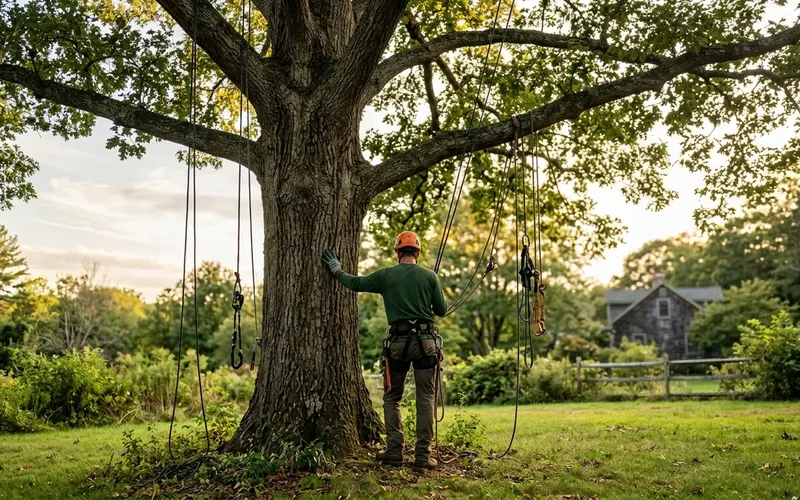
An ISA Certified Arborist has at least 3 years of tree care experience, passed a 200-question exam and keeps up with continuing education. Hire one for large-tree pruning, risk checks, removal decisions and sick trees.
October 26, 2026
For landscape pros
Claim your free listing to keep your details right, add photos and earn the Verified badge. Not listed yet? Add your business.